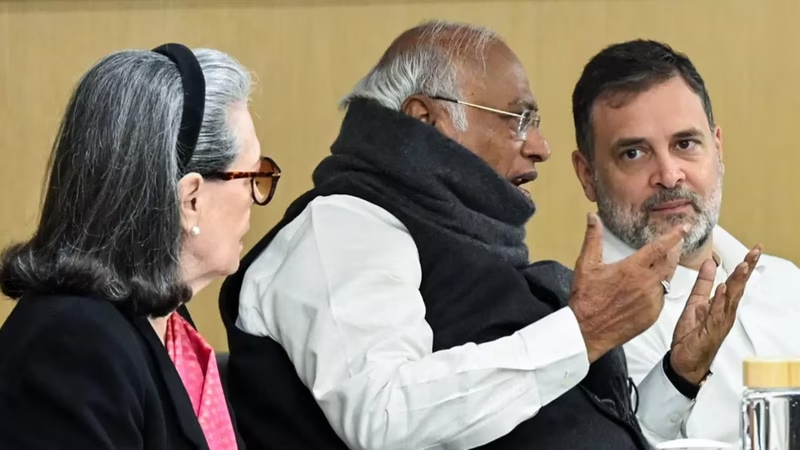
It started with a 12-second clip. But in India’s hypercharged political climate, that was all it took to ignite a national controversy.
At a recent Congress press conference announcing nationwide protests against the alleged scrapping of MGNREGA, a moment went viral: Jairam Ramesh, senior Congress leader, appeared to hand a note to party president Mallikarjun Kharge and instruct him to read it aloud. To many, it looked routine. But to the BJP, it was proof of a deeper, uglier truth—one they’re now branding as “Hate for Dalit.”
Kharge, India’s first Dalit Opposition leader in the Lok Sabha and a veteran with over five decades in public service, was allegedly being “treated like a puppet” by the Gandhi-Vadra family, the BJP claimed. The incident has since spiraled into a full-blown political firestorm, with both parties trading barbs over caste, respect, and who truly represents India’s marginalized communities.
Table of Contents
- The Viral Moment That Sparked a Storm
- BJP’s ‘Hate for Dalit’ Allegation
- Congress Response and Context
- Why Kharge’s Symbolism Matters
- MGNREGA Protests and the ‘Gandhi Insult’ Claim
- Broader Politics of Dalit Representation
- Conclusion: A Debate Beyond One Clip
- Sources
The Viral Moment That Sparked a Storm
On December 24, 2025, the Congress held a press conference in New Delhi to denounce what it called the government’s plan to replace the Mahatma Gandhi National Rural Employment Guarantee Act (MGNREGA) with a new scheme dubbed the “VB G Ram G Act”—a name Congress leaders claim mocks both Mahatma Gandhi and B.R. Ambedkar.
During the event, Jairam Ramesh handed a printed note to Kharge, who then read a prepared statement. The clip—shared widely by BJP leaders—shows Ramesh saying, “Please read this,” as he passes the paper. The BJP alleges this was condescending, especially given Kharge’s stature and identity as a Dalit leader.
BJP spokesperson Sambit Patra posted the clip with the caption: “This is their Hate for Dalit. They use Dalit leaders as props while the Gandhi family pulls the strings from behind.” The post garnered over 200,000 shares within 24 hours .
BJP’s ‘Hate for Dalit’ Allegation
The BJP didn’t stop at social media. Party leaders doubled down in Parliament and on news debates, framing the incident as symptomatic of Congress’s long-standing “tokenism” toward Dalits.
“For decades, the Gandhi family has kept Dalit leaders like Kharge and others in ornamental roles—visible but voiceless,” said Union Minister G. Kishan Reddy. “This clip is just the tip of the iceberg.”
The phrase “Hate for Dalit” has now become a central talking point in BJP’s narrative, especially as the party seeks to consolidate Dalit and OBC votes ahead of the 2029 general elections. By positioning itself as the true champion of social justice—a stark reversal from its traditional image—the BJP aims to dismantle Congress’s historical claim as the guardian of marginalized communities.
BJP’s Strategic Caste Narrative
This isn’t isolated rhetoric. In recent years, the BJP has heavily promoted Dalit icons—installing statues of Ambedkar, celebrating Bhim Jayanti, and appointing Dalit leaders to key ministries. The attack on Congress over Kharge fits neatly into this larger strategy:
- Undermine Congress’s moral authority on social justice.
- Rebrand BJP as inclusive and meritocratic.
- Appeal to younger Dalit voters disillusioned with dynastic politics.
Congress Response and Context
Congress has dismissed the controversy as a “deliberate misinterpretation” and a “distraction tactic.” Senior leader Randeep Surjewala stated: “Jairam Ramesh was simply ensuring the party president read the official statement on MGNREGA. To twist this into a caste issue is despicable.”
Congress supporters point out that Kharge himself has never complained about being sidelined. In fact, since becoming Congress president in 2022, he has led election campaigns, reshaped organizational structures, and publicly defended Rahul Gandhi—actions inconsistent with the “puppet” narrative.
Moreover, the note in question reportedly contained technical details about MGNREGA’s budget allocation—precisely the kind of data a spokesperson like Ramesh would prepare for a leader to read verbatim in a formal setting.
Why Kharge’s Symbolism Matters
Regardless of intent, the incident touches a raw nerve in Indian politics. Mallikarjun Kharge isn’t just any politician—he’s a symbol.
As a Dalit who rose from a railway clerk to become Leader of the Opposition, Kharge embodies the possibility of upward mobility in a caste-ridden society. Any perceived slight against him is seen by many as a slight against the entire Dalit community’s political dignity.
This is why the “Hate for Dalit” framing is so potent. It weaponizes symbolism, turning a procedural moment into a referendum on respect and representation.
MGNREGA Protests and the ‘Gandhi Insult’ Claim
The press conference wasn’t just about Kharge—it was the launchpad for Congress’s nationwide “Save MGNREGA” agitation. The party alleges the Modi government is quietly replacing the landmark welfare scheme with a poorly defined alternative called the “VB G Ram G Act.”
Congress claims the name is a sarcastic acronym mocking Mahatma Gandhi (“G”), B.R. Ambedkar (“B”), and possibly V.D. Savarkar (“V”)—a narrative the government has denied. Yet, the ambiguity has fueled public anxiety, especially in rural India where MGNREGA remains a lifeline for over 80 million households .
By tying the Kharge incident to this larger welfare battle, Congress hopes to reframe the debate: not as an internal party hiccup, but as part of a systemic assault on the values Gandhi and Ambedkar stood for.
Broader Politics of Dalit Representation
Beyond the headlines, this clash reflects a deeper realignment in Indian politics. Dalit voters are no longer a monolithic bloc. While Congress once dominated, parties like BSP, VCK, and now even the BJP have made significant inroads.
According to a 2024 Pew Research Center study, only 28% of Dalit voters identify strongly with Congress—down from 52% in 2004 . This shift forces both parties to constantly prove their Dalit credentials, often through symbolic gestures and rhetorical battles like the current one.
Yet, critics argue that real representation isn’t about who sits at the podium—it’s about policy outcomes: land rights, education access, protection from violence, and economic equity. As one Dalit activist in Uttar Pradesh told us: “We don’t need photo-ops. We need jobs and justice.”
Conclusion: A Debate Beyond One Clip
The “Hate for Dalit” controversy may have started with a fleeting moment, but it’s rooted in decades of political mistrust, caste dynamics, and electoral strategy. While the BJP sees an opportunity to expose Congress’s contradictions, Congress sees a cynical attempt to divert attention from governance failures.
For the average Indian voter—Dalit or otherwise—the real question isn’t who handed whom a note. It’s who will deliver dignity, opportunity, and respect beyond the press conference stage. Until then, expect more clips, more accusations, and more battles over who truly speaks for India’s most marginalized.
[INTERNAL_LINK:dalit-political-leadership-india] | [INTERNAL_LINK:mgnrega-impact-rural-india]