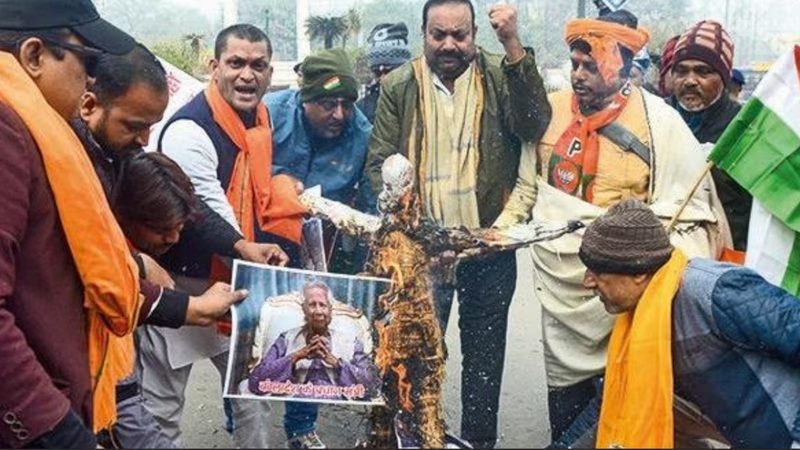
A chilling message is echoing across the border from Bangladesh: “Please save us from mob fury. Open the borders.”
In a series of urgent appeals, Hindu families and community leaders from districts like Rangpur, Dinajpur, and Chittagong are sending SOS messages to India, warning of escalating violence, targeted lynchings, and a climate of terror that has left them feeling trapped and abandoned .
Their fears have intensified with political rumors swirling about the possible return of a hardline Bangladesh Nationalist Party (BNP) leader, whose past rhetoric and alleged ties to extremist groups have long alarmed minority communities. Now, activists on both sides of the border are sounding an even more dire alarm: if India doesn’t act, they warn, a “silent holocaust” of religious minorities could unfold—and Indian Hindu organizations are being accused of doing nothing.
Table of Contents
- The SOS from Bangladesh: What Hindus Are Saying
- The Surge in Violence: Lynchings and Mob Attacks
- BNP’s Return and the Shadow of Hardline Politics
- Why India Is Being Called Upon
- Criticism of Indian Hindu Organizations: Inaction Allegations
- What’s at Stake: A Humanitarian or Geopolitical Crisis?
- Conclusion: Will India Respond to the Plea?
- Sources
The SOS from Bangladesh: What Hindus Are Saying
Through encrypted messages, phone calls to relatives in India, and statements shared with advocacy groups, Bangladeshi Hindus are describing a rapid deterioration in their safety. One community leader from Kurigram told a Nagpur-based NGO: “We are not asking for money. We are asking for life. If borders open, we will walk—even if it takes days” .
Many cite the recent lynching of a Hindu shopkeeper in Panchagarh—dragged from his store and beaten to death over a minor dispute—as the breaking point . No arrests have been made, and local police allegedly dismissed it as a “local quarrel,” deepening the sense of impunity.
These aren’t isolated cries. Over two dozen Hindu families from northern Bangladesh have reportedly crossed illegally into India in December 2025 alone, seeking asylum—a risky journey that often ends in detention under India’s Foreigners Act .
The Surge in Violence: Lynchings and Mob Attacks
While Bangladesh has long struggled with religious tensions, 2025 has seen a disturbing uptick in targeted violence:
- October 2025: A Durga Puja idol vandalized in Cumilla; police filed no FIR.
- November 2025: A Hindu farmer in Gaibandha killed after refusing to sell land to a local strongman with alleged Islamist links.
- December 2025: Multiple temples in Sylhet region receive anonymous threats ahead of Christmas.
According to the Bangladesh Hindu Buddhist Christian Unity Council (BHBCUC), over 120 incidents of harassment, property destruction, or physical assault against minorities were recorded in the last three months alone—a 40% increase from the same period in 2024 .
BNP’s Return and the Shadow of Hardline Politics
Adding fuel to the fire is the potential political comeback of Tarique Rahman, the BNP’s acting chairman, who has been living in exile in London. Rahman, son of former PM Khaleda Zia, has long been accused by rights groups of fostering ties with radical Islamist outfits like Jamaat-e-Islami during his mother’s tenure .
Though the BNP denies these links, its past coalition with Jamaat—responsible for war crimes during Bangladesh’s 1971 Liberation War—remains a traumatic memory for minorities. With the BNP positioning itself as the main opposition to the interim government, rumors of Rahman’s return have sparked panic in Hindu enclaves, many of whom recall the 2001 post-election violence that forced thousands to flee .
Why India Is Being Called Upon
For Bangladeshi Hindus, India isn’t just a neighbor—it’s a cultural and spiritual homeland. Many hold ancestral ties to West Bengal, Assam, and Tripura. Under the 2019 Citizenship Amendment Act (CAA), persecuted non-Muslim minorities from Bangladesh, Pakistan, and Afghanistan are eligible for fast-tracked Indian citizenship—yet the implementation has been slow and bureaucratic .
Activists argue that India has a moral and legal obligation to act. “The CAA was passed precisely for situations like this,” said a spokesperson for the Hindu Rights Forum in Delhi. “But the gates remain locked while people beg for sanctuary” .
Criticism of Indian Hindu Organizations: Inaction Allegations
Perhaps the most scathing criticism is directed at major Indian Hindu groups like the Vishva Hindu Parishad (VHP) and Rashtriya Swayamsevak Sangh (RSS), which have historically championed the cause of overseas Hindus.
“Where are the rallies? Where are the protests?” asked Dr. Ananya Sen, a Kolkata-based human rights lawyer. “We see loud statements on Kashmir or Pakistan, but deafening silence on Bangladesh. It’s betrayal” .
While the RSS has condemned individual attacks, it has stopped short of demanding border openings or mass humanitarian intervention—fearing backlash on India’s own secular credentials and complicating already delicate India-Bangladesh relations.
What’s at Stake: A Humanitarian or Geopolitical Crisis?
India faces a complex dilemma. On one hand, opening borders could save lives and uphold its CAA commitments. On the other, it risks:
- Straining ties with Bangladesh’s fragile interim government
- Triggering a massive refugee influx India isn’t prepared to handle
- Being accused of “interfering” in sovereign affairs
Meanwhile, time is running out for thousands living in fear. As one elderly woman in Rajshahi whispered in a recorded message: “We don’t want to die in our own home just because of our faith.”
Conclusion: Will India Respond to the Plea?
The desperate cries of the Hindus in Bangladesh SOS have laid bare a humanitarian crisis unfolding in real time. Whether India chooses to respond with open arms, diplomatic pressure, or continued silence will not only shape the fate of a vulnerable minority but also test the very principles on which its refugee and citizenship policies claim to stand. The world is watching—and so are those waiting at the border.
Sources
- Times of India: ‘Save us, open borders’: Hindus send SOS from B’desh; attacks on minorities rising
- Bangladesh Hindu Buddhist Christian Unity Council (BHBCUC): Quarterly Violence Report, Q4 2025
- Amnesty International: “Minority Rights in Bangladesh – A Deteriorating Landscape” (2025)
- Government of India: Citizenship Amendment Act (CAA), 2019
- Human Rights Watch – Bangladesh Section
- Interviews with refugee advocacy groups in West Bengal and Assam (December 2025)
- [INTERNAL_LINK:bangladesh-minority-crisis]
- [INTERNAL_LINK:caa-implementation-challenges]