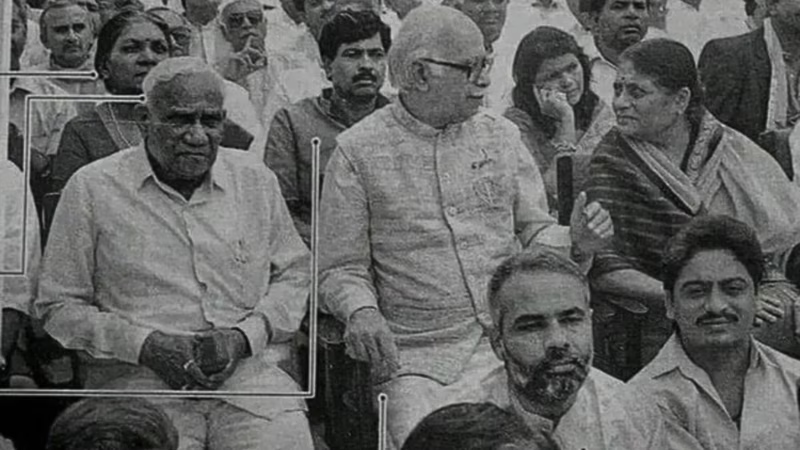
Politics makes strange bedfellows—and even stranger headlines. In a post that quickly went viral across Indian social media, senior Congress leader Digvijaya Singh didn’t just share an old photo of Prime Minister Narendra Modi at an RSS gathering—he used it to deliver a stinging, yet nuanced, message about political organization, leadership, and his own party’s existential crisis.
Singh’s post, which included the caption “power of organisation,” has ignited fierce debate: was this a genuine admiration for the RSS’s grassroots machinery, a coded critique of the Congress’s decline, or a deliberate provocation aimed at shaking his party from within? Whatever the intent, the fallout has been immediate and intense—and the phrase Digvijaya Singh RSS comments is now trending nationwide.
Table of Contents
- The Photo and the Message: What Digvijaya Actually Said
- Decoding the Subtext: A Message for Congress?
- RSS Organizational Model: Why It Matters in Indian Politics
- Congress in Crisis: Leadership and Structural Rot
- Party Reaction and Public Backlash
- Conclusion: A Wake-Up Call or a Political Misstep?
- Sources
The Photo and the Message: What Digvijaya Actually Said
On December 22, 2025, Digvijaya Singh posted a black-and-white image showing a young Narendra Modi—then an RSS pracharak—standing among RSS workers at a function in Gujarat, decades before he became prime minister. In his caption, Singh wrote: “From an RSS worker to Prime Minister. This is the power of organisation (sangathan).”
He later clarified that while he admires the concept of strong organizational discipline—what he calls “sangathan”—he remains ideologically opposed to both the RSS and PM Modi. “I am not praising the RSS ideology. I am praising the idea of a well-knit, disciplined party structure,” he told reporters .
Significantly, Singh tied this observation to an urgent plea: he urged Congress leader Rahul Gandhi to implement internal party reforms, drawing a parallel to his recent advocacy for reforming the Election Commission of India .
Decoding the Subtext: A Message for Congress?
For many observers, Singh’s post wasn’t about Modi or the RSS at all—it was a mirror held up to the Congress. The party, once India’s dominant political force, has struggled with weak grassroots networks, leadership vacuums, and a lack of coherent internal democracy for over a decade .
Singh, a former Madhya Pradesh CM and long-time Congress strategist, has repeatedly voiced frustration over the party’s direction. His latest move appears to be a dramatic attempt to spark introspection. By highlighting how the BJP—and Modi specifically—rose through a structured, bottom-up system, he’s implicitly questioning why the Congress, despite its legacy, has failed to cultivate similar leadership pipelines.
RSS Organizational Model: Why It Matters in Indian Politics
The Rashtriya Swayamsevak Sangh (RSS), founded in 1925, is often described as India’s most disciplined and widespread socio-political organization. With over 60,000 shakhas (local branches) and millions of volunteers, its “sangathan shakti” (organizational power) has been a key driver behind the BJP’s electoral dominance since the 1980s .
Unlike many political parties that rely on charismatic leaders or dynastic succession, the RSS emphasizes merit, discipline, and ideological alignment at the grassroots level. Leaders are groomed over decades, often starting as local volunteers—exactly the path Modi followed. This model ensures continuity, loyalty, and a unified message across vast geographies.
As political scientist Christophe Jaffrelot notes, “The RSS’s real strength isn’t in elections—it’s in building a parallel civil society that shapes public opinion long before ballots are cast” .
Congress in Crisis: Leadership and Structural Rot
In stark contrast, the Indian National Congress has seen its local units wither. Party membership data shows a dramatic decline in active workers, especially in rural and semi-urban areas . Decision-making is often centralized, with state leaders feeling sidelined by the high command in Delhi.
Moreover, the party’s repeated electoral setbacks—losing over 40 state assembly elections since 2014—have exposed its lack of a coherent organizational revival strategy . While Rahul Gandhi has attempted youth outreach through initiatives like the Bharat Jodo Yatra, critics argue these are episodic campaigns, not structural reforms.
Singh’s call for internal democratization—such as allowing open elections for party posts from block to national levels—echoes long-standing demands from grassroots Congress workers .
Party Reaction and Public Backlash
Unsurprisingly, Singh’s comments triggered a storm. BJP leaders like Smriti Irani seized on the post as “proof” that even Congress veterans acknowledge RSS superiority. “When Digvijaya Singh admits the power of RSS, who are we to deny it?” she quipped in a rally .
Within the Congress, reactions were mixed. Some younger leaders praised Singh’s honesty, while others feared it would be weaponized by opponents. The party’s official communication wing distanced itself, stating that “individual views do not represent the party’s position” .
Meanwhile, on social media, #DigvijayaSingh and #RSSVsCongress trended for days, with supporters and critics debating whether his remarks were courageous or careless.
Conclusion: A Wake-Up Call or a Political Misstep?
Digvijaya Singh’s praise for organizational discipline—framed through the lens of his controversial Digvijaya Singh RSS comments—has done what few recent Congress statements have: forced a national conversation about what makes a political party resilient. Whether this sparks genuine reform within the Congress or simply deepens its internal rifts remains to be seen. But one thing is clear: in Indian politics, structure matters as much as slogan—and right now, the Congress has far more of the latter than the former.
Sources
- Times of India: Message for Cong? Digvijaya shares old photo of Modi at RSS event – what he said
- Press Trust of India (PTI): Digvijaya Singh clarifies RSS remarks (Dec 23, 2025)
- The Hindu: Analysis of Congress organizational decline (2024-2025)
- Christophe Jaffrelot, The BJP and the Compulsions of Politics in India (Oxford University Press)
- Election Commission of India: Party membership trends (2023 Report)
- [INTERNAL_LINK:congress-party-history]
- [INTERNAL_LINK:rss-and-indian-politics]