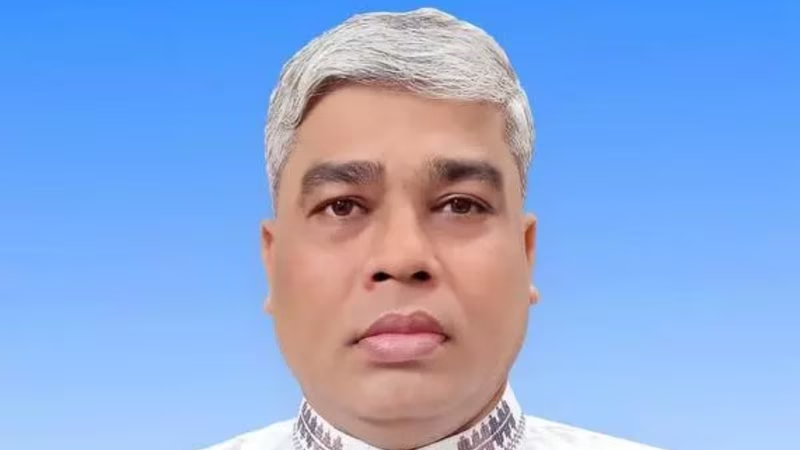
In a move that has sent ripples through Dhaka’s political corridors, a new party is stepping onto the national stage with a singular, powerful mission: to be the definitive political voice for Bangladesh’s dwindling Hindu population and other religious minorities. The Bangladesh Minority Janta Party (BMJP) isn’t just forming—it’s declaring its intent to win a staggering 40 to 45 seats in the upcoming 2026 general elections .
This isn’t a fringe group making a symbolic stand. This is a registered party, officially recognized by the Election Commission in April 2025, and it’s preparing to contest on a platform built entirely on the urgent need for minority protection and a return to genuine secularism [[3], [7]].
Table of Contents
- The Rise of the BMJP: A Voice for the Silenced
- The Stakes Are High: The Hindu Demographic Crisis
- The 2026 Election Landscape: A Strategic Battlefield
- The Alliance Game: Can BMJP Leverage BNP or Jamaat?
- Beyond Politics: The Fight for a Secular Bangladesh
- Conclusion: A Pivotal Moment for Bangladesh
- Sources
The Rise of the BMJP: A Voice for the Silenced
Founded on the principles of Bangladeshi nationalism and secularism, the Bangladesh Minority Janta Party positions itself as the first political party exclusively dedicated to the social and political rights of Hindus, Buddhists, and Christians [[1], [4], [7]]. While the party was initially founded in 2017, its recent official registration marks its transition from a social movement to a formal electoral contender .
The party’s leadership is clear on its primary objective: to end the “brutal persecution” of minorities and to ensure their safety and full participation in the nation’s democratic process. Their strategy is twofold: first, to run candidates in a massive 91 constituencies to maximize their presence, and second, to seek strategic alliances with mainstream parties to amplify their influence and guarantee their core demands are heard .
The Stakes Are High: The Hindu Demographic Crisis
The BMJP’s urgency is not born from political ambition alone, but from a stark and alarming demographic reality. Once a significant portion of the population, Bangladesh’s Hindu community has been in a steady, decades-long decline.
According to the most recent census data, Hindus now constitute just 8.5% of the total population, a sharp drop from 9.2% in 2001 [[12], [17]]. This is a dramatic fall from the estimated 28% at the time of the 1947 Partition. That translates to a community of roughly 13 million people who feel increasingly marginalized and vulnerable [[16], [20]].
This decline isn’t just a number; it represents a deep-seated insecurity, often driven by a combination of socio-economic pressures, land-grabbing incidents, and targeted violence, especially during politically volatile periods like elections. The BMJP is betting its entire existence on the belief that this 13-million-strong community is ready for a dedicated political champion.
The 2026 Election Landscape: A Strategic Battlefield
The BMJP’s grand entrance is perfectly timed for what promises to be a historic and fiercely contested election. Bangladesh’s 13th parliamentary election is officially scheduled for February 12, 2026 [[21], [22]]. This election follows a year of political upheaval, including the ouster of long-time Prime Minister Sheikh Hasina, and will be run by an interim government led by Nobel laureate Muhammad Yunus [[24], [25]].
In this climate of immense change and public demand for a new political order, the BMJP sees a unique opening. The traditional two-party dominance of the Awami League and the Bangladesh Nationalist Party (BNP) is being scrutinized like never before. A new player, especially one representing a large, cohesive, and previously under-mobilized voter bloc, could be a significant kingmaker.
The Alliance Game: Can BMJP Leverage BNP or Jamaat?
The party’s president has openly stated his desire to form alliances with major players, specifically naming the BNP and Jamaat-e-Islami, to “ensure minority safety and participation” . This is a high-risk, high-reward strategy that hinges on complex political dynamics.
Historically, the BNP and Jamaat-e-Islami were staunch allies, with Jamaat joining BNP-led coalition governments in the past [[27], [30], [34]]. However, recent reports suggest this decades-old alliance may be fracturing . This political realignment could create a vacuum that the BMJP aims to fill.
For the BNP, aligning with the BMJP could be a way to bolster its own secular credentials and appeal to a broader voter base. For Jamaat-e-Islami, a party with a more Islamist orientation, an alliance with a Hindu-focused party seems ideologically fraught, but might be a pragmatic move to gain a crucial foothold in a new political era. The BMJP’s success may well depend on its ability to navigate these treacherous waters and turn its bloc of minority voters into a prized asset in coalition talks.
Beyond Politics: The Fight for a Secular Bangladesh
At its core, the BMJP’s mission transcends mere electoral politics. It is a direct appeal to the foundational principles of the Bangladeshi state. The nation’s original 1972 Constitution enshrined secularism as a core tenet, guaranteeing equal rights for all religious communities [[35], [36]].
However, the path of secularism in Bangladesh has been rocky, with the principle being removed and later restored through various constitutional amendments [[37], [38]]. Today, the country operates with a curious duality: it is officially a secular state that also has Islam as its state religion . This ambiguity has often left religious minorities in a legal and social gray area.
The BMJP is demanding a return to a clear, unambiguous form of secularism—a state where one’s faith is a private matter and not a determinant of their safety, property rights, or political voice. This fight for the soul of the nation’s constitution is what gives the party its profound moral weight and what will likely resonate with many Bangladeshis, both minority and majority, who cherish the original vision of their country.
Conclusion: A Pivotal Moment for Bangladesh
The emergence of the Bangladesh Minority Janta Party is more than just the formation of a new political entity. It is a powerful referendum on the state of minority rights and secular democracy in Bangladesh. Whether it achieves its ambitious goal of 40-45 seats remains to be seen, but its mere presence on the ballot will force other parties to address an issue they have long ignored or paid lip service to. In the lead-up to the critical February 2026 vote, all eyes will be on the BMJP to see if it can transform the anxiety of a marginalized community into a formidable political force that reshapes the nation’s future.
Sources
- Times of India: ‘India must change stand’: Hindus form party in B’desh; hope to win 40-45 seats in polls
- Bangladesh Election Commission: Registration of BMJP (Cited in various news reports [[3], [6]])
- Bangladesh Bureau of Statistics: 2021 & 2022 Census Data on Religious Demographics [[11], [12], [13], [16], [20]]
- Interim Government of Bangladesh: Announcement on 2026 Election Date [[21], [22], [24]]
- Constitution of the People’s Republic of Bangladesh: Provisions on Secularism and Religious Freedom [[35], [36], [37], [42]]
- [INTERNAL_LINK:bangladesh-political-history]
- [INTERNAL_LINK:religious-freedom-in-asia]