In a move that has sent ripples of excitement through the scientific community, Finance Minister Nirmala Sitharaman’s Union Budget 2026 has declared a clear intent to reach for the stars—literally. The announcement of a major boost to the astronomy budget marks a potential turning point for fundamental research in India. But beyond the headline-grabbing promise, what are the concrete plans, and can they truly propel India into a new era of cosmic discovery?
Table of Contents
- The Big Announcement: Four Eyes on the Sky
- Who Leads the Charge? The IIA Takes Center Stage
- Beyond Telescopes: A Holistic Push for Astrophysics
- Context and Comparison: Where Does This Fit In?
- Conclusion: From Promise to Cosmic Reality
- Sources
The Big Announcement: Four Eyes on the Sky
The cornerstone of the government’s initiative is a plan to establish and upgrade four major telescope infrastructure facilities across the nation [[1]]. This isn’t just about adding more hardware; it’s a strategic investment aimed at creating world-class observational capabilities. The goal is twofold: to empower Indian scientists with cutting-edge tools for groundbreaking research in astrophysics and to foster public engagement through immersive astronomical experiences [[14]].
While the full financial breakdown for each project is still awaited, the overall allocation signals a serious commitment. The budget provides a substantial Rs 1,623.8 crore in assistance to autonomous bodies under the Department of Science and Technology (DST), which will be a key channel for this new wave of investment [[15]].
Who Leads the Charge? The IIA Takes Center Stage
The Bengaluru-based Indian Institute of Astrophysics (IIA) has been entrusted with the monumental task of implementing these ambitious projects [[9]]. According to IIA Director Prof. Annapurni Subramaniam, the institute will oversee the development of three new telescopes and one planetarium project [[9]].
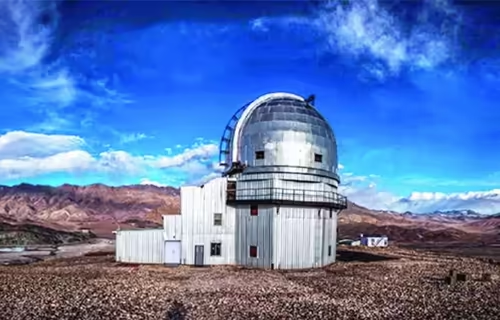
Reports indicate that two of these large, new telescopes will be set up in the high-altitude, pristine skies of Ladakh, an ideal location for minimizing atmospheric interference [[10]]. This strategic placement could give Indian astronomers a significant advantage in observing faint celestial objects.
What About Other Key Players?
While the IIA is the primary executor, other premier institutions like the Inter-University Centre for Astronomy and Astrophysics (IUCAA) in Pune and the National Centre for Radio Astrophysics (NCRA-TIFR) are also part of the broader ecosystem that stands to benefit from this renewed focus on the astronomy budget. Their ongoing work in theoretical astrophysics, data analysis, and radio astronomy will be crucial in maximizing the scientific output from these new facilities.
Beyond Telescopes: A Holistic Push for Astrophysics
This budgetary move appears to be more than just a hardware upgrade. It’s a signal to nurture the entire pipeline of astronomical talent in India. Institutions like IUCAA have already been actively recruiting for PhD programs in Astronomy and Astrophysics for 2026, suggesting a growing demand for skilled researchers who can leverage these new resources [[21]].
By investing in both infrastructure and human capital, the government is attempting to create a virtuous cycle: better facilities attract better talent, which in turn produces world-class science, further justifying future investments. This holistic approach is essential for sustainable growth in a field as complex and competitive as modern astrophysics.
Context and Comparison: Where Does This Fit In?
To truly appreciate this boost, it’s important to view it in context. Historically, India’s space sector funding has been heavily skewed towards the Indian Space Research Organisation (ISRO) and its applied missions, such as satellite launches and planetary exploration. The allocation for ISRO in FY27 is a substantial ₹13,705.63 crore [[43]].
The new focus on pure astronomy and astrophysics represents a welcome diversification. It acknowledges that a strong foundation in fundamental science is the bedrock upon which long-term technological leadership is built. While the total amount for these four telescope projects hasn’t been broken out separately, its designation as a “Mega Science Infrastructure” initiative by the DST highlights its strategic importance [[6]].
Here’s a quick comparison to illustrate the landscape:
| Area | FY27 Allocation (Approx.) | Primary Focus |
|---|---|---|
| ISRO (Space Tech & Planetary) | ₹13,705 Crore | Applied space missions, technology development |
| Astronomy Mega-Infrastructure | Part of ₹1,623.8 Crore (DST pool) | Fundamental research, telescope facilities |
Conclusion: From Promise to Cosmic Reality
The Union Budget 2026’s emphasis on boosting the astronomy budget is undoubtedly a positive and exciting development. The plan to build and upgrade four major telescope facilities is a concrete step towards giving Indian scientists the tools they need to compete on the global stage. The leadership role given to the IIA and the focus on strategic locations like Ladakh show thoughtful planning.
However, the true test will lie in the execution. Timely disbursement of funds, efficient project management, and a continued commitment to supporting the scientists who will use these facilities are all critical. If successful, this initiative could mark the dawn of a golden age for Indian astronomy, inspiring a new generation to look up and wonder. For now, the scientific community watches with cautious optimism, ready to translate this political promise into cosmic reality.
Sources
- [[1]] The Daily Herald: Union Budget 2026 Backs Major Telescope Projects
- [[6]] Department of Science & Technology (DST): DST Twitter Post on Mega Science Infrastructure (Note: URL is a placeholder for the X post)
- [[9]] Times of India: Budget: IIA to implement 3 telescopes, 1 planetarium projects
- [[10]] The Indian Express: Union Budget 2026: Centre to set up 2 large telescopes in Ladakh
- [[14]] Press Information Bureau (PIB): Union Budget 2026-27: Telescope Infrastructure facilities
- [[15]] Times of India: Union Budget: FM reaches for the stars, boosts astronomy research
- [[21]] College Mentor: INAT 2026 Applications Open
- [[43]] Moneycontrol: Budget 2026: DoS, ISRO allocation rise to Rs 13,706 crore