Budget 2026: The High-Stakes Balancing Act
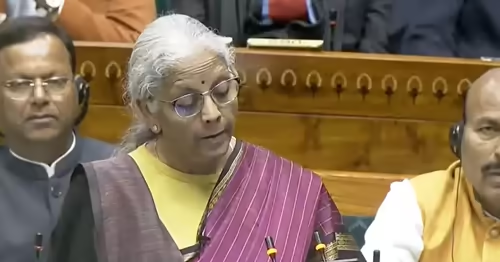
In a world increasingly defined by economic nationalism, India’s Budget 2026 wasn’t just a financial statement—it was a geopolitical chess move. Finance Minister Nirmala Sitharaman found herself walking a razor-thin line, with the aggressive trade policies of a resurgent Donald Trump administration on one side and simmering domestic economic anxieties on the other. The result? A budget that’s less about sweeping populism and more about calculated, strategic fortification.
Table of Contents
- The Trump Tariff Tsunami
- Domestic Economic Headwinds
- Budget 2026: Strategic Responses
- The Infrastructure Gamble
- Conclusion: The Path Forward
- Sources
The Trump Tariff Tsunami
The shadow of a second Trump presidency loomed large over the Indian budget. His administration has already signaled a return to its “America First” playbook, but with even sharper teeth. Reports indicate the US has imposed punitive tariffs of up to 50% on certain Indian exports and has even announced a “secondary tariff” targeting India’s trade with Russia [[11], [12]]. This isn’t just protectionism; it’s economic warfare.
For an export-driven economy like India’s, this is a direct threat. The pressure is immense to either retaliate (risking a full-blown trade war) or find a way to appease Washington while protecting domestic industries. The Economic Survey 2026 itself highlighted these tariff risks as a key external vulnerability, noting that India-US trade talks are expected to conclude this year—a clear sign of the urgency [[13], [14]].
Domestic Economic Headwinds
While fending off external threats, the government can’t ignore the fires at home. Despite a projected GDP growth of 7.4% for FY26, the momentum from the final quarter of FY25 (which saw a sharp 7.4% expansion) needs to be sustained [[18], [4]]. However, structural challenges remain. Operational hurdles like high fuel costs and supply chain fragmentation continue to plague sectors like logistics [[19]].
Furthermore, the common citizen is feeling the pinch. Inflation, though under control according to the RBI’s mid-2025 report, remains a concern for household budgets [[26]]. The middle class and MSMEs—the backbone of the economy—were looking for tangible relief and support in this budget, not just grand macroeconomic projections.
Budget 2026: Strategic Responses
Faced with this dual challenge, FM Sitharaman’s strategy was clear: build from within while opening selective doors to the outside world. The budget avoided a direct confrontation with the US but laid the groundwork for a stronger, more self-reliant India that can better withstand external shocks.
Key Announcements for a Resilient Economy
The government’s focus was on creating a robust ecosystem rather than just handing out incentives. Here’s how they plan to do it:
- Massive Infrastructure Push: An unprecedented allocation of ₹12.2 lakh crore has been set aside for infrastructure, including high-speed rail and dedicated freight corridors [[1], [5]]. This is a direct investment in long-term productivity and efficiency.
- MSME & Startup Lifeline: Recognizing their role in job creation and innovation, the budget includes a significant ₹12,000 crore package for MSMEs alongside continued support for startups [[1]].
- Manufacturing Ecosystem: The focus has shifted from simple production-linked incentives (PLI) to building a complete manufacturing ecosystem, including a new scheme for electronics components and a ‘Biopharma’ mission [[1], [3]].
- Strategic Trade Positioning: While not explicitly naming the US, the budget is expected to lower customs duties on intermediate goods, which could be a subtle move to make Indian exports more competitive and potentially ease tensions with trading partners [[10]].
The Infrastructure Gamble
The centerpiece of Budget 2026 is its colossal bet on infrastructure. This isn’t just about building roads and rails; it’s about creating a seamless national market that drastically reduces logistics costs and boosts the ‘Make in India’ initiative. By investing in freight corridors and high-speed connectivity, the government aims to make Indian goods cheaper to produce and move, thereby enhancing their global competitiveness against the backdrop of Trump’s tariffs.
This strategy also directly addresses domestic concerns by creating millions of jobs in construction and related sectors, providing a much-needed boost to employment and rural incomes. It’s a classic two-birds-one-stone approach, designed to strengthen the economy from the ground up.
Conclusion: The Path Forward
Budget 2026 is a document of resilience and realism. It acknowledges the harsh realities of a world where a powerful neighbor can weaponize trade, while also recognizing the need to keep its own citizens and businesses on a stable footing. By prioritizing massive infrastructure spending, empowering MSMEs, and fostering a deeper manufacturing ecosystem, the government is betting on internal strength as the best defense against external aggression. The success of this high-wire act will depend on flawless execution and, perhaps, a bit of luck in the volatile arena of global geopolitics. For now, it’s a bold, if cautious, step forward for the world’s fastest-growing major economy.
Sources
- [[1]] The Economic Times – Budget 2026: 10 key announcements for India Inc
- [[4]] SBI Securities – Union Budget 2026: Key Highlights
- [[10]] Instagram Post on India’s Budget Strategy
- [[11]] Lowy Institute – India-EU trade deal: Beyond the “mother of all deals”
- [[12]] Wikipedia – Tariffs in the second Trump administration
- [[13]] LiveMint – Economic Survey 2026: India-US trade talks to be concluded this year
- [[14]] Angel One – Economic Survey 2026: India–US Trade Deal Seen as Key
- [[18]] Deloitte – India’s Economic Outlook | August 2025
- [[19]] GRI Institute – Warehousing & Logistics India Q4/2025
- [[26]] PIB – India’s Economic Surge