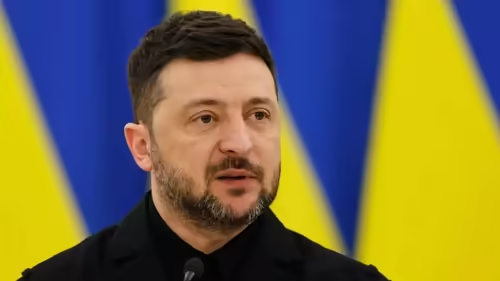
In a world weary from the relentless drumbeat of war, a flicker of hope has emerged from the desert sands of the United Arab Emirates. Ukrainian President Volodymyr Zelenskyy has officially announced that the next critical round of Russia-Ukraine peace talks is back on the calendar, scheduled for February 4th and 5th in Abu Dhabi [[2]]. This isn’t just another meeting; it’s a second attempt at a delicate trilateral negotiation involving the United States, following a previous session that ended without a breakthrough [[8]]. The stakes couldn’t be higher, as both sides remain locked in a bitter territorial dispute that has defined the conflict since its inception.
Table of Contents
- The New Timeline: A Second Chance in Abu Dhabi
- Why the Delay? Understanding the Diplomatic Shuffle
- The Territorial Deadlock: Core Issues on the Table
- What’s at Stake for Each Party?
- Can These Russia-Ukraine Peace Talks Succeed?
- Conclusion: A Narrow Path to Peace
- Sources
The New Timeline: A Second Chance in Abu Dhabi
The confirmation from President Zelenskyy puts an end to speculation about the fate of these crucial negotiations. The first trilateral meeting between Ukraine, Russia, and the US took place in Abu Dhabi from January 23rd to 24th, 2026 [[10]]. While officials described those initial talks as “productive” and “positive,” they ultimately failed to produce a concrete agreement, primarily due to the unmovable positions on territory [[15]]. The upcoming February 4-5 summit is now seen as a vital opportunity to build on that initial dialogue and push towards a tangible framework for peace. The choice of Abu Dhabi as a neutral ground continues to be a strategic move, offering a discreet and secure environment away from the intense media glare of Western capitals.
Why the Delay? Understanding the Diplomatic Shuffle
The rescheduling of these talks wasn’t arbitrary. It appears to be directly linked to a surprise bilateral meeting between US and Russian officials in Florida [[14]]. This behind-the-scenes discussion, which both sides later described as “constructive,” likely served as a pre-negotiation to align positions and manage expectations before bringing Ukraine back to the table [[14]]. This sequence of events—first a US-Russia chat, then a trilateral summit—highlights the complex, multi-layered nature of modern diplomacy. It suggests that Washington is playing a central role as a mediator, attempting to bridge the vast chasm between Kyiv and Moscow. For Zelenskyy, agreeing to this new timeline signals a willingness to engage, but also a demand that any progress made in Florida be presented transparently and in good faith.
The Territorial Deadlock: Core Issues on the Table
At the heart of the impasse lies the issue of territory. Russia continues to demand formal Ukrainian recognition of its annexation of four regions—Donetsk, Luhansk, Kherson, and Zaporizhzhia—despite not having full control over them. From Ukraine’s perspective, ceding any of its sovereign land is a non-starter, a betrayal of its citizens and its future. This fundamental disagreement creates a seemingly insurmountable barrier. Beyond territory, other key issues on the negotiating table are likely to include:
- Security Guarantees: What kind of international security assurances will Ukraine receive to prevent future aggression? This is a top priority for Kyiv [[8]].
- Black Sea Access: Securing safe passage for Ukrainian grain exports and naval operations is critical for the nation’s economy and sovereignty.
- Prisoner Exchanges & War Crimes: Addressing the humanitarian crisis of prisoners of war and establishing a framework for accountability for alleged war crimes.
- The Future of Crimea: While often treated as a separate, long-term issue, the status of the peninsula annexed by Russia in 2014 remains a deeply emotional and strategic point for Ukraine.
What’s at Stake for Each Party?
For Ukraine, the talks represent a chance to secure its survival and a path to rebuilding. A successful negotiation could lead to a ceasefire, an end to the daily loss of life, and a clear, internationally-backed roadmap for its future. Failure, however, could mean a prolonged war of attrition that drains its resources and tests its allies’ resolve.
For Russia, the summit is an opportunity to gain international legitimacy for its wartime gains and potentially ease the crippling economic sanctions that have hampered its economy. However, its maximalist demands risk isolating it further if they are perceived as unreasonable by the global community.
For the United States, the stakes involve its global leadership and credibility. Successfully brokering a peace deal would be a major foreign policy victory. Conversely, a collapse of the talks could signal a weakening of US influence and embolden other adversaries. The US is walking a tightrope, trying to support its ally Ukraine while preventing the conflict from escalating into a wider European war.
Can These Russia-Ukraine Peace Talks Succeed?
Honestly, the path to a comprehensive peace agreement remains steep and fraught with obstacles. The core territorial dispute is a zero-sum game where one side’s gain is the other’s loss. However, the very fact that all three parties are returning to the table just days after the last session is a significant development. It suggests a shared, albeit reluctant, understanding that a military solution is elusive for both sides. The most realistic outcome of the February 4-5 talks might not be a final peace treaty, but rather a more modest agreement on a temporary ceasefire or a framework for future negotiations. As experts from [INTERNAL_LINK:geopolitical-risk-analysis] often note, in such protracted conflicts, incremental progress is often the only viable path forward. The constructive tone from the recent US-Russia meeting in Florida offers a sliver of cautious optimism that the parties may be inching towards a more pragmatic stance [[14]].
Conclusion: A Narrow Path to Peace
The rescheduled Russia-Ukraine peace talks in Abu Dhabi mark a critical juncture in a devastating conflict. While the deep-seated territorial deadlock presents a formidable challenge, the renewed diplomatic engagement is a necessary and welcome step. The world will be watching closely on February 4th to see if the leaders of Ukraine, Russia, and the US can move beyond entrenched positions and demonstrate the political will needed to forge a path out of the darkness of war. Even a small step towards de-escalation would be a victory for humanity.
Sources
- National News (UAE). (2026, February 1). Ukraine’s Zelenskyy says Abu Dhabi to host further US-Ukraine-Russia peace talks next week. https://www.thenationalnews.com/news/uae/2026/02/01/ukraines-zelenskyy-says-abu-dhabi-to-host-further-us-ukraine-russia-peace-talks-next-week/
- NV.ua. (2026, February 1). Peace talks between Ukraine, US, and Russia — Zelenskyy announces date and location of new meeting. https://english.nv.ua/nation/peace-talks-between-ukraine-us-and-russia-zelenskyy-announces-date-and-location-of-new-meeting-50580091.html
- CGTN. (2026, February 1). U.S., Russia call Florida meeting on Ukraine conflict ‘constructive’. https://news.cgtn.com/news/2026-02-01/news-1KoLZwFRBBe/p.html
- Axios. (2026, January 24). Ukrainian officials call talks with U.S. and Russia “positive”. https://www.axios.com/2026/01/24/us-russia-ukraine-talks-abu-dhabi
- Korean Encyclopedia. (2026). Peace and Security Talks Between Ukraine, Russia and the United States in Abu Dhabi. https://kureansiklopedi.com/en/detay/peace-and-security-talks-between-ukraine-russia-an