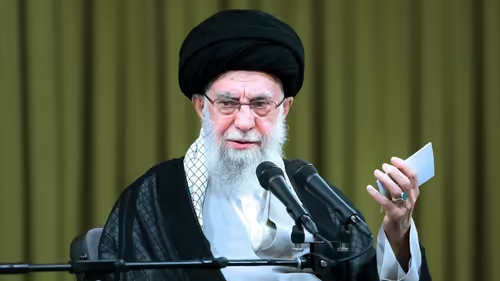
In a speech that has sent shockwaves through diplomatic corridors from Washington to Tel Aviv, Iran’s Supreme Leader, Ayatollah Ali Khamenei, has issued his most direct and chilling warning yet: an attack by the United States on Iran will not be a contained event. Instead, he declared, “This time, it will be a regional war.”
This isn’t just political posturing; it’s a calculated message aimed squarely at the network of US allies who form the backbone of American power in the Middle East. With tensions already at a boiling point, Khamenei’s words force a critical question: is the region on the precipice of a conflict that could engulf us all?
Table of Contents
- Khamenei’s Stark Warning: Decoding the Message
- Who Are the US Allies in the Crosshairs?
- The Trump Factor and Escalating Rhetoric
- What a Regional War Could Look Like
- Conclusion: Is Diplomacy Still an Option?
- Sources
Khamenei’s Stark Warning: Decoding the Message
Speaking during a legislative session, Khamenei sought to reassure the Iranian public not to fear the aggressive rhetoric coming from former President Donald Trump, but his primary audience was clearly international [[1]]. His core message was one of deterrence: any US-initiated conflict will have immediate and catastrophic consequences far beyond Iran’s borders.
He emphasized that Iran does not seek war but is fully prepared to defend itself. However, the defense, he warned, would not be passive. It would involve Iran’s extensive network of regional proxies and allies, effectively turning any bilateral conflict into a multi-front regional war. This strategy leverages Iran’s influence in countries like Iraq, Syria, Lebanon (through Hezbollah), and Yemen (through the Houthis) to create a complex and unwinnable quagmire for any adversary [[7]].
Who Are the US Allies in the Crosshairs?
Khamenei’s threat is not abstract. It is a direct challenge to the security of America’s closest partners in the region. A regional war would almost certainly involve attacks on these nations, which are seen by Tehran as extensions of US power. Key US allies who would be immediately vulnerable include:
- Israel: The most prominent US ally in the region and a long-standing adversary of Iran. It would be a primary target for Iranian missile barrages and attacks from Hezbollah.
- Saudi Arabia and the UAE: These Gulf states host major US military bases and have been central to US efforts to contain Iran. They are within range of Iranian ballistic missiles and would face threats from Houthi forces in Yemen.
- Jordan and Egypt: While their involvement might be more complex, their strategic locations and alliances with the US would make them potential flashpoints or targets for destabilization.
The US has built up its naval presence in the region in response to rising threats, a move that underscores the seriousness with which Washington views the situation [[9]].
The Trump Factor and Escalating Rhetoric
Khamenei’s speech was also a direct rebuke of Donald Trump’s recent hawkish statements on Iran. Trump has repeatedly threatened military intervention, creating a volatile feedback loop of threat and counter-threat [[5]]. While Trump has also confirmed that talks with Tehran are ongoing, the mixed signals from Washington only serve to heighten anxiety and mistrust in Tehran [[5]].
Khamenei’s message is clear: he sees Trump’s rhetoric not as a negotiating tactic, but as a genuine prelude to aggression. By framing any potential conflict as a regional war, he is attempting to raise the stakes so high that even the most bellicose voices in Washington would be forced to pause. He is betting that the US and its allies have too much to lose to risk a full-scale regional conflagration.
What a Regional War Could Look Like
The scenario Khamenei describes is not a conventional war between standing armies. It would be a chaotic, multi-dimensional conflict characterized by:
- Asymmetric Warfare: Reliance on proxy forces, cyberattacks, and drone strikes to inflict maximum damage while maintaining plausible deniability.
- Energy Market Chaos: Attacks on oil infrastructure in the Persian Gulf could send global energy prices skyrocketing, triggering a worldwide economic crisis.
- Humanitarian Catastrophe: Millions of civilians across the region would be caught in the crossfire, leading to a refugee crisis of unprecedented scale.
Experts at organizations like the Soufan Center have long warned that the Middle East in 2026 stands at a fork in the road, capable of either moving towards stability or descending into a regional conflagration [[22]]. Khamenei’s latest statement suggests he is actively preparing for the latter path if provoked.
Conclusion: Is Diplomacy Still an Option?
Khamenei’s warning of a regional war is a desperate, high-stakes gamble. It is designed to deter the US by showcasing the unbearable cost of military action. For the US and its allies, the message is a sobering reminder that the status quo is untenable. The current cycle of threats and counter-threats is a dangerous game of chicken with no winners.
The only viable path forward is a return to serious, good-faith diplomacy. Both sides must find a way to de-escalate and address the core issues driving this confrontation before Khamenei’s grim prophecy becomes a terrifying reality. The stability of the entire Middle East—and the global economy—depends on it. For more on the complex web of alliances in the region, see our deep dive on [INTERNAL_LINK:us-middle-east-alliances].
Sources
- Times of India: ‘This time, it will be a regional war’: Khamenei warns US’ Middle East allies
- Middle East Eye: Khamenei warns of ‘regional war’ if US attacks Iran
- The Straits Times: Tehran warns of regional conflict if US attacks Iran
- The Soufan Center: Middle East Forecast for 2026
- ABC 3340: Exploring complex web of US alliances in Middle East