Table of Contents
- Introduction: Budget 2026 as a Strategic Vision
- Budget 2026 Key Financials: The Foundation for Growth
- Securing India’s Future: The Rare Earths Push
- Building a Silicon India: The Semiconductor Mission 2.0
- Beyond Chips and Minerals: The Biopharma Shakti Scheme
- The Rise of the Orange Economy
- What the New Income Tax Act Means for You
- Conclusion: Is This India’s Inflection Point?
- Sources
Introduction: Budget 2026 as a Strategic Vision
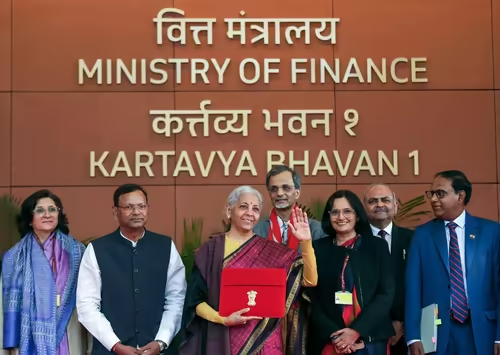
Forget the usual budget chatter about tax slabs and standard deductions. Budget 2026 is a different beast altogether. It’s less a financial statement and more a declaration of intent—a roadmap for India to claim its place in the 21st-century global order. Finance Minister Nirmala Sitharaman has laid out a bold, ambitious plan that prioritizes self-reliance in the most critical sectors of the modern economy.
This isn’t just about spending money; it’s about investing in strategic sovereignty. From the rare earths that power our smartphones and electric vehicles to the semiconductors that are the brain of every digital device, India is making a concerted push to move from being a consumer to a creator. Let’s break down the key pillars of this transformative Budget 2026 and what they mean for the nation’s economic trajectory.
Budget 2026 Key Financials: The Foundation for Growth
At the heart of this ambition is a rock-solid fiscal foundation. The government has set a capital expenditure target of a staggering ₹12.2 lakh crore for FY 2026-27, a significant jump from the current year’s ₹11.2 lakh crore [[38]]. This massive public investment is designed to be the engine of growth, crowding in private capital and accelerating infrastructure development across the board.
Crucially, this spending spree is being managed with a keen eye on fiscal discipline. The fiscal deficit target for the year has been pegged at 4.3% of GDP, a slight improvement from the 4.4% in the previous year [[11]]. This delicate balance—aggressive investment without reckless borrowing—is the hallmark of a mature economic strategy. It signals to global markets that India is serious about sustainable, long-term growth.
Securing India’s Future: The Rare Earths Push
One of the most strategic moves in Budget 2026 is the focused initiative on rare earth elements (REEs). These 17 critical minerals are the unsung heroes of modern technology, essential for everything from defense systems and wind turbines to EVs and consumer electronics. For decades, China has held a near-monopoly on their supply chain, creating a significant vulnerability for nations like India.
The budget directly addresses this by announcing the creation of dedicated Rare Earth Corridors in four mineral-rich states: Odisha, Kerala, Andhra Pradesh, and Tamil Nadu [[3]]. This cluster-based approach, complete with plug-and-play chemical parks, aims to create a complete domestic ecosystem for REE extraction, processing, and manufacturing of high-value products like permanent magnets. This isn’t just an industrial policy; it’s a national security imperative.
Building a Silicon India: The Semiconductor Mission 2.0
Complementing the rare earths push is a supercharged India Semiconductor Mission 2.0. With a fresh outlay of ₹40,000 crore, the government is doubling down on its ambition to make India a global hub for chip design and manufacturing [[1]]. The focus is shifting from just attracting large fabs to fostering a vibrant, industry-led R&D ecosystem.
This move is critical for the ‘Make in India’ vision in electronics. Without a domestic semiconductor industry, India will remain dependent on foreign imports for its most critical hardware components. By building this foundational layer of the tech stack, Budget 2026 is laying the groundwork for a truly indigenous electronics and digital hardware industry.
Beyond Chips and Minerals: The Biopharma Shakti Scheme
The vision of self-reliance extends beyond hardware into the life sciences. The newly announced Biopharma Shakti scheme, backed by a ₹10,000 crore outlay over five years, aims to transform India into a global leader in biologics and biosimilars [[21]]. This is a natural evolution for a country that is already a major supplier of generic medicines.
By focusing on advanced therapies and complex biological drugs, the scheme targets the next frontier of healthcare innovation. This not only promises to bring down the cost of cutting-edge treatments for Indian citizens but also positions the country as a key player in the global fight against complex diseases.
The Rise of the Orange Economy
While the focus on hard tech is clear, Budget 2026 also recognizes the immense potential of the creative sector, often dubbed the ‘Orange Economy’. This encompasses industries like film, music, design, fashion, and digital content—sectors where India already has a rich cultural heritage and a massive young talent pool.
Though specific financial allocations for the Orange Economy were not detailed in the initial announcements, its explicit mention alongside semiconductors and rare earths in the budget speech signals a major policy shift [[2]]. The government is acknowledging that in the knowledge economy, creativity and intellectual property are as valuable as physical resources. Expect targeted schemes and easier access to finance for startups and MSMEs in this space in the coming months.
What the New Income Tax Act Means for You
On the personal finance front, the most significant announcement is the introduction of a completely new Income Tax Act, which will come into effect from April 1, 2026 [[31]]. While the immediate impact on tax slabs might be minimal, the long-term goal is a radical simplification of the tax code.
The current, archaic 1961 Act is a labyrinth of complex provisions. The new law promises to be more user-friendly, with simplified rules and forms, reducing compliance burdens for salaried individuals and small businesses alike. This is a welcome step towards a more transparent and efficient tax system, aligning with the government’s broader ease-of-doing-business agenda.
Conclusion: Is This India’s Inflection Point?
Budget 2026 feels like a pivotal moment. It moves decisively beyond short-term populism and instead plants a flag for India’s long-term strategic future. By pouring resources into securing critical mineral supply chains, building a domestic semiconductor industry, and fostering advanced biopharma capabilities, the government is tackling the foundational challenges of a modern, self-reliant economy.
The success of this grand vision will depend entirely on flawless execution. Setting up complex industrial corridors and high-tech fabs is far harder than announcing them. However, the direction is clear and undeniably ambitious. If executed well, this budget could be remembered as the one that finally propelled India from a services-led economy to a comprehensive, innovation-driven powerhouse. For investors and entrepreneurs, the message is simple: the future is being built in India, and now is the time to get involved.
Sources
- [[1]] Sunday Guardian Live: Union Budget 2026 Highlights: From Semiconductor Mission 2.0…
- [[2]] Times of India: Union Budget 2026-27: Rare earths, semiconductors & Orange Economy – key takeaways
- [[3]] AutoCar Professional: Budget 2026–27: India to Create Rare Earth Corridors in Four States
- [[11]] Moneycontrol: Centre pegs FY27 fiscal deficit at 4.3% of GDP
- [[21]] Mint: Union Budget 2026: Government announces ₹10000 crore outlay for Biopharma Shakti scheme
- [[31]] The Hindu: New Income Tax Act will come into effect April 1, 2026
- [[38]] PIB: Highlights of Union Budget 2026-27