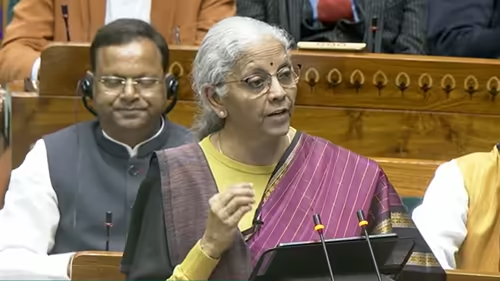
For years, India’s booming IT sector has navigated a complex web of tax classifications—software development here, KPOs there, contract R&D somewhere else. But that ends now. In a game-changing announcement during the Union Budget 2026, Finance Minister Nirmala Sitharaman has consolidated all ‘Information Technology Services’ into a single, unified category. This isn’t just bureaucratic housekeeping; it’s a strategic masterstroke aimed at reducing litigation, boosting investor confidence, and future-proofing India’s crown-jewel export industry.
Table of Contents
- What Changed in the Union Budget 2026 IT Services Policy?
- Why a Single Category Matters for Indian IT Firms
- The 15.5% Safe Harbour Margin Explained
- Fast-Track Unilateral APA Process: What You Need to Know
- Who Benefits Most from These Reforms?
- Potential Challenges and Industry Concerns
- Conclusion
- Sources
What Changed in the Union Budget 2026 IT Services Policy?
Previously, the Indian tax authorities treated different IT sub-sectors—like software development, IT-enabled services (ITES), Knowledge Process Outsourcing (KPO), and contract-based Research & Development—as distinct entities. This led to inconsistent profit margin assessments, frequent transfer pricing disputes, and prolonged audits.
The Union Budget 2026 IT services reform eliminates this fragmentation. Now, all these activities fall under one official classification: “Information Technology Services.” Alongside this, the government has introduced three key measures:
- A uniform 15.5% safe harbour operating margin for eligible companies.
- Increased revenue thresholds for eligibility under the safe harbour regime.
- A fast-track Unilateral Advance Pricing Agreement (APA) process with a target conclusion within two years.
Why a Single Category Matters for Indian IT Firms
This consolidation is more than administrative—it’s existential for an industry that contributes over 8% to India’s GDP and employs nearly 5 million professionals [[1]]. By creating a single, predictable framework, the government addresses long-standing pain points:
- Reduced Compliance Burden: Companies no longer need separate documentation for each service line.
- Fewer Tax Disputes: Clear definitions minimize subjective interpretations by tax officers.
- Enhanced Global Competitiveness: Predictable margins make Indian vendors more attractive to MNC clients seeking stable partners.
As one industry veteran put it, “This brings much-needed sanity to transfer pricing—a domain where even honest players faced endless scrutiny” [INTERNAL_LINK:india-it-sector-growth].
The 15.5% Safe Harbour Margin Explained
The new 15.5% safe harbour margin is perhaps the most impactful element. Under this provision, eligible IT firms that declare an operating profit of at least 15.5% on their international transactions will be exempt from detailed transfer pricing audits.
This rate is notably higher than the previous 8–10% range applied inconsistently across sub-sectors—reflecting the increased value-add of modern IT services, which now include AI integration, cloud migration, and cybersecurity consulting.
To qualify, companies must meet updated thresholds:
- International transaction value up to ₹300 crore (previously ₹200 crore).
- At least 75% of total revenue from IT services (ensuring genuine tech firms benefit).
This change acknowledges that today’s IT services are far more sophisticated—and profitable—than basic back-office support.
Fast-Track Unilateral APA Process: What You Need to Know
For larger firms exceeding the safe harbour limits, the budget introduces a streamlined Unilateral Advance Pricing Agreement (APA) process specifically for IT services. An APA allows a company to agree in advance with tax authorities on its transfer pricing methodology for the next 5 years.
Historically, APAs in India took 3–4 years to conclude—creating uncertainty. The new fast-track system aims to wrap up approvals within **24 months**, with dedicated cells in the Central Board of Direct Taxes (CBDT) and automated document tracking.
This is a direct response to industry feedback. According to a 2025 NASSCOM report, 68% of large IT exporters cited APA delays as a top operational risk [[2]].
Who Benefits Most from These Reforms?
While the entire ecosystem gains, certain segments stand to win big:
- Midsized IT Exporters: Firms with $50M–$500M revenue now get audit immunity if they meet the 15.5% margin.
- R&D-Focused Startups: Contract R&D units, previously excluded, are now covered under the unified definition.
- Global Capability Centers (GCCs): Multinationals running captive IT units in India gain pricing certainty for intercompany charges.
Even global clients benefit—knowing their Indian partners operate under a transparent, government-backed margin framework reduces supply chain risk.
Potential Challenges and Industry Concerns
Despite the optimism, some questions remain:
- Will the 15.5% margin be sustainable for firms in highly competitive niches like legacy maintenance?
- How will the CBDT define “IT services” versus adjacent fields like digital marketing or fintech SaaS?
- Will state-level tax authorities align quickly with this central policy?
Industry bodies like NASSCOM are expected to engage with the finance ministry in the coming weeks to iron out ambiguities.
Conclusion
The Union Budget 2026 IT services overhaul marks a turning point. By unifying categories, setting a realistic safe harbour margin, and accelerating dispute resolution, the government has listened to one of India’s most vital sectors. This isn’t just about tax—it’s about trust. And in an era where global tech partnerships hinge on predictability, this move could cement India’s position as the world’s preferred digital transformation partner for decades to come.
Sources
- Times of India: FM brings IT services under single category in Union Budget
- NASSCOM Strategic Review 2025: Transfer Pricing and Global Competitiveness
- Ministry of Finance – Budget 2026 Highlights: Direct Tax Proposals
- OECD Guidelines on Transfer Pricing: Safe Harbour Frameworks