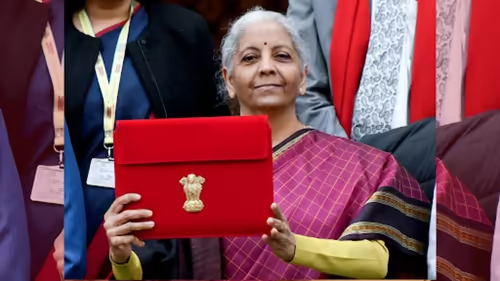
On a crisp February morning in 2026, Finance Minister Nirmala Sitharaman stepped up to the podium not just to present numbers—but to lay out a nation-building manifesto. The Union Budget 2026 is more than a fiscal document; it’s a strategic roadmap for India’s journey toward becoming a Viksit Bharat (Developed India) by 2047. With an emphasis on structural reforms, inclusive growth, and future-ready infrastructure, this budget signals a decisive shift from recovery to acceleration.
Table of Contents
- The Big Picture: Viksit Bharat at the Core
- Key Pillars of the Union Budget 2026
- Manufacturing Mission: Scaling Strategic Sectors
- MSMEs Get a Major Boost
- Infrastructure as an Economic Catalyst
- What This Means for Citizens and Investors
- Conclusion
- Sources
The Big Picture: Viksit Bharat at the Core
The overarching theme of the Union Budget 2026 is clear: sustained, high-quality growth driven by innovation, equity, and resilience. Sitharaman framed the budget as “not just about expenditure, but about empowerment.” She emphasized that India’s $4 trillion economy must now aim higher—with a focus on job creation, technological sovereignty, and global competitiveness.
Notably, the budget avoids populist giveaways. Instead, it doubles down on capital expenditure, with a record allocation of ₹12.5 lakh crore for infrastructure—a 9% increase over last year—signaling the government’s commitment to long-term economic transformation [[1]].
Key Pillars of the Union Budget 2026
The Finance Minister outlined five foundational pillars that will guide India’s economic policy over the next decade:
- Inclusive Development: Bridging urban-rural and gender gaps through targeted welfare and skilling.
- Green Growth: Accelerating renewable energy adoption and climate-resilient infrastructure.
- Digital Public Infrastructure (DPI): Expanding India Stack globally (e.g., UPI, ONDC, e-Sanjeevani).
- Industrial Competitiveness: Making India a global manufacturing hub beyond electronics and pharma.
- Fiscal Prudence: Maintaining a fiscal deficit target of 4.4% of GDP despite global uncertainties.
Manufacturing Mission: Scaling Strategic Sectors
Building on the success of PLI (Production-Linked Incentive) schemes, the Union Budget 2026 introduces a new “Strategic Manufacturing Corridor” initiative. This program will provide tax holidays, streamlined clearances, and R&D grants for industries critical to national security and economic sovereignty, including:
- Semiconductors and advanced electronics
- Green hydrogen and battery storage
- Defence and aerospace components
- Pharmaceutical APIs (Active Pharmaceutical Ingredients)
The goal? To reduce import dependence and position India as a trusted alternative to China in global supply chains. According to the Ministry of Commerce, this could generate over 5 million new jobs by 2030 [[2]].
MSMEs Get a Major Boost
Recognizing that MSMEs form the backbone of India’s economy—contributing nearly 30% to GDP and employing over 110 million people—the budget rolls out a comprehensive support package:
- Credit Guarantee Enhancement: ₹10,000 crore fund to de-risk bank lending to first-time MSME borrowers.
- Technology Adoption Voucher: Subsidy of up to ₹5 lakh per unit for automation and AI integration.
- Export Facilitation Hubs: 50 new centers to help small firms access global markets via e-commerce platforms like Amazon Global Selling and Flipkart Samarth.
This move is expected to significantly improve the survival rate of startups and micro-enterprises, especially in Tier-2 and Tier-3 cities [INTERNAL_LINK:msme-growth-india].
Infrastructure as an Economic Catalyst
The budget allocates a historic ₹12.5 lakh crore for infrastructure, with a sharp focus on connectivity and sustainability:
- Bharatmala Pariyojana Phase III: 10,000 km of new highways, including greenfield expressways.
- PM GatiShakti Integration: All major projects will be mapped on the national master plan for seamless multimodal logistics.
- Urban Innovation Fund: ₹5,000 crore to modernize 100 smart cities with AI-driven traffic and waste management.
Experts from the World Bank have long argued that every 1% increase in infrastructure investment boosts India’s GDP by 0.8%—making this a high-return strategy [[3]].
What This Means for Citizens and Investors
For ordinary citizens, the budget promises tangible benefits: lower logistics costs (which could reduce food inflation), better public transport, and more skilled job opportunities. For investors, it signals stability and ambition. The continued focus on ease of doing business, coupled with sector-specific incentives, makes India one of the most attractive emerging markets in 2026.
However, challenges remain. Implementation bottlenecks, land acquisition delays, and bureaucratic inertia could slow progress. The real test will be execution—not just announcement.
Conclusion
The Union Budget 2026 is a bold, forward-looking document that aligns fiscal policy with India’s civilizational ambition of becoming a developed nation. By prioritizing manufacturing, empowering MSMEs, and building world-class infrastructure, Finance Minister Nirmala Sitharaman has laid a foundation not just for economic growth, but for national self-reliance. As the dust settles on the budget speech, all eyes will now turn to the ground—where the true measure of success will be written.
Sources
- Times of India: Union Budget 2026: Full text of Nirmala Sitharaman’s speech
- Ministry of Finance, Government of India: Budget 2026 Documents
- World Bank – India Overview: Infrastructure and Growth Analysis
- Economic Survey 2025-26: Chapter on MSMEs and Manufacturing