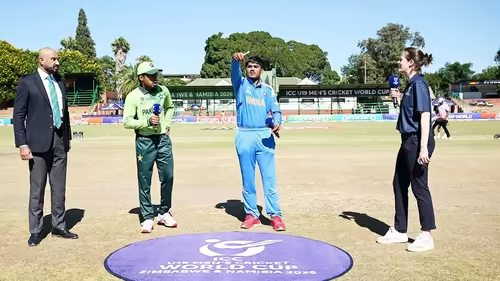
The coin hadn’t even hit the ground, but the tension was already palpable. In a moment that has now become a grim ritual, India’s U19 captain Ayush Mhatre and his Pakistani counterpart deliberately bypassed the customary handshake at the toss for their crucial ICC U19 World Cup 2026 encounter. This wasn’t just a missed greeting; it was a stark, silent statement echoing far beyond the boundary ropes, plunging the beautiful game back into the deep end of geopolitical currents.
Table of Contents
- The Moment That Spoke Volumes
- A Pattern, Not an Incident
- Why Does the India vs Pakistan U19 World Cup Match Matter So Much?
- The Human Cost of Politics in Sport
- What the Future Holds for Cricket Diplomacy
- Conclusion
- Sources
The Moment That Spoke Volumes
The image is now seared into the memory of cricket fans: two young captains, representing nations with a shared history and a fraught present, standing mere feet apart yet worlds away. The refusal to shake hands before the India vs Pakistan U19 World Cup match wasn’t a spontaneous act of teenage petulance. It was a calculated, top-down directive, a continuation of a policy that has defined recent encounters between the two cricketing giants [[2]].
This act of omission set the tone for a high-stakes contest that Pakistan desperately needed to win to keep their semi-final dreams alive in the Super Six stage of the tournament [[17]]. For India, it was another step towards securing their spot in the knockout rounds, a mission they accomplished with a commanding performance on the field.
A Pattern, Not an Incident
To view this as an isolated event is to miss the larger, more troubling picture. Over the past year, the Indian men’s senior team has consistently declined to exchange handshakes with their Pakistani counterparts in all three of their Asia Cup 2025 encounters [[6], [11]]. This policy has now trickled down to the U19 level, a clear signal that the stance is institutional rather than individual.
The trend is impossible to ignore:
- Asia Cup 2025 (Senior Men): No handshakes before or after matches [[14], [16]].
- U19 Asia Cup 2025: India maintained its ‘no-handshake policy’ against Pakistan [[7]].
- ICC U19 World Cup 2026: The pattern continues with the captains at the toss [[2], [17]].
This consistent approach suggests a formal, if unspoken, protocol from the Board of Control for Cricket in India (BCCI), reflecting the broader diplomatic chill between the two nuclear-armed neighbors. While other international teams, like Bangladesh, have had similar non-handshake moments attributed to being “unintentional” [[3]], the India-Pakistan dynamic carries a weight that makes such explanations implausible.
Why Does the India vs Pakistan U19 World Cup Match Matter So Much?
Beyond the political theatre, the match itself held immense sporting significance. The ICC U19 World Cup is a proven nursery for future stars—players like Virat Kohli, Kane Williamson, and Babar Azam all cut their teeth on this very stage. A performance here can be a career-defining launchpad.
For Pakistan, the stakes were existential in the tournament context. With their campaign hanging by a thread, a loss would effectively end their journey. The pressure on these young athletes was immense, compounded by the heavy symbolism of their every action. According to the Super Six points table, Pakistan entered the match with a precarious position, needing a win to stay in contention, while India was already in a strong qualifying spot [[18]].
The Human Cost of Politics in Sport
The most poignant aspect of this controversy is its impact on the players themselves. These are teenagers, some as young as 16, who have dedicated their lives to mastering a sport. They are thrust onto a global stage not just to compete, but to represent a nation’s pride and, increasingly, its political stance.
Imagine the internal conflict for a young cricketer who might admire his opponent’s talent, who shares the same love for the game, yet is instructed to withhold a basic gesture of sportsmanship. This politicization of a simple handshake robs them of the pure, unadulterated joy of competition. It turns a potential moment of mutual respect into a public display of division. It’s a burden no young athlete should have to bear.
What the Future Holds for Cricket Diplomacy
Cricket has long been touted as a potential bridge between India and Pakistan—a form of “cricket diplomacy.” Yet, the persistent handshake refusals signal a retreat from that hopeful ideal. The International Cricket Council (ICC) has so far refrained from intervening, likely wary of stepping into a geopolitical minefield. However, the question remains: at what point does the governing body of the sport need to step in to protect its core values of fair play and respect?
While the blind women’s teams of both nations have shown a heartening example of camaraderie by shaking hands and travelling together [[13]], the main representative teams seem locked in a cycle of symbolic one-upmanship. The path forward is unclear, but it will require leadership that prioritizes the spirit of the game over the politics of the day.
Conclusion
The handshake refusal at the start of the India vs Pakistan U19 World Cup match was more than just a news headline; it was a microcosm of a much larger, more complex issue. It highlighted the uncomfortable intersection of sport and state, where the actions of young athletes become proxies for national sentiment. While India secured a vital victory on the pitch, the real loss may be the erosion of a fundamental principle of sportsmanship. As fans, we can only hope that future generations of cricketers from both nations will be allowed to compete, and greet each other, on their own terms.
Sources
- Free Press Journal: IND vs PAK, ICC U19 World Cup 2026: Ayush Mhatre avoids handshake with Pakistan captain during toss time
- Gulf News: Will handshake row take centrestage again in U19 India-Pakistan clash?
- NDTV Sports: India Stick To ‘No-Handshake’ Policy Against Pakistan In U19 Asia Cup
- Al Jazeera: India vs Pakistan Asia Cup match hit by ‘no handshake’ controversy
- NDTV Sports: ‘Handshake Row’ Returns, India And Pakistan Captains Skip Customary Greeting At Toss
- Facebook (Afghan Cricket Association): Once Again no Handshake at the toss
- Facebook (Brut India): India’s and Pakistan’s blind women’s cricket teams shook hands