Table of Contents
- The Historic Ninth Budget Speech
- A Timeline of Nirmala Sitharaman’s Budget Speeches
- What the Length of a Budget Speech Reveals
- Breaking Records: A Legacy in the Making
- Conclusion: More Than Just Minutes on the Clock
- Sources
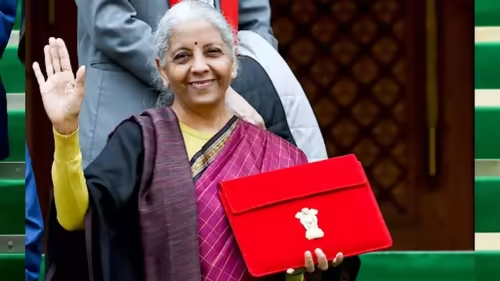
On February 1st, 2026, Finance Minister Nirmala Sitharaman stood at the iconic Budget podium in Parliament for the ninth time in a row. Her voice, now familiar to millions, filled the chamber for 1 hour and 25 minutes as she laid out the government’s fiscal vision for the year ahead. This wasn’t just another Budget speech; it was a milestone that cemented her status as the longest-serving Finance Minister in India’s recent history under a single Prime Minister [[1]].
But beyond the numbers and the policies, there’s a fascinating story in the very length of her addresses. From her most succinct to her most exhaustive, each Budget speech offers a window into the economic challenges and political priorities of its time.
The Historic Ninth Budget Speech
The Budget 2026 speech was a masterclass in balancing detail with vision. Lasting 85 minutes, it was one of her longer presentations, reflecting the complexity of steering an economy through a global landscape marked by technological disruption and geopolitical flux. She covered everything from the new tax holiday for cloud companies to the ambitious Khelo India mission, all while maintaining a steady, authoritative tone [[5]].
Prime Minister Narendra Modi, in his praise for the event, called it a “proud parliamentary tradition,” highlighting the democratic ritual of presenting the nation’s financial plan to its elected representatives. This framing underscores the symbolic weight of the Budget speech—it’s not just a financial document, but a statement of national intent.
A Timeline of Nirmala Sitharaman’s Budget Speeches
To understand her journey, let’s look at the evolution of her speaking time:
| Budget Year | Duration (Approx.) | Context |
|---|---|---|
| 2019 (Interim) | 45 minutes | First speech, post-election interim budget. |
| 2019 (Full) | 1 hour 30 minutes | First full-term budget, outlining a 5-year vision. |
| 2020 | 1 hour 40 minutes | Pre-pandemic; focused on infrastructure and manufacturing. |
| 2021 | 1 hour 20 minutes | Pandemic recovery focus, heavy on healthcare and capital expenditure. |
| 2022 | 1 hour 15 minutes | Post-pandemic growth strategy, PLI schemes. |
| 2023 | 1 hour 10 minutes | Focus on green energy and digital public infrastructure. |
| 2024 | 1 hour 5 minutes | Pre-election budget, populist measures balanced with fiscal prudence. |
| 2025 | 1 hour 20 minutes | Post-election, second term agenda setting. |
| 2026 | 1 hour 25 minutes | Ninth speech, consolidating a long-term economic legacy. |
Her shortest full Budget speech was in 2024, a strategic choice in an election year to keep the message crisp and focused. Her longest, in 2020, came just before the world changed forever, packed with ambitious plans that would soon be tested by unprecedented crisis.
What the Length of a Budget Speech Reveals
The duration of a Finance Minister’s speech is never arbitrary. It’s a direct reflection of the economic narrative they need to convey.
- Complexity Demands Time: A longer speech is often needed when introducing sweeping reforms, new missions, or complex fiscal math, as seen in Budgets 2020 and 2026.
- Political Strategy: In an election year, brevity can be a virtue. A shorter speech avoids getting bogged down in details that can be spun negatively by opponents.
- Confidence & Control: A Finance Minister who has been in office for a long time, like Sitharaman, can afford to be more detailed. Their command over the subject matter allows them to explain nuances without losing the audience’s attention [INTERNAL_LINK:indian-economic-policy-evolution].
Historically, legendary Finance Ministers like Manmohan Singh and Yashwant Sinha were known for their lengthy, intellectually dense speeches that laid the groundwork for major economic shifts. Sitharaman’s style, while more modern and accessible, carries a similar weight of responsibility.
Breaking Records: A Legacy in the Making
With her ninth consecutive budget, Nirmala Sitharaman has now served for six years and eight months as Finance Minister—a record tenure in the current political era. This longevity is significant. It provides a level of continuity and consistency in economic policy that is rare in Indian politics.
This sustained leadership has allowed for the execution of long-term projects, from the creation of the National Infrastructure Pipeline to the push for a digital rupee. Her Budget speech is the annual checkpoint on this journey, a moment to account for past actions and set the course for the future.
For a deeper understanding of the role and history of the Finance Minister in India, the Ministry of Finance’s official archives provide a rich resource on the evolution of the Union Budget [[https://www.finmin.nic.in/]].
Conclusion: More Than Just Minutes on the Clock
Nirmala Sitharaman’s 2026 Budget speech is more than a 85-minute presentation; it’s the culmination of a historic tenure. The length of her speeches, from her shortest to her longest, tells a story of an economy navigating through calm and storm, guided by a steady hand. As she continues to shape India’s fiscal destiny, her words from the Budget podium will remain a crucial barometer of the nation’s economic health and ambition.
Sources
- Times of India. “Union Budget 2026: A look at Nirmala Sitharaman’s longest and shortest Budget speeches.” https://timesofindia.indiatimes.com/… [[1]]
- NDTV. “Budget 2026: Nirmala Sitharaman Delivers 9th Consecutive Budget Speech.” https://www.ndtv.com/… [[5]]
- India Today. “Nirmala Sitharaman becomes longest-serving FM under PM Modi with Budget 2026.” https://www.indiatoday.in/…
- Ministry of Finance, Government of India. “History of the Union Budget.” https://www.finmin.nic.in/