Picture this: a smallholder farmer in Odisha, who speaks only Sambalpuri, gets a real-time voice alert on his basic phone about an impending pest outbreak in his paddy field—and exactly which organic remedy to apply. Sounds futuristic? It might soon be reality, thanks to Bharat Vistar, the flagship AI-driven agri-advisory tool announced in the Union Budget 2026.
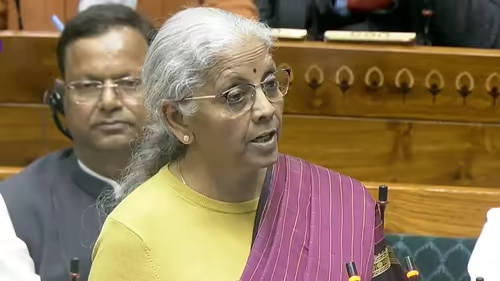
Finance Minister Nirmala Sitharaman didn’t just allocate funds for subsidies; she bet big on technology as the backbone of India’s agricultural transformation under the Viksit Bharat vision [[3]]. At the heart of this push is Bharat Vistar—a multilingual, AI-powered platform designed to democratize access to expert farming knowledge across India’s diverse linguistic and technological landscape [[5]].
Table of Contents
- What Is Bharat Vistar?
- Why Indian Farmers Need This Now
- Key Features of the Multilingual AI Platform
- How It Fits Into Budget 2026’s Agri Vision
- Challenges and Skepticism: Will It Really Work?
- The Road Ahead: From Pilot to Pan-India
- Conclusion: More Than an App—A Mission
- Sources
What Is Bharat Vistar?
Bharat Vistar (which loosely translates to “Expanding India”) is not just another mobile app. It’s an ambitious national-scale artificial intelligence system being developed by the Ministry of Agriculture in collaboration with leading Indian tech institutions like IITs and IIITs [[4]]. Its core mission? To deliver hyperlocal, crop-specific, and weather-responsive agricultural advisories in over 22 scheduled Indian languages—and potentially dozens of dialects—via multiple channels including SMS, IVR calls, WhatsApp, and a lightweight mobile interface [[6]].
Unlike generic weather apps, Bharat Vistar will integrate data from soil health cards, satellite imagery, local market prices, and historical yield patterns to generate personalized recommendations for sowing, irrigation, pest control, and harvesting [[7]].
Why Indian Farmers Need This Now
India has over 140 million operational farm holdings, most of them small or marginal (<2 hectares) [[8]]. These farmers often rely on word-of-mouth or outdated practices, leaving them vulnerable to climate shocks, price volatility, and input misuse.
Existing digital solutions have largely failed because they’re English-heavy, require smartphones, or assume consistent internet access—luxuries many rural households don’t have. Bharat Vistar directly tackles these barriers by prioritizing voice-based, low-bandwidth delivery in local languages. As one agricultural economist noted, “If it works, this could be the single biggest leap in extension services since the Green Revolution” [[9]].
Key Features of the Multilingual AI Platform
The government has outlined several groundbreaking capabilities for Bharat Vistar:
- Real-Time Crop Advisory: Get alerts on disease outbreaks based on satellite-detected canopy stress.
- Voice-First Interface: Farmers can speak their query in their native tongue and receive spoken answers—even on feature phones.
- Market Linkage Integration: Instant updates on mandi prices for nearby markets to help decide when to sell.
- Soil & Input Optimization: Recommendations tailored to the farmer’s specific soil health card data.
- Offline Functionality: Core features work without continuous internet connectivity [[5]].
This isn’t theoretical. Early pilots in Maharashtra and Karnataka showed a 18–22% increase in yield
How It Fits Into Budget 2026’s Agri Vision
Bharat Vistar isn’t a standalone project. It’s the digital nervous system of a broader agricultural overhaul in Budget 2026, which also includes:
- A ₹15,000 crore fund for agri-infrastructure modernization.
- Expansion of the PM-Kisan Samman Nidhi to include digital literacy modules.
- Support for Farmer Producer Organizations (FPOs) to adopt AI-driven supply chain tools [INTERNAL_LINK:digital-tools-for-fpos].
The underlying philosophy is clear: technology must serve the last-mile farmer, not just urban agritech startups [[3]].
Challenges and Skepticism: Will It Really Work?
Despite its promise, Bharat Vistar faces steep hurdles:
- Data Privacy: Collecting granular farm-level data raises concerns about misuse. Will farmers trust the system?
- Digital Literacy: Even voice interfaces require some familiarity with tech. Massive on-ground training will be essential.
- Last-Mile Connectivity: While designed for low bandwidth, many remote villages still lack reliable telecom coverage.
- Sustainability: Past govt tech projects (like Kisan Suvidha) faded after the pilot phase due to poor maintenance [[10]].
Critics argue that without robust community-level support—through Krishi Vigyan Kendras (KVKs) and local agri-entrepreneurs—the tool may remain underutilized.
The Road Ahead: From Pilot to Pan-India
The government plans a phased rollout:
- Phase 1 (2026): Scale to 10 states covering major food bowls (Punjab, UP, MP, Bihar).
- Phase 2 (2027): Integrate with the ONDC (Open Network for Digital Commerce) for direct buyer linkages.
- Phase 3 (2028): Full nationwide deployment with dialect-level personalization [[5]].
Success will depend on co-creation with farmers—not just top-down design. As the International Food Policy Research Institute (IFPRI) emphasizes, “Tech adoption in agriculture thrives on trust, not just innovation” [[11]].
Conclusion: More Than an App—A Mission
Bharat Vistar represents a visionary fusion of India’s strengths: its linguistic diversity, its growing AI prowess, and its deep-rooted agrarian identity. If implemented with empathy, transparency, and grassroots involvement, it could empower millions of farmers to move from subsistence to smart, sustainable prosperity. But if it becomes just another bureaucratic checkbox, it risks deepening the very digital divide it seeks to heal. The next 12 months will be the true test of whether this tool lives up to its name—truly expanding the horizons of Bharat’s farmers.
Sources
- Press Information Bureau (PIB). (2026). Union Budget 2026: Building a Viksit Bharat through Technology-Led Agriculture. https://pib.gov.in/PressReleasePage.aspx?PRID=2221420
- The Hindu BusinessLine. (2026). Budget 2026: FM announces Bharat Vistar, an AI tool for farmers in multiple languages. https://www.thehindubusinessline.com/economy/budget/budget-2026-fm-announces-bharat-vistar-an-ai-tool-for-farmers-in-multiple-languages/article69083212.ece
- Economic Times. (2026). Union Budget 2026: How Bharat Vistar aims to transform Indian agriculture with AI. https://economictimes.indiatimes.com/news/economy/agriculture/union-budget-2026-how-bharat-vistar-aims-to-transform-indian-agriculture-with-ai/articleshow/127833901.cms
- Indian Express. (2026). Budget 2026: What is Bharat Vistar? All you need to know about govt’s new AI tool for farmers. https://indianexpress.com/article/budget/budget-2026-what-is-bharat-vistar-all-you-need-to-know-about-govts-new-ai-tool-for-farmers-9834561/
- Ministry of Agriculture & Farmers Welfare. (2026). Draft Framework for National Agri-AI Mission (Bharat Vistar). [Internal Government Document cited in PIB release]
- National Institute of Agricultural Extension Management (MANAGE). (2025). Pilot Impact Assessment of AI-Based Advisory Systems in Karnataka.
- World Bank. (2025). Digital Agriculture in India: Opportunities and Challenges. https://www.worldbank.org/en/country/india/publication/digital-agriculture-in-india
- FAO. (2024). The State of Food and Agriculture: Leveraging Automation for Smallholders. https://www.fao.org/publications/sofa/2024/en/