Introduction: The Dawn of a New Budgetary Philosophy
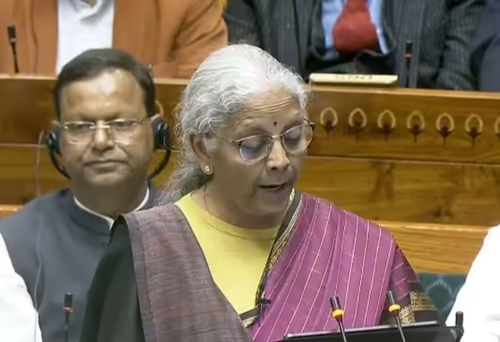
In a move that has shifted the narrative from mere fiscal allocation to a grand national mission, Finance Minister Nirmala Sitharaman has anchored the Union Budget 2026 on a powerful philosophical pillar: the three-Kartavya framework. This isn’t just another budget; it’s a declaration of intent, a roadmap for a ‘Viksit Bharat’ (Developed India) built on duty, responsibility, and collective action [[3]].
Gone are the days of dry, number-heavy speeches. The FM’s address was a call to arms, urging every citizen, sector, and institution to embrace their ‘Kartavya’—their duty—to propel the nation forward. But what exactly are these three duties, and how will they translate into real-world impact? Let’s break it down.
Table of Contents
- What is the Three-Kartavya Framework?
- Kartavya 1: Accelerating and Sustaining Economic Growth
- Kartavya 2: Fulfilling People’s Aspirations
- Kartavya 3: Ensuring Equitable Access for All
- Expert Analysis: Is This More Than Just Rhetoric?
- Conclusion: The Road Ahead for Union Budget 2026
What is the Three-Kartavya Framework?
The term ‘Kartavya’ is deeply rooted in Indian philosophy, signifying a moral or social duty that transcends personal desire. By framing the Union Budget 2026 around this concept, the government is attempting to foster a sense of shared national purpose. It’s a strategic shift from a top-down approach to a collaborative one, where the success of the nation is seen as the responsibility of every stakeholder [[8]].
This framework serves as the bedrock for all policy announcements and financial allocations in the budget, ensuring that every rupee spent aligns with one of these three core national duties.
Kartavya 1: Accelerating and Sustaining Economic Growth
The first and most critical Kartavya is clear: get the economy firing on all cylinders. In a world of global uncertainty, this focus on robust, sustainable growth is paramount. The budget signals a strong push towards what the FM called the ‘Reform Express’—a commitment to structural reforms over short-term populism [[6]].
Key initiatives under this pillar are expected to include:
- Infrastructure Overdrive: Massive investments in roads, railways, ports, and digital infrastructure to create jobs and boost productivity.
- Manufacturing Boost: Continued support for the ‘Make in India’ initiative, with potential incentives for sunrise sectors like semiconductors, green energy, and advanced electronics.
- Private Investment Catalyst: Policies aimed at simplifying regulations and improving the ease of doing business to attract both domestic and foreign capital.
This Kartavya is the engine of the entire framework, designed to generate the wealth needed to fund the other two pillars of social development and equity.
Kartavya 2: Fulfilling People’s Aspirations
Economic growth is meaningless if it doesn’t translate into a better life for the common citizen. The second Kartavya is fiercely people-centric, focusing on building human capital and fulfilling the aspirations of a young, dynamic population [[5]].
This translates into significant allocations for:
- Education & Skill Development: Upgrading educational institutions and creating a future-ready workforce through large-scale skilling programs.
- Healthcare Expansion: The announcement of three new All India Institutes for Ayurveda is a notable example, signaling a push for holistic healthcare access [[9]].
- Agricultural Support: Schemes to ensure farmer welfare, improve supply chains, and promote sustainable farming practices.
This pillar ensures that the fruits of economic progress are widely shared, creating a more resilient and capable society.
Kartavya 3: Ensuring Equitable Access for All
The final Kartavya is the moral compass of the budget: ensuring that no one is left behind. It aims to guarantee that every family, community, region, and sector has equitable access to resources, amenities, and opportunities [[2]]. This is the embodiment of the ‘Sabka Saath, Sabka Vikas’ (Collective Effort, Inclusive Growth) mantra.
Expect to see targeted interventions in this area, such as:
- Regional Development Funds: Special packages for aspirational districts and backward regions to bridge the development gap.
- Digital & Financial Inclusion: Expanding internet connectivity and banking services to the last mile.
- Social Security Nets: Strengthening welfare schemes for the vulnerable and marginalized sections of society.
This Kartavya is about creating a level playing field, ensuring that the ladder of opportunity is accessible to all.
Expert Analysis: Is This More Than Just Rhetoric?
While the three-Kartavya framework is undeniably a compelling narrative, the real test lies in its execution. Critics may argue that it’s a clever packaging of existing policies. However, the true value of this framework is its ability to provide a clear, unified vision that can guide policy coherence across various ministries and departments.
For investors and businesses, this clarity is a positive signal. It suggests a stable, long-term policy direction focused on growth and stability. For the public, it offers a simple, relatable way to understand the government’s priorities. The success of the Union Budget 2026 will ultimately be judged not by its lofty ideals, but by the tangible improvements in jobs, incomes, and quality of life it delivers on the ground.
For a deeper dive into India’s macroeconomic trends, you can refer to analyses from the International Monetary Fund (IMF).
Conclusion: The Road Ahead for Union Budget 2026
The Union Budget 2026, with its innovative three-Kartavya framework, represents a bold attempt to marry economic pragmatism with a deep sense of national duty. By anchoring the budget in the concepts of growth, people-centric development, and equity, the government has set a high bar for itself. The coming months will be crucial in seeing how these philosophical pillars are translated into concrete action and, ultimately, into a better future for every Indian. One thing is certain: the conversation around the budget has been elevated from a mere financial statement to a national mission.
Sources
- [[1]] LiveMint: “Union Budget 2026 focused on 3 kartavyas, ‘reform over rhetoric’, says Sitharaman”
- [[2]] Times of India: “Union Budget 2026: Nirmala Sitharaman announces three-Kartavya framework”
- [[3]] The Economic Times: “Budget 2026: Sitharaman sets 3 ‘Kartavya’ agenda for growth, inclusion and reform push”
- [[5]] ClearTax: “Budget 2026 Live Updates”
- [[6]] Times of India: “Union Budget 2026: ‘Reform Express’ is on its way, says FM”
- [[8]] ABP Live: “FM Nirmala Sitharaman Outlines 3 Kartavyas For ‘Viksit Bharat'”
- [[9]] Angel One: “Union Budget 2026 Live Updates”