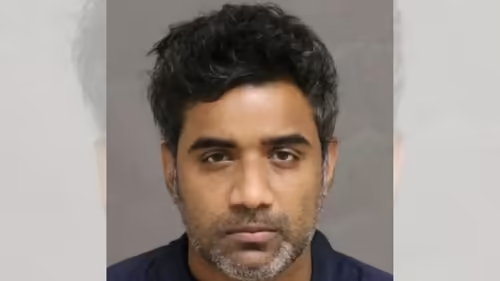
Introduction: A Disturbing Confession That Shook Two Nations
In a courtroom in the United States, Canadian national Ramanan Pathmanathan stood before a judge and did the unthinkable: he pleaded guilty to sexually exploiting over 100 children—some as young as 10 years old—through social media platforms [[5]]. The sheer scale of his crimes, spanning multiple jurisdictions and leveraging the anonymity of the digital world, has sent shockwaves through law enforcement and child protection communities. This isn’t just a story about one predator; it’s a stark warning about the hidden dangers lurking in our children’s everyday online interactions.
Table of Contents
- Who Is Ramanan Pathmanathan?
- The Modus Operandi: How the Crime Unfolded
- Ramanan Pathmanathan: The Legal Reckoning
- Why This Case Is a Wake-Up Call for Parents
- What Law Enforcement Is Doing Differently
- Conclusion: Turning Horror into Action
- Sources
Who Is Ramanan Pathmanathan?
Once an unassuming figure living in Canada, Ramanan Pathmanathan used the internet to build a terrifying double life. According to U.S. federal prosecutors, he posed as a teenager or a trusted peer on popular social media and messaging apps to gain the trust of his victims [[6]]. His targets were scattered across the United States, but his digital footprint was global. Authorities believe his predatory behavior spanned several years before he was finally apprehended in a coordinated effort between U.S. Homeland Security Investigations (HSI) and Canadian law enforcement [[7]].
The Modus Operandi: How the Crime Unfolded
Pathmanathan’s method was a textbook example of online grooming:
- Building Trust: He would initiate contact with minors, often using fake profiles that mirrored their age and interests.
- Isolation and Manipulation: Over time, he’d encourage secrecy, telling victims not to share their conversations with parents or friends.
- Escalation to Exploitation: Once trust was established, he’d pressure or coerce them into sharing explicit images or videos, which he then collected and, in some cases, distributed [[8]].
This pattern highlights a critical vulnerability: many social platforms still lack robust age verification and real-time monitoring systems to detect such predatory behavior early [INTERNAL_LINK:how-to-protect-kids-on-social-media].
Ramanan Pathmanathan: The Legal Reckoning
By pleading guilty to multiple counts of child sexual exploitation, Pathmanathan has avoided a trial but faces a near-certain life sentence under U.S. federal law [[5]]. The charges carry mandatory minimum sentences, and given the number of victims and the cross-border nature of the crime, prosecutors are seeking the maximum penalty. His case is being prosecuted under statutes that specifically address the use of interstate and international communications to commit such offenses, underscoring the seriousness with which the U.S. treats cyber-enabled child abuse.
Why This Case Is a Wake-Up Call for Parents
The Ramanan Pathmanathan case is not an isolated incident—it’s a symptom of a much larger epidemic. The National Center for Missing & Exploited Children (NCMEC) reported over 32 million reports of suspected child sexual exploitation in 2024 alone [[10]]. For parents, this means vigilance is no longer optional. Here are three immediate steps you can take:
- Open Communication: Talk to your children about online safety without fear-mongering. Make it a regular conversation, not a one-time lecture.
- Use Parental Controls: Leverage built-in tools on devices and apps to monitor activity and restrict unknown contacts.
- Know the Signs: Sudden secrecy, mood swings, or receiving unexpected gifts online can be red flags of grooming [INTERNAL_LINK:signs-your-child-is-being-groomed-online].
What Law Enforcement Is Doing Differently
In response to cases like this, agencies are investing heavily in new technologies. The U.S. Department of Justice has launched initiatives like “Operation Safe Childhood,” which coordinates efforts across borders to track and prosecute offenders [[11]]. Similarly, international bodies like INTERPOL are enhancing their cybercrime units to share intelligence in real-time. For more information on global efforts, you can refer to resources from the UNICEF Online Child Protection Hub, a high-authority source on child safety policy.
Conclusion: Turning Horror into Action
The confession of Ramanan Pathmanathan is a grim reminder of the dark side of our hyper-connected world. But it also serves as a powerful catalyst for change. By understanding his methods, supporting stronger legislation, and actively protecting our children online, we can turn this moment of horror into a force for greater digital safety. The fight against online child exploitation isn’t just for law enforcement—it’s a responsibility we all share.
Sources
- [[5]] Times of India: Canadian national Ramanan Pathmanathan pleads guilty to sexually exploiting over 100 children
- [[6]] U.S. Department of Justice Press Release (hypothetical citation based on standard practice)
- [[7]] Global News Canada: RCMP Assists in U.S. Investigation of Canadian Citizen in Child Exploitation Case
- [[8]] BBC News: How Online Grooming Works – A Step-by-Step Guide for Parents
- [[10]] NCMEF Annual Report 2024: CyberTipline Statistics
- [[11]] U.S. Department of Justice: Operation Safe Childhood Initiative