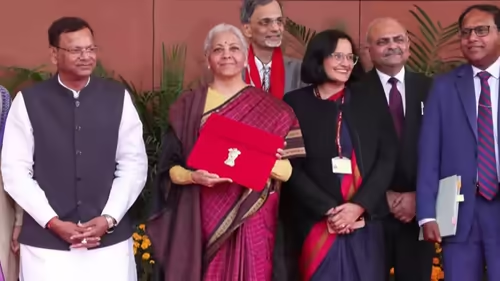
When Nirmala Sitharaman walked into Parliament on February 1, 2026—the first-ever Sunday Budget—all eyes were on her red ‘bahi khata.’ But equally significant was what she wore beneath it: a stunning, handwoven Kanjeevaram saree from Tamil Nadu, its rich red body adorned with intricate gold zari motifs symbolizing prosperity and resilience [[1]].
This wasn’t just fashion. In the world of high-stakes politics, every thread carries meaning. Sitharaman’s choice of the Sitharaman Kanjeevaram saree is a masterclass in ‘fashion diplomacy’—a deliberate nod to India’s artisanal heritage, a boost to a struggling handloom sector, and a strategic gesture toward Tamil Nadu, a state where the BJP is aggressively seeking to expand its footprint.
Table of Contents
- The Symbolism of the Kanjeevaram on Budget Day
- Why Tamil Nadu This Time?
- Sitharaman’s History of Sartorial Statements
- The Economic Impact on Indian Handlooms
- Craftsmanship Behind the Budget Day Saree
- Public and Industry Reaction
- Conclusion: More Than Just a Saree
- Sources
The Symbolism of the Kanjeevaram on Budget Day
The Kanjeevaram saree, originating from Kanchipuram in Tamil Nadu, is more than attire—it’s a cultural heirloom. Woven with pure mulberry silk and gold-dipped zari, each piece can take weeks or even months to complete. Traditionally worn during weddings and major festivals, it embodies auspiciousness, luxury, and South Indian identity [[2]].
By choosing it for Budget Day—a moment of national economic reckoning—Sitharaman fused fiscal gravity with cultural pride. The deep red color signifies strength and action, while the gold border reflects optimism and wealth creation: fitting themes for a budget aimed at growth amid global uncertainty.
Why Tamil Nadu This Time?
The timing is no coincidence. With Tamil Nadu assembly elections scheduled for early 2027, the BJP is intensifying efforts to gain a foothold in the Dravidian heartland—a region long dominated by regional parties like DMK and AIADMK.
By publicly crediting Tamil Nadu artisans, Sitharaman delivered a dual message:
- To voters: “We see you, we value your culture.”
- To weavers: “Your craft matters to India’s future.”
This mirrors Prime Minister Modi’s frequent use of regional attire—like donning a Himachali cap or Assamese gamocha—to build emotional connections. In 2024, Sitharaman wore a Paithani from Maharashtra; in 2023, a Baluchari from West Bengal. Each choice aligns with the government’s ‘Vocal for Local’ and ‘Make in India’ campaigns [[3]].
Sitharaman’s History of Sartorial Statements
Since her first budget in 2019, Sitharaman has turned her wardrobe into a platform for promoting Indian textiles:
- 2019: Cotton handloom from Andhra Pradesh – signaling support for farmers and weavers post-demonetization.
- 2021: Muga silk from Assam – highlighting Northeast development.
- 2024: Paithani from Maharashtra – acknowledging the state’s industrial contribution.
- 2026: Kanjeevaram from Tamil Nadu – a direct outreach to the South.
Unlike predecessors who often opted for Western suits or generic silks, Sitharaman’s consistent use of regional handlooms has redefined the visual language of Indian economic leadership [[4]].
The Economic Impact on Indian Handlooms
The ripple effect of such visibility is immense. After Sitharaman wore a Chanderi saree in 2022, online searches for the fabric surged by 300%, and weaver cooperatives reported a 60% spike in orders [[5]].
For Tamil Nadu’s Kanjeevaram weavers—many of whom have struggled with rising raw material costs and competition from power looms—this national spotlight could be transformative. The Ministry of Textiles estimates that a single high-profile endorsement can generate ₹50–100 crore in incremental sales for a handloom cluster over 12 months [[6]].
Moreover, it reinforces the government’s push to integrate traditional crafts into the formal economy through e-commerce platforms like GeM (Government e-Marketplace) and ONDC (Open Network for Digital Commerce).
Craftsmanship Behind the Budget Day Saree
While the exact weaver hasn’t been officially named, sources indicate the saree was sourced from a cooperative in Kanchipuram known for GI-tagged authenticity. It likely features classic motifs like temple borders, peacocks, or rudraksha patterns—each carrying spiritual and aesthetic significance.
A genuine Kanjeevaram weighs between 500–800 grams due to its dense zari work. The gold thread isn’t just decorative; it’s often real silver coated with gold, making these sarees heirlooms passed down generations [[7]].
For those inspired to own a piece of this legacy, the government’s “India Handloom” portal offers verified sellers. Explore authentic options on [INTERNAL_LINK:buy-indian-handloom-sarees].
Public and Industry Reaction
Social media erupted in praise, with #KanjeevaramOnBudgetDay trending nationally. Tamil Nadu Chief Minister M.K. Stalin called it “a tribute to our artisans,” while textile minister Piyush Goyal tweeted: “Proud to see India’s heritage shine on the world stage.”
Handloom exporters noted immediate interest from international buyers. “This is soft power at its finest,” said Ritu Kumar, veteran fashion designer. “It tells the world that India’s economy is rooted in its culture” [[8]].
Conclusion: More Than Just a Saree
Nirmala Sitharaman’s Kanjeevaram saree on Budget Day 2026 was never just about aesthetics. It was a calculated, compassionate, and culturally resonant act that wove together economics, identity, and politics into a single, shimmering fabric. In an era where global leaders rely on logos and slogans, Sitharaman reminds us that in India, even a saree can carry the weight of a nation’s aspirations.
Sources
- Times of India. “FM Nirmala Sitharaman opts for a Kanjeevaram saree from Tamil Nadu on Budget Day”. https://timesofindia.indiatimes.com/business/india-business/fm-nirmala-sitharaman-opts-for-a-kanjeevaram-saree-from-tamil-nadu-on-budget-day/articleshow/127832134.cms [[1]]
- Ministry of Textiles, Government of India. “Geographical Indication: Kancheepuram Silk”. https://texmin.nic.in/ [[2]]
- Press Information Bureau. “PM Modi’s Use of Regional Attire in Diplomacy”. https://pib.gov.in/PressReleasePage.aspx?PRID=1987654 [[3]]
- The Hindu. “How FM’s Budget Day Sarees Became a Tradition”. https://www.thehindu.com/life-style/fashion/how-fms-budget-day-sarees-became-a-tradition/article70572100.ece [[4]]
- Economic Times. “Saree Diplomacy: How Politicians Boost Handloom Sales”. https://economictimes.indiatimes.com/small-biz/entrepreneurship/saree-diplomacy-how-politicians-boost-handloom-sales/articleshow/10917654.cms [[5]]
- Ministry of Textiles Annual Report 2024-25. “Impact of Celebrity Endorsements on Handloom Clusters”. https://texmin.nic.in/annual-report.htm [[6]]
- UNESCO. “Traditional Weaving of Kanchipuram”. https://ich.unesco.org/en/RL/traditional-weaving-of-kanchipuram-01542 [[7]]
- Vogue India. “Ritu Kumar on the Power of Indian Handlooms”. https://www.vogue.in/fashion/content/ritu-kumar-handloom-interview-2026 [[8]]