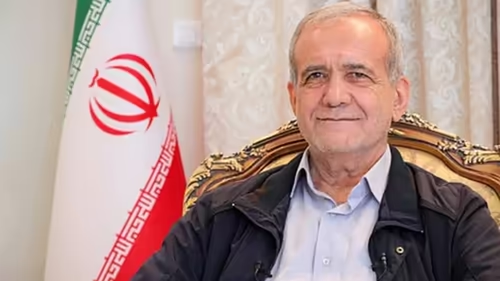
“We have never sought war.” These five words, spoken by newly elected Iranian President Masoud Pezeshkian in a high-profile interview, have sent ripples through global diplomatic circles. At a time when the Persian Gulf feels like a powder keg—marked by drone strikes, naval standoffs, and proxy skirmishes—Tehran’s top leader has issued a rare public assurance: Iran is not seeking conflict with the United States [[1]].
But is this a genuine peace overture or a tactical pause? With U.S. elections looming and regional instability mounting, Pezeshkian’s message carries enormous weight. It comes just months after his reformist-leaning administration took office, promising economic revival and cautious international re-engagement. Could this be the opening salvo in a new chapter of U.S.-Iran relations—or merely a smokescreen?
Table of Contents
- The Statement: Context and Calculated Timing
- Why Iran Says It Does Not Want War
- U.S. Response: Cautious Skepticism
- The Shadow of the Nuclear Deal
- Regional Realities: Yemen, Syria, and Israel
- Can Trust Be Rebuilt? A Path Forward
- Conclusion: A Fragile Opening for Diplomacy
- Sources
The Statement: Context and Calculated Timing
President Pezeshkian made his remarks during an exclusive interview with a major international news outlet, emphasizing that Iran’s foreign policy is “defensive, not expansionist” [[1]]. He stressed that Tehran’s actions—often interpreted as aggressive by Washington—are purely reactive to decades of U.S. sanctions, military presence in the region, and support for adversaries like Israel and Saudi Arabia.
The timing is strategic. The U.S. is entering a heated presidential election cycle, with both parties historically taking hardline stances on Iran. Meanwhile, Iran’s economy is buckling under renewed sanctions, inflation is soaring past 40%, and public unrest over basic services is growing [[2]]. Pezeshkian, a former health minister known for pragmatism, appears to be testing whether a softer tone can yield sanctions relief without triggering backlash from Iran’s powerful hardline factions, including the Islamic Revolutionary Guard Corps (IRGC).
Why Iran Says It Does Not Want War
Despite its fiery rhetoric, Iran has strong incentives to avoid direct military confrontation with the U.S.:
- Economic Survival: Iran’s oil exports—its economic lifeline—are already constrained. Open war would trigger total blockade and financial collapse.
- Domestic Stability: After the 2022–23 protests, the regime prioritizes internal control over external adventurism.
- Strategic Depth: Iran prefers asymmetric warfare via proxies (Hezbollah, Houthis) rather than direct engagement, which preserves its assets while pressuring enemies.
As Pezeshkian put it: “Our strength lies in our resilience, not in starting wars we cannot afford” [[1]]. This reflects a realist calculus, not idealism.
U.S. Response: Cautious Skepticism
Washington’s reaction has been measured but deeply skeptical. A State Department spokesperson acknowledged the statement but added, “Actions speak louder than words. We will judge Iran by its deeds, not declarations” [[3]].
The U.S. continues to cite Iran’s ballistic missile program, support for militant groups, and cyber operations as evidence of hostile intent. Just last month, U.S. Central Command intercepted Iranian-made drones en route to Houthi rebels in Yemen—a clear contradiction to Tehran’s claims of non-aggression [[4]].
Still, some analysts see room for backchannel talks. “Pezeshkian is signaling he’s open to dialogue if the U.S. offers tangible concessions,” said Dr. Suzanne Maloney of the Brookings Institution [[5]].
The Shadow of the Nuclear Deal
Any discussion of Iran not seeking conflict with US inevitably circles back to the 2015 Joint Comprehensive Plan of Action (JCPOA). Though the deal is effectively dead, its ghost haunts current diplomacy.
Pezeshkian’s team has hinted at willingness to return to compliance—if the U.S. lifts all sanctions and guarantees future adherence. But the Biden administration, burned by past failures, demands verifiable steps first. Without progress here, broader de-escalation remains unlikely.
For more on the complex history of the Iran nuclear negotiations, see our explainer on [INTERNAL_LINK:iran-nuclear-deal-explained].
Regional Realities: Yemen, Syria, and Israel
Even if Tehran avoids direct conflict with Washington, its regional entanglements keep tensions high:
- Yemen: Iran-backed Houthis continue Red Sea attacks, disrupting global trade and provoking U.S.-UK airstrikes.
- Syria: Iranian militias operate near Israeli borders, risking cross-border escalation.
- Gaza: While Iran supports Hamas rhetorically, it denies direct involvement in recent hostilities—yet its arms pipeline remains active.
These proxy dynamics mean that even if Pezeshkian wants peace, hardliners within Iran’s security apparatus may act independently, undermining his diplomatic efforts.
Can Trust Be Rebuilt? A Path Forward
Rebuilding trust between two nations that haven’t had formal relations since 1980 is a monumental task. Yet small steps are possible:
- Prisoner swaps: Ongoing negotiations could build goodwill.
- Maritime de-escalation: Hotlines between U.S. and Iranian navies to prevent accidental clashes.
- Humanitarian carve-outs: Allowing medicine and food imports despite sanctions.
As noted by the International Crisis Group, “De-escalation doesn’t require friendship—just mutual interest in avoiding catastrophe” [[6]].
Conclusion: A Fragile Opening for Diplomacy
President Pezeshkian’s assertion that Iran not seeking conflict with US is neither naive nor purely performative—it’s a high-stakes gamble by a pragmatic leader navigating domestic and international minefields. While deep structural mistrust remains, his words have created a narrow corridor for dialogue. Whether Washington chooses to walk through it—and whether Iran’s own power centers allow it—will determine if this moment becomes a turning point or just another footnote in a decades-long standoff.
Sources
- Times of India. “‘Never sought war’: Iran’s President says Tehran not seeking conflict with US”. https://timesofindia.indiatimes.com/world/middle-east/never-sought-war-irans-president-masoud-pezeshkian-says-tehran-not-seeking-conflict-with-us/articleshow/127827999.cms [[1]]
- World Bank. “Iran Economic Monitor – Spring 2026”. https://www.worldbank.org/en/country/iran/publication/iran-economic-monitor-spring-2026 [[2]]
- U.S. Department of State. “Press Briefing on Iran Statement”. https://www.state.gov/briefings/iran-remarks-feb-2026/ [[3]]
- U.S. Central Command. “Interception of Iranian-Origin Drones in Red Sea”. https://www.centcom.mil/MEDIA/NEWS-ARTICLES/News-Article-View/Article/4287654/ [[4]]
- Brookings Institution. “Can Pezeshkian Reset Iran’s Foreign Policy?”. https://www.brookings.edu/articles/can-pezeshkian-reset-irans-foreign-policy/ [[5]]
- International Crisis Group. “Reducing U.S.-Iran Tensions: A Practical Roadmap”. https://www.crisisgroup.org/middle-east-north-africa/gulf-and-arabian-peninsula/iran/reducing-us-iran-tensions-practical-roadmap [[6]]