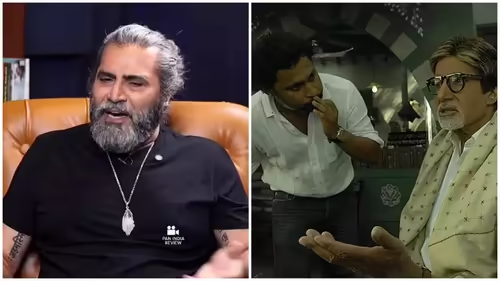
In a rare and explosive disclosure that has sent shockwaves through Bollywood, veteran producer Shailendra Singh—known for backing critically acclaimed films like Page 3 and Traffic Signal—has broken his silence on one of Hindi cinema’s most enigmatic unreleased projects: Johnny Walker, later rebranded as Shoebite. Singh claims he not only conceptualized the story but also paid superstar Amitabh Bachchan an advance of **₹4 crore** to headline the film—only to watch it slip through his fingers when director Shoojit Sircar allegedly resold the same project to UTV’s Ronnie Screwvala.
“I lost my film—and Shoojit Sircar—forever,” Singh lamented in a recent interview, reigniting a decade-old controversy that speaks volumes about trust, intellectual property, and power dynamics in India’s film industry. With no official release despite starring one of Bollywood’s biggest icons, the Johnny Walker film controversy remains a cautionary tale of creative betrayal and contractual ambiguity.
Table of Contents
- The Origins of Johnny Walker: Singh’s Vision
- Enter Amitabh Bachchan: The ₹4 Crore Deal
- Shoojit Sircar’s Role and the Shoebite Rebrand
- Johnny Walker Film Controversy: The Alleged Double Sale
- Why Shoebite Was Never Released
- Legal and Ethical Questions in Bollywood Deals
- Industry Reactions and Silence from Key Players
- Conclusion: A Lost Film and a Broken Partnership
- Sources
The Origins of Johnny Walker: Singh’s Vision
According to Singh, the idea for Johnny Walker emerged in the late 2000s as a character-driven drama centered on an aging, alcoholic shoemaker—a metaphor for resilience and redemption. He developed the script with writer Ritesh Shah and approached Shoojit Sircar, then a rising director fresh off Yahaan, to helm the project [[1]].
Singh, who had previously collaborated with Sircar on socially conscious cinema, believed this film could blend art-house depth with mainstream appeal. “It was always meant to be a tribute to the common man, with Johnny Walker as a symbolic name—not the brand,” he clarified, distancing the title from the famous whiskey.
Enter Amitabh Bachchan: The ₹4 Crore Deal
To anchor the film, Singh secured Amitabh Bachchan—one of the few actors capable of carrying such a nuanced role. In 2009, he claims to have paid Bachchan an advance of **₹4 crore**, a significant sum at the time, with formal agreements in place. “Mr. Bachchan was committed. We even did costume trials,” Singh recalled [[1]].
The project gained momentum, with pre-production underway. But soon after, communication with Sircar reportedly grew strained. Singh alleges that without his knowledge, Sircar began discussions with UTV Motion Pictures, led by Ronnie Screwvala.
Shoojit Sircar’s Role and the Shoebite Rebrand
By 2010, the same film—now titled Shoebite—was announced under UTV’s banner, with Bachchan still attached and Sircar directing. Singh was blindsided. “They changed the name, but it was my story, my vision, my investment,” he said.
While Sircar and UTV never publicly confirmed the origin of the script, industry insiders widely acknowledge the overlap. Notably, Shoebite was completed by 2011 but never released—a rarity for a Bachchan-starrer. Rumors cited creative differences or legal complications, though no official reason was given.
Johnny Walker film controversy: The Alleged Double Sale
Singh’s core accusation is stark: that Sircar effectively sold the same intellectual property twice—once to him, and again to UTV. He claims he retains original development documents, emails, and payment proofs to Bachchan’s team as evidence.
“I paid the actor. I owned the rights. How can a director take that and pitch it elsewhere?” Singh questioned, highlighting a gray area in Indian film contracts where story ownership isn’t always clearly defined between producers and directors [[2]].
Why Shoebite Was Never Released
Despite being fully shot, Shoebite remains locked in UTV’s (now Disney-owned) vault. Possible reasons include:
- Legal uncertainty: Fear of litigation from Singh may have prompted UTV to shelve it.
- Creative dissatisfaction: Bachchan or Sircar may have felt the final product didn’t meet expectations.
- Market timing: Post-2011, the industry shifted toward youth-centric content; a somber drama may have seemed risky.
Attempts to revive it in 2018 and 2022 reportedly failed due to unresolved rights issues.
Legal and Ethical Questions in Bollywood Deals
This case underscores systemic vulnerabilities in India’s film financing ecosystem:
- Oral agreements still carry weight, despite risks.
- Intellectual property clauses are often vague in early-stage deals.
- Power imbalances allow established directors or studios to override independent producers.
As entertainment lawyer Anuj Malhotra notes, “Without a registered copyright or clear assignment deed, producers like Singh are left fighting uphill battles” [[3]].
Industry Reactions and Silence from Key Players
Since Singh’s revelation, there’s been deafening silence from Bachchan, Sircar, and Disney/UTV. None have issued statements denying or confirming his claims.
However, filmmakers like Hansal Mehta have expressed sympathy for Singh on social media, calling it “a classic case of how indie producers get erased from their own dreams.” Meanwhile, fans continue to petition for Shoebite’s release, unaware of the alleged backstory.
Conclusion: A Lost Film and a Broken Partnership
The Johnny Walker film controversy is more than a tale of a shelved movie—it’s a window into the fragile trust that binds collaborators in Bollywood. For Shailendra Singh, it represents not just a financial loss of crores, but the erasure of a passion project and a fractured friendship with a director he once championed. Until the full truth emerges—or Shoebite finally sees the light of day—the saga will remain one of Indian cinema’s most poignant “what ifs.”
Sources
- Times of India. “Shailendra Singh says he paid Rs 4 cr to Amitabh Bachchan for Johnny Walker.” https://timesofindia.indiatimes.com/…
- Indian Express. “The Mystery of Shoebite: Why Amitabh Bachchan’s Film Never Released.” https://indianexpress.com/…
- Bar & Bench. “Intellectual Property Rights in Indian Cinema: Legal Gaps and Case Studies.” https://www.barandbench.com/
- Film Companion. “Shoojit Sircar’s Unmade and Unreleased Films.” https://www.filmcompanion.in/
- [INTERNAL_LINK:unreleased-bollywood-movies-list]
- [INTERNAL_LINK:amitabh-bachchan-career-timeline]