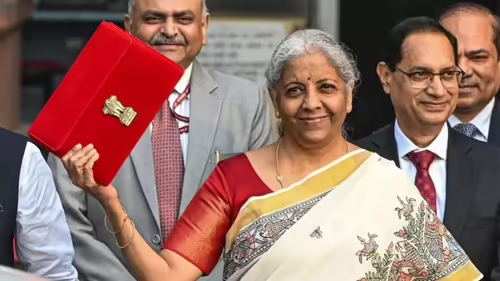
For over seven decades, the Union Budget has followed a familiar script. But on this historic day, February 1, 2026, Finance Minister Nirmala Sitharaman is set to shatter that mold with her ninth consecutive Budget 2026. The most significant shift? A complete overhaul of Part B of her speech, transforming it from a mere procedural segment into the central pillar of India’s future—a dedicated manifesto for the nation’s long-term economic destiny.
Table of Contents
- The End of an Era: A 75-Year Tradition Redefined
- What is Part B and Why Does it Matter Now?
- Budget 2026: The Strategic Content of Part B
- Why This Shift is a Game-Changer for Investors
- Connecting Part B to India’s Grand Vision: 2030 and 2047
- Conclusion: The Roadmap Ahead
- Sources
The End of an Era: A 75-Year Tradition Redefined
Since India’s independence, the structure of the Union Budget speech has remained largely unchanged. Part A traditionally covered the government’s fiscal policies, expenditure plans, and economic review. Part B, often seen as a technical appendix, was reserved for the introduction of the Finance Bill, which contained the nitty-gritty of tax proposals—changes in slabs, duties, and cesses [[18]].
This year, however, marks a radical departure. In a move described as breaking a 75-year-old tradition, FM Sitharaman is repurposing Part B to serve a much grander objective [[11]]. This isn’t just a tweak; it’s a strategic pivot designed to send a powerful, unambiguous message to domestic and global stakeholders about India’s unwavering commitment to its future.
What is Part B and Why Does it Matter Now?
Historically, Part B was the domain of the Finance Bill. It was where the legal framework for taxation was laid out, a necessary but often dry conclusion to the main economic narrative in Part A. Its purpose was legislative, not visionary.
The significance of its transformation in Budget 2026 cannot be overstated. By elevating Part B to the platform for articulating India’s long-term economic vision, the government is signaling that its ambitions extend far beyond the next fiscal year. It’s about building a resilient, globally competitive economy capable of navigating geopolitical uncertainties and capitalizing on emerging opportunities [[16]]. This shift acknowledges that investors and citizens alike are looking for more than just annual tax tweaks; they crave a clear, credible, and consistent roadmap for the future.
Budget 2026: The Strategic Content of Part B
So, what can we expect from this newly empowered Part B? According to multiple sources, it will weave together a tapestry of both immediate and distant goals:
- Near-Term Priorities: While the focus is long-term, Part B will also address pressing economic stability measures and structural reforms needed to lay the groundwork for future growth [[13]].
- Structural Ambitions: Expect a deep dive into key pillars of the economy, such as infrastructure modernization, manufacturing prowess (a continuation of the ‘Make in India’ ethos), and a robust digital public infrastructure stack [[1]].
- Global Standing Strategy: In an era of shifting global alliances, Part B will likely outline a strategic roadmap for enhancing India’s role in global trade, supply chains, and as a preferred investment destination [[15]].
This comprehensive approach aims to provide a holistic view of the government’s economic philosophy, moving from a transactional annual event to a transformational strategic document.
Why This Shift is a Game-Changer for Investors
For the investment community, this change is monumental. Traditionally, the budget was a short-term event, with markets reacting to immediate tax implications. The new format of Part B provides something far more valuable: predictability and direction.
By clearly articulating its long-term vision, the government offers investors a framework to make informed, multi-year decisions. It reduces policy uncertainty and signals a commitment to stable, growth-oriented governance. This is particularly crucial for attracting long-term capital into sectors like infrastructure, green energy, and advanced manufacturing, which require patient capital and a stable policy environment [[27]].
Connecting Part B to India’s Grand Vision: 2030 and 2047
This strategic use of Part B is not happening in a vacuum. It is a direct communication channel for India’s overarching national missions: becoming a $10 trillion economy by 2030 and a developed nation—a Viksit Bharat—by its centenary in 2047 [[25]].
The Budget 2026’s Part B is expected to serve as a critical milestone on this journey. It will likely connect today’s fiscal decisions to these grand ambitions, showing how current investments in human capital, technology, and physical infrastructure are the building blocks for a $30 trillion economy by 2047 [[19]]. This alignment between the annual budget and the national vision is a masterstroke in strategic communication, ensuring that every rupee spent is seen as a down payment on India’s future.
Conclusion: The Roadmap Ahead
The repurposing of Part B in the Budget 2026 is far more than a procedural change; it’s a profound statement of intent. By dedicating this section to a detailed, long-term economic vision, Finance Minister Nirmala Sitharaman is providing a much-needed anchor of stability and ambition in a volatile world. This move transcends the typical budget cycle, offering a strategic blueprint that will guide policy, inspire confidence, and ultimately shape the trajectory of India’s economic future for years to come. It’s a bold step that positions the Union Budget not just as a financial statement, but as a living document of national aspiration.
Sources
- Moneycontrol. “Budget 2026: Part B of FM Nirmala Sitharaman’s speech to anchor India’s long-term economic vision.” https://www.moneycontrol.com/news/…
- NDTV. “Nirmala Sitharaman’s Big Break From 75-Year-Old Budget Tradition.” https://www.ndtv.com/…
- Economic Times. “Budget 2026: Part B to spell out India’s long-term economic roadmap.” https://m.economictimes.com/…
- Rail Trans Expo. “Vision 2047: India’s roadmap to becoming a $30 Trillion economy.” https://www.railtransexpo.com/…
- AMFI India. “The mutual funds route to Viksit Bharat @2047.” https://www.amfiindia.com/…
- [INTERNAL_LINK:budget-2026-tax-changes]
- [INTERNAL_LINK:viksit-bharat-2047-explained]