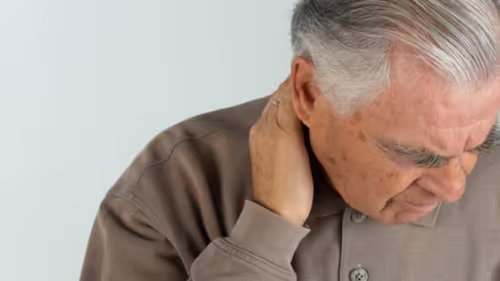
Imagine your neck muscles twisting against your will, causing relentless, searing pain that makes even the simplest act—like looking someone in the eye—feel like an impossible feat. For years, this was the daily reality for an octogenarian battling cervical dystonia, a cruel neurological disorder.
But then, everything changed. In a state-of-the-art operating room in Gurugram, a team of neurosurgeons performed a groundbreaking procedure: Deep Brain Stimulation surgery. Often dubbed a ‘brain pacemaker,’ this intervention didn’t just offer hope; it delivered near-miraculous relief within days, restoring his quality of life and silencing the chronic pain that had defined his existence [[1]].
His story is not just one of personal triumph; it’s a powerful testament to the incredible potential of modern neuroscience. But what exactly is this procedure? Who is it for? And what are the real risks and rewards?
Table of Contents
- What is Cervical Dystonia? The Invisible Torment
- The Last Resort: Deep Brain Stimulation Surgery
- How DBS Works: A Step-by-Step Journey Inside the Brain
- Is DBS Right for You? Success Rates and Considerations
- Conclusion: A New Chapter for Neurological Care
- Sources
What is Cervical Dystonia? The Invisible Torment
Cervical dystonia, also known as spasmodic torticollis, is a focal dystonia characterized by involuntary muscle contractions in the neck [[23]]. These contractions can force the head to twist or turn to one side, tilt forward or backward, or even tremble uncontrollably [[26]]. The result is often severe, chronic pain, stiffness, and profound social and physical disability [[21]].
Standard treatments typically start with botulinum toxin (Botox) injections, which can provide temporary relief by paralyzing the overactive muscles [[25]]. However, for many patients, especially those with more severe or generalized forms of the disorder, these injections become less effective over time, leaving them with few options [[27]]. This is where advanced interventions like Deep Brain Stimulation surgery enter the picture.
The Last Resort: Deep Brain Stimulation Surgery
For decades, patients with treatment-resistant movement disorders faced a bleak future. Deep Brain Stimulation surgery has emerged as a revolutionary, albeit complex, solution. It’s not a cure, but a highly effective management tool that can dramatically improve symptoms and quality of life [[18]].
The core idea is elegant in its simplicity: by delivering precisely controlled electrical pulses to specific, deep-seated areas of the brain that are malfunctioning, DBS can effectively ‘reset’ the faulty neural circuits responsible for the involuntary movements [[13]]. Think of it as a sophisticated pacemaker, but for the brain’s motor control system instead of the heart.
How DBS Works: A Step-by-Step Journey Inside the Brain
The procedure is a marvel of modern neurosurgery and involves two main stages, often performed on the same day or over two consecutive days [[12]].
- Electrode Implantation: Using advanced imaging (like MRI) and a rigid frame to keep the patient’s head perfectly still, surgeons drill small holes in the skull. They then insert thin, insulated wires (electrodes) into the exact target area of the brain—most commonly the Globus Pallidus internus (GPi) for dystonia [[14]].
- Neurostimulator Implantation: In the second stage, a battery-powered device called a neurostimulator (or implantable pulse generator) is surgically placed under the skin near the collarbone or in the abdomen, much like a heart pacemaker [[17]].
- Connection and Activation: The electrodes in the brain are connected to the neurostimulator via extension wires tunneled under the skin. After a short healing period, a neurologist programs the device to deliver the optimal level of electrical stimulation for the patient’s specific needs [[20]].
Is DBS Right for You? Success Rates and Considerations
While the results can be life-changing, DBS is a major surgical procedure with inherent risks, including infection, bleeding in the brain, and hardware complications. It’s typically reserved for patients who have not responded adequately to conventional medical therapies [[27]].
The good news for dystonia patients is that the success rates are promising. Studies show that patients with primary cervical dystonia can experience up to an 80% improvement in their symptoms within six months of the surgery [[4]]. In India, the overall success rate for DBS is reported to be around 85%, thanks to highly skilled neurosurgeons and well-equipped institutions [[1]].
It’s crucial to understand that DBS is not a one-size-fits-all solution. A thorough evaluation by a multidisciplinary team of neurologists, neurosurgeons, and psychiatrists is essential to determine if a patient is a suitable candidate. Factors like the type of dystonia, age, and overall health play a significant role in the decision-making process [[16]].
Conclusion: A New Chapter for Neurological Care
The story of the retiree in Gurugram is a beacon of hope for countless others suffering from debilitating movement disorders. Deep Brain Stimulation surgery represents the cutting edge of neurological care, offering a powerful tool to reclaim a life stolen by disease. While it’s not without its challenges and is certainly not a first-line treatment, its ability to provide profound and lasting relief makes it a vital option in the modern medical arsenal. For those who qualify, it can be the key to unlocking a future free from the prison of involuntary movement and chronic pain. To learn more about other neurological treatments, see our guide on [INTERNAL_LINK:advanced-neurological-therapies].
Sources
- Times of India: Octogenarian reclaims health after battling cervical dystonia and undergoing brain pacemaker surgery
- MedSurge India: Success Rate Of Deep Brain Stimulation In India [[1]]
- National Organization for Rare Disorders (NORD): Cervical Dystonia [[23]]
- Pacific Neuroscience Institute: What is Cervical Dystonia? [[21]]
- Dr. Chirag Solanki: Step-By-Step Process Of Deep Brain Stimulation Surgery [[12]]
- PMC Journal: Surgical Management for Dystonia: Efficacy of Deep Brain Stimulation [[4]]
- Johns Hopkins Medicine: Deep Brain Stimulation [[18]]