Table of Contents
- The Stage Was Set for War
- Sachin’s Heroic (and Heartbreaking) 136
- The ‘Chennai Standing Ovation Pakistan’ Moment
- Why This Act of Sportsmanship Still Matters
- Conclusion: A Legacy of Respect
- Sources
Cricket between India and Pakistan is rarely just a game. It’s a high-stakes drama, a proxy for decades of political tension, and a source of immense national pride. So, when the two teams faced off in the first Test of the 1999 series at the iconic M.A. Chidambaram Stadium in Chennai, everyone expected fireworks—and perhaps even hostility.
What happened next, however, was not just unexpected; it was extraordinary. In a moment that has since become legendary, the Chennai crowd did the unthinkable. They gave the victorious Pakistani team a standing ovation. This singular act of grace, coming on the heels of a devastating loss, remains one of the purest displays of sportsmanship in the history of the sport.
The Stage Was Set for War
The year was 1999. The Kargil War had just ended a few months prior, and the air between the two nuclear-armed neighbors was thick with suspicion and animosity. Extremist groups in India had even issued threats against the Pakistani team’s tour [[12]]. The atmosphere at Chepauk was electric, but it was also fraught with an undercurrent of tension that could have erupted at any moment.
Against this backdrop, the cricket itself was intense. Pakistan, led by the mercurial Mohammad Azharuddin, posted a competitive total. India’s response was shaky, leaving them with a daunting target in the final innings. The stage was set for a hero—or a heartbreak.
Sachin’s Heroic (and Heartbreaking) 136
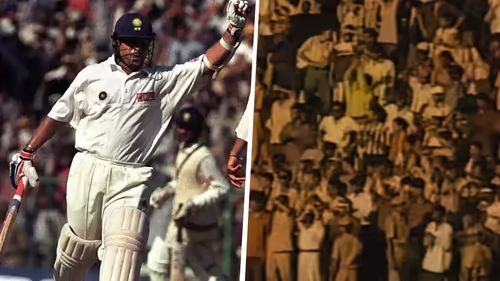
That hero was, of course, Sachin Tendulkar. But his heroism came at a tremendous personal cost. Battling a severe back injury that would later be confirmed as a pulled muscle in his lower back [[15]], Tendulkar walked out to bat with the weight of a nation on his shoulders [[17]].
For over seven grueling hours, he defied pain, a potent Pakistani bowling attack, and the mounting pressure. He batted with ice packs and painkillers, crafting a masterful 136 that was as courageous as it was brilliant [[14]]. His innings is still remembered as one of the greatest knocks in Test cricket history, a display of sheer willpower that almost single-handedly dragged India to victory.
Tragically, his dismissal—caught behind off Saqlain Mushtaq—proved to be the turning point. India collapsed soon after, falling short by a mere 12 runs. The heartbreak was palpable; reports even say Tendulkar was seen weeping in the dressing room, feeling he had let his team down [[6]].
The ‘Chennai Standing Ovation Pakistan’ Moment
This is where the story transcends the boundary ropes. In most stadiums around the world, a loss of this magnitude to a rival would have been met with silence, boos, or even anger. But Chennai, known for its deep love of the game, chose a different path.
As the Pakistani players, stunned by their narrow victory, began a tentative lap of honour, something remarkable happened. The crowd, which had been silent in their grief, rose to its feet. One by one, then in waves, they began to applaud. It was a spontaneous, thunderous, and deeply respectful Chennai standing ovation Pakistan that echoed through the stands [[1]].
The Pakistani players were visibly moved. Captain Wasim Akram later expressed his profound gratitude, acknowledging the incredible grace shown by the Indian fans. This moment wasn’t just about applauding a good performance; it was about respecting the spirit of competition itself, even in defeat [[12]].
Why This Act of Sportsmanship Still Matters
Over two decades later, this moment remains a powerful beacon. In an era of online toxicity and hyper-nationalism, the Chennai crowd’s actions serve as a timeless reminder of what sport can truly be: a unifying force that celebrates excellence, regardless of the jersey.
Here’s why this event is so significant:
- It defied politics: At a time of heightened political tension, the fans chose sport over statecraft.
- It honored true grit: They recognized the collective effort of the Pakistani team, who had fought just as hard to win.
- It set a global standard: This moment is often cited by international bodies and fans as the gold standard for fan behavior in sport [[3]].
For anyone who believes that the India-Pakistan rivalry is only about hatred, the 1999 Chennai Test is the ultimate counter-narrative. It’s a story you can share with fellow fans on [INTERNAL_LINK:india-pakistan-cricket-rivalry-history] to remind them of the beautiful side of this intense contest.
Conclusion: A Legacy of Respect
The 1999 Chennai Test is remembered for Sachin Tendulkar’s valiant, injury-plagued 136. But its true legacy lies in the final, unforgettable scene: a sea of Indian fans, their hearts broken, choosing to stand and applaud their rivals. This Chennai standing ovation Pakistan moment is more than just a piece of cricket trivia; it’s a permanent lesson in humility, respect, and the enduring power of the human spirit within the arena of sport. It’s a victory not just for Pakistan, but for the game of cricket itself.
Sources
- ESPNcricinfo. “Chennai applauds Pakistan.” https://www.espncricinfo.com/story/chennai-applauds-pakistan-410452
- Times of India. “‘I have lost this match…’: When Sachin Tendulkar was ‘weeping like a school boy’ after India lost to Pakistan.” https://timesofindia.indiatimes.com/sports/cricket/news/i-have-lost-this-match-when-sachin-tendulkar-was-weeping-like-a-school-boy-after-india-lost-to-pakistan/articleshow/113901813.cms
- PCB. “1999 Chennai Test voted by fans as Pakistan’s greatest Test.” https://www.pcb.com.pk/press-release-detail/1999-chennai-test-voted-by-fans-as-pakistan-s-greatest-test.html
- ESPNCricinfo. “Tendulkar injury the concern for India (4 February 1999).” https://www.espncricinfo.com/story/tendulkar-injury-the-concern-for-india-4-february-1999-79455
- Times of India. “Sixth sense helped Sachin Tendulkar battle injuries.” https://timesofindia.indiatimes.com/bharat-ratna-sachin-tendulkar/top-stories/sixth-sense-helped-sachin-tendulkar-battle-injuries/articleshow/12312246.cms