Table of Contents
- A New Chapter in Maharashtra’s Political Drama
- Sunetra Pawar Maharashtra Deputy CM: The Swearing-In and the Scope
- A Long Tradition of Political Widows in India
- Notable Wives Who Carried the Torch
- Why This Pattern Persists in Indian Politics
- Challenges Ahead for Sunetra Pawar
- Conclusion: More Than a Symbolic Succession
- Sources
A New Chapter in Maharashtra’s Political Drama
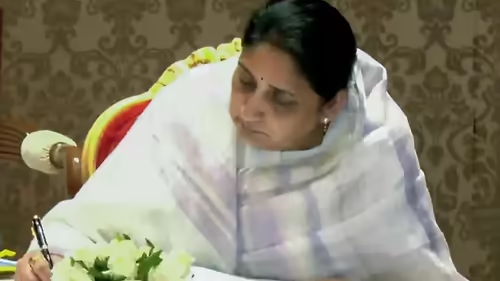
In a move that blends personal tragedy with high-stakes political strategy, Sunetra Pawar has officially taken the oath as Maharashtra’s Deputy Chief Minister. Her appointment comes just three days after the sudden and shocking death of her husband, Ajit Pawar, in a private plane crash—a loss that sent tremors through the state’s power corridors [[1]].
But this isn’t just about filling a vacancy. It’s about legacy, loyalty, and the enduring influence of political dynasties in India. By stepping into her husband’s shoes (minus the finance portfolio), Sunetra Pawar joins an exclusive—and often scrutinized—club of women who’ve inherited their spouses’ political mantles to keep family empires intact.
Sunetra Pawar Maharashtra Deputy CM: The Swearing-In and the Scope
On January 30, 2026, Sunetra Pawar was unanimously elected leader of the NCP (Ajit Pawar faction) legislative party—a swift and decisive internal move that paved the way for her historic swearing-in [[2]]. While she assumes most of her late husband’s responsibilities, the critical Finance Ministry has been kept separate, likely to allow her time to acclimate to executive governance [[3]].
This strategic decision reflects both pragmatism and sensitivity. As a former Rajya Sabha MP with deep roots in Baramati—the Pawar family stronghold—Sunetra is no political novice. Yet transitioning from behind-the-scenes influence to front-line administration is a monumental leap, especially under the weight of public grief and expectation.
A Long Tradition of Political Widows in India
Sunetra Pawar’s ascension didn’t happen in a vacuum. Across India’s political history, the “widow’s succession” has been a recurring theme—often serving as a bridge between generations or a stabilizing force during crises. These women are rarely mere placeholders; many evolve into formidable leaders in their own right.
The phenomenon speaks to a complex mix of voter sentiment, party machinery, and cultural narratives that view the widow as the rightful guardian of her husband’s vision. For deeper context on gender and power in South Asian politics, see this analysis from Brookings Institution [[8]].
Notable Wives Who Carried the Torch
Here are some of the most prominent examples of women who stepped into politics after their husbands’ deaths:
- Indira Gandhi: Though not a direct “widow successor” in the typical sense, she entered politics after Jawaharlal Nehru’s death and later became Prime Minister—ushering in one of India’s most consequential political eras.
- Jayalalithaa (AIADMK): Took over M.G. Ramachandran’s party after his death in 1987 and went on to become Tamil Nadu’s longest-serving female CM.
- Rabri Devi (RJD): Became Bihar’s Chief Minister in 1997 after Lalu Prasad Yadav was forced to resign due to legal issues—effectively continuing his political project.
- Vasundhara Raje (BJP): Entered politics after her husband’s death and rose to become Rajasthan’s first woman CM.
- Sonia Gandhi (INC): Though initially reluctant, she took over the Congress party after Rajiv Gandhi’s assassination and led it to two national election victories.
Each of these women transformed personal loss into political capital—but not without immense scrutiny and struggle.
Why This Pattern Persists in Indian Politics
Several factors explain why parties repeatedly turn to widows:
- Name Recognition & Voter Sympathy: The deceased leader’s name still carries emotional weight. Voters often transfer their loyalty to the spouse as a mark of respect.
- Party Stability: Appointing a family member prevents internal factionalism and maintains control over key constituencies.
- Cultural Expectations: In many communities, the wife is seen as the natural custodian of her husband’s legacy and unfinished work.
- Lack of Institutionalized Succession: Many regional parties remain personality-driven rather than ideology-driven, making dynastic continuity the default path.
While critics call it anti-democratic, supporters argue it provides continuity during turbulent times—especially when the alternative is chaos or fragmentation.
Challenges Ahead for Sunetra Pawar
Sunetra Pawar now faces a steep learning curve. She must:
- Navigate coalition dynamics with BJP and Shiv Sena factions;
- Prove her administrative competence beyond symbolic representation;
- Manage expectations in Baramati, where the Pawar name is almost sacrosanct;
- Carve out her own identity while honoring her husband’s legacy.
Her success—or stumble—will not only shape Maharashtra’s immediate future but also influence how political parties view widow succession in the years to come. For more on Maharashtra’s evolving political landscape, check out our feature on [INTERNAL_LINK:maharashtra-coalition-politics].
Conclusion: More Than a Symbolic Succession
Sunetra Pawar’s appointment as Sunetra Pawar Maharashtra Deputy CM is far more than a ceremonial gesture. It’s a calculated political maneuver rooted in decades of precedent. While she steps into office draped in mourning, her real test begins now: can she govern effectively, command respect from allies and opponents alike, and ensure that “Ajit Dada amar rahe” isn’t just a slogan—but a living legacy she actively builds upon? Only time—and her actions—will tell.
Sources
- Times of India: Sunetra Pawar is new Maha dy CM: Wives who inherited husbands’ political legacy [[1], [2]]
- India Today: Sunetra Pawar takes oath as Maharashtra Deputy CM [[3]]
- The Hindu: Sunetra Pawar sworn in as first woman Deputy CM of Maharashtra
- Brookings Institution: Women in Indian Politics: Status, Challenges, and Opportunities [[8]]