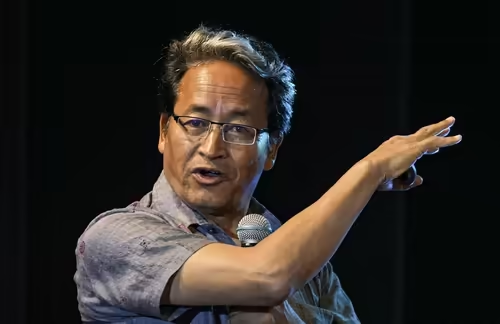
The health of renowned climate activist and education reformer Sonam Wangchuk has become a focal point of national concern after he was taken from Jodhpur Central Jail to AIIMS Jodhpur for an urgent medical examination. This move comes on the heels of a direct order from the Supreme Court of India, which is currently reviewing the controversial grounds of his detention under the National Security Act (NSA) [[1]].
Wangchuk, who has been a vocal advocate for Ladakh’s statehood and environmental protection, has reportedly been suffering from persistent stomach ailments while in custody. His deteriorating health has sparked widespread anxiety among his supporters and raised serious questions about the conditions of his detention [[7]].
Table of Contents
- The Medical Emergency at Jodhpur Jail
- Supreme Court Intervention and the NSA Challenge
- Who is Sonam Wangchuk? A Legacy Beyond the Headlines
- The National Security Act: A Controversial Tool
- Public and Political Reaction to the Crisis
- Conclusion: A Test for India’s Democratic Institutions
- Sources
The Medical Emergency at Jodhpur Jail
Reports confirm that the 59-year-old activist was escorted to the All India Institute of Medical Sciences (AIIMS) in Jodhpur to be seen by a gastroenterologist, a specialist in digestive system disorders [[5]]. The hospital visit, which lasted nearly one and a half hours, was a direct response to his ongoing complaints of stomach pain [[8]].
This isn’t his first medical check-up since his detention. He had undergone a previous examination at the same facility just days before, indicating a pattern of health issues that are now being taken seriously at the highest judicial level [[7]]. The fact that the Supreme Court felt compelled to intervene underscores the gravity of the situation and the potential risks to his well-being.
Supreme Court Intervention and the NSA Challenge
The medical examination is not an isolated event but a critical component of a larger legal battle. The Supreme Court ordered this specialist assessment as part of its ongoing review of Wangchuk’s detention under the NSA [[6]]. His wife has filed a habeas corpus petition, directly challenging the government’s justification for his arrest and prolonged incarceration without formal charges [[4]].
The court’s directive is a significant development. It signals that the judiciary is taking a hands-on approach to ensure that the fundamental rights of the detained activist, including his right to health, are not being violated. The next major date in this legal saga is February 2nd, when a detailed report on his medical condition is expected to be submitted to the court [[1]].
Key Legal Questions Before the Court
- Was the invocation of the National Security Act against Sonam Wangchuk legally justified?
- Are the conditions of his detention in Jodhpur Central Jail meeting basic humanitarian standards?
- Does his current health status warrant a change in his custody arrangement or even his release on medical grounds?
Who is Sonam Wangchuk? A Legacy Beyond the Headlines
To understand the national outcry over his detention, one must look beyond the current crisis. Sonam Wangchuk is not just a political protester; he is a globally recognized innovator and educator. He is the founder of the Students’ Educational and Cultural Movement of Ladakh (SECMOL) and the mind behind the Ice Stupa artificial glacier project, a brilliant solution to water scarcity in the high desert of Ladakh. His life’s work inspired the character of Phunsukh Wangdu in the iconic film 3 Idiots.
His recent activism has centered on demanding constitutional safeguards for Ladakh under the Sixth Schedule, which would grant the region greater autonomy and protect its fragile ecosystem from unchecked industrial exploitation. His peaceful protests, including a 21-day hunger strike, have drawn massive public support across the country [INTERNAL_LINK:ladakh-sixth-schedule-movement].
The National Security Act: A Controversial Tool
The NSA, often dubbed the “no-trial” law, allows for preventive detention for up to 12 months without formal charges or a trial. While intended for cases involving threats to national security, its application in Wangchuk’s case—a peaceful environmental and political activist—has been widely criticized as a misuse of power and a tool to stifle dissent [[6]].
Human rights organizations, including Amnesty International, have long condemned the act for its potential to circumvent standard legal protections. The current situation with Sonam Wangchuk serves as a stark, real-time example of these concerns, where a man’s health is at risk while he is held under a law that offers him minimal recourse.
Public and Political Reaction to the Crisis
News of Wangchuk’s medical emergency has ignited a firestorm on social media and in political circles. Opposition leaders have called for his immediate release on humanitarian grounds, while civil society groups have organized vigils and online campaigns demanding transparency and justice. The government, meanwhile, has remained largely silent on the specifics of his health, focusing instead on defending the legal basis of his detention.
Conclusion: A Test for India’s Democratic Institutions
The saga of Sonam Wangchuk is more than just a story about one man’s health. It is a litmus test for India’s democratic institutions. The Supreme Court’s active involvement offers a glimmer of hope that the rule of law will prevail. However, the ultimate outcome will reveal whether the state’s power to detain can be balanced against an individual’s fundamental right to life, liberty, and health. As the nation awaits the February 2nd report, all eyes are on the judiciary to deliver a verdict that upholds the core values of the Constitution.
Sources
- [[1]] Economic Times: “SC directs Sonam Wangchuk’s medical examination by specialist doctor”
- [[4]] Live Law Facebook: “Supreme Court Allows Specialist Medical Examination for Sonam Wangchuk”
- [[5]] Greater Kashmir: “Sonam Wangchuk, imprisoned in Jodhpur jail, taken to gastroenterologist in AIIMS”
- [[6]] The Quint: “Supreme Court reviews Sonam Wangchuk detention hearing updates”
- [[7]] National Herald: “Sonam Wangchuk imprisoned in Jodhpur jail, taken to gastroenterologist in AIIMS”
- [[8]] Greater Kashmir: “He remained at the hospital for nearly one and a half hours before being taken back to jail.”