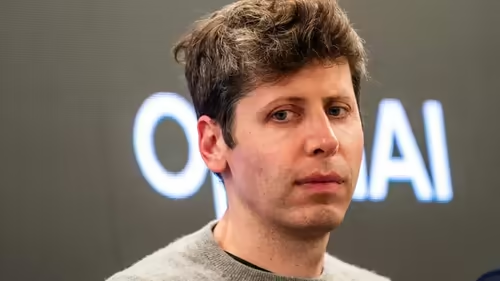
The AI gold rush of 2025 was supposed to be a coronation for Sam Altman and his creation, OpenAI. But instead of champagne corks popping, there’s a growing sense of unease in Silicon Valley. Headlines screaming “OpenAI doomed” are no longer just the rantings of skeptics—they’re echoing serious concerns from within one of its most crucial potential partners: Nvidia. The chip giant’s landmark $100 billion investment, once hailed as the biggest deal in tech history, has reportedly hit a wall, with internal doubts casting a long shadow over OpenAI’s future [[5]].
Table of Contents
- The $100 Billion Lifeline That Might Not Come
- Why Nvidia Is Having Second Thoughts
- The Perfect Storm Threatening OpenAI
- Sam Altman’s Ambitious Plans on the Brink
- The Broader Implications for the AI Race
- Conclusion: Is This the End or a Course Correction?
- Sources
The $100 Billion Lifeline That Might Not Come
For months, the tech world buzzed with the news of Nvidia’s unprecedented commitment to OpenAI—a staggering $100 billion investment aimed at supercharging the development of next-generation AI infrastructure. This wasn’t just a financial transaction; it was a strategic alliance that would have cemented the dominance of both companies. However, recent reports suggest that negotiations have stalled significantly. Sources within Nvidia indicate a growing wariness about the sheer scale of the outlay and the long-term return on such a massive bet [[5]]. For a company known for its shrewd business acumen, this hesitation is a major red flag.
Why Nvidia Is Having Second Thoughts
Nvidia’s pause isn’t born out of a lack of belief in AI’s potential—that market is undeniable. Their concerns are far more specific and grounded in hard financial reality. The primary issue is OpenAI’s escalating cost structure. Building and running the massive data centers required for cutting-edge AI models like GPT-6 is an astronomically expensive endeavor. Nvidia’s leadership is reportedly questioning whether OpenAI’s current business model can ever generate enough revenue to justify this level of investment, especially given the intense competitive landscape [[3]].
The Perfect Storm Threatening OpenAI
The potential collapse of the Nvidia deal is just the tip of the iceberg. OpenAI is facing a confluence of challenges that have created a perfect storm:
- Rising Costs: The computational power needed for advanced AI is becoming prohibitively expensive, squeezing margins.
- Fierce Competition: Rivals like Google DeepMind and Anthropic are not just keeping pace but are making significant breakthroughs of their own, eroding OpenAI’s first-mover advantage [[8]].
- Monetization Pressure: While ChatGPT has millions of users, converting that into sustainable, high-margin revenue at the scale needed is proving difficult.
- Talent Wars: The battle for top AI researchers is fierce, and competitors are willing to pay top dollar, increasing OpenAI’s operational costs further.
This combination of factors has led to a critical question: is the current trajectory of OpenAI financially sustainable in the long run? This is the core of the OpenAI doomed narrative that is gaining traction.
Sam Altman’s Ambitious Plans on the Brink
Sam Altman has never been one to think small. His vision extends far beyond chatbots; he’s talked about building artificial general intelligence (AGI) and using it to solve humanity’s biggest problems. This grand ambition requires a near-limitless supply of capital. The $100 billion from Nvidia was meant to be the fuel for this rocket ship. Without it, Altman’s entire roadmap could be in jeopardy. Projects could be delayed, scaled back, or even shelved entirely. The pressure on Altman to find alternative sources of funding or to demonstrate a clear path to profitability has never been greater. His ability to navigate this crisis will define his legacy in the tech world.
The Broader Implications for the AI Race
If the Nvidia deal falls through, it won’t just be a blow to OpenAI; it could reshape the entire global AI race. It would signal to other investors that even the most promising AI startups are not immune to harsh financial realities. This could lead to a more cautious investment climate, potentially slowing down the breakneck pace of innovation. Conversely, it could be a massive opportunity for competitors. Google and Anthropic, backed by the deep pockets of Alphabet and Amazon respectively, might see this as their moment to pull ahead and capture market share from a weakened OpenAI. The balance of power in the AI industry is precariously poised.
Conclusion: Is This the End or a Course Correction?
Declaring OpenAI “doomed” might be premature. The company still possesses some of the world’s best AI talent and a powerful brand. However, the stalling of the Nvidia deal is a stark wake-up call. It forces a necessary reckoning with the financial fundamentals of the AI business. The era of blank checks and unchecked growth may be over, replaced by a new era of fiscal discipline and demonstrable value. Whether OpenAI can adapt to this new reality will determine if it remains a leader or becomes a cautionary tale of ambition outpacing economics.
Sources
- Times of India: Sam Altman’s biggest deal of 2025 ‘in trouble’ as ‘OpenAI doomed’ predictions make headlines
- Reuters: Nvidia reconsiders $100 billion OpenAI investment over sustainability concerns
- The Verge: OpenAI faces funding crisis as Nvidia deal stalls
- Bloomberg: OpenAI’s $100 Billion Nvidia Deal Stalls Amid Cost Concerns