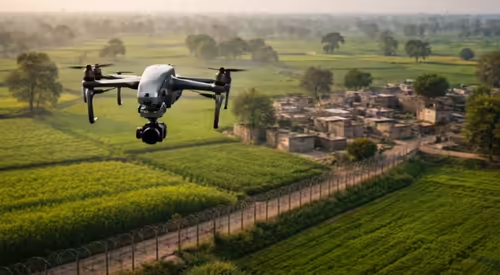
In the quiet hours of a Saturday evening in late January 2026, the skies over Samba district in Jammu and Kashmir were anything but peaceful. A small, buzzing object—identified as a Pakistani drone—was spotted hovering near the International Border (IB) in the Chillyari village area, sending security forces into a flurry of action [[5]]. This isn’t an isolated incident; it’s the second such sighting in the region in a matter of weeks, marking a disturbing and dangerous trend that is redefining the security dynamics along the India-Pakistan frontier.
Table of Contents
- The Latest Incident in Samba
- A Pattern of Aggression: The Rise of Pakistani Drone Incursions
- Why Samba? India’s New Vulnerable Frontier
- India’s Counter-Drone Shield: Technology on the Frontlines
- The Strategic Game-Changer: Drones as a Hybrid Warfare Tool
- Conclusion: Navigating the New Normal of Border Security
- Sources
The Latest Incident in Samba
The recent event unfolded when security personnel from the Border Security Force (BSF) observed a suspicious unmanned aerial vehicle (UAV) breaching Indian airspace. The drone lingered for a few critical minutes before vanishing, prompting an immediate and extensive search operation across the sensitive border belt [[5]]. While officials have not yet confirmed if the drone was carrying any payload, the mere act of intrusion is a serious violation of sovereignty and a potential reconnaissance mission. This follows another drone sighting in the same district just days prior, creating a palpable sense of unease among local residents and security establishments alike [[3]].
A Pattern of Aggression: The Rise of Pakistani Drone Incursions
This Samba incident is far from a one-off. It is a stark data point in a rapidly growing and alarming trend. The Indian Ministry of Defence reported a staggering 791 drone incursions along the western border with Pakistan in 2025 alone [[13]]. This represents a massive escalation from just a few years ago, signaling a clear shift in tactics from Islamabad.
Security experts believe these drones are being used for a dual purpose: intelligence gathering and, increasingly, as a delivery mechanism for weapons and narcotics. In early January 2026, a drone was intercepted in the Ghagwal area of Samba, which was found to be carrying a cache of arms, confirming these fears [[3]]. The use of drones provides a low-cost, low-risk method for hostile actors to probe India’s defenses and create instability without engaging in direct, conventional conflict.
Why Samba? India’s New Vulnerable Frontier
Samba, located in the Jammu plains, has emerged as a focal point for these incursions. Its relatively flat terrain compared to the mountainous regions of Kashmir makes it a more accessible route for small, commercially available drones. The proximity to the IB allows for quick in-and-out missions, making detection and interception a significant challenge. The repeated targeting of this specific sector suggests a deliberate strategy by elements across the border to test India’s response mechanisms and identify potential weak spots in its surveillance network. Just a day before the latest Samba sighting, ten suspected Pakistani drones were spotted in the Keran sector of Kupwara, indicating a coordinated effort across multiple fronts [[1]].
India’s Counter-Drone Shield: Technology on the Frontlines
Faced with this new-age threat, India is not standing idle. The country is rapidly deploying a multi-layered technological shield to protect its borders. The Defence Research and Development Organisation (DRDO) has been at the forefront, developing advanced systems like the Integrated Drone Detection and Interdiction System (Mark-2). This indigenous system combines radar, RF detection, and a powerful 10 kW laser capable of neutralizing hostile UAVs up to 2 kilometers away [[17]].
Beyond high-powered lasers, the Indian Army is also inducting portable counter-drone systems from domestic startups and companies like Axiscades Technologies [[19]]. These systems can detect, track, and jam the communication links of incoming drones, forcing them to land or return to their origin. The deployment of AI-powered gunshot detection and autonomous drone response systems is another layer being added to this complex defense architecture [[18]]. The goal is to move from a reactive posture to a proactive one, where threats are identified and neutralized before they can achieve their objective.
The Strategic Game-Changer: Drones as a Hybrid Warfare Tool
The persistent use of Pakistani drones represents a classic case of hybrid warfare. It blends conventional military posturing with unconventional, asymmetric tactics. By using drones, the adversary can:
- Conduct covert surveillance on Indian military installations and troop movements.
- Smuggle contraband like weapons and drugs to fuel local militancy and crime.
- Test and exhaust India’s air defense and surveillance resources.
- Create a constant state of alert, impacting the morale and operational efficiency of security forces.
This low-intensity, high-frequency approach is designed to keep India off-balance without triggering a full-scale military response. It’s a strategic gamble that exploits the grey zone between peace and war.
Conclusion: Navigating the New Normal of Border Security
The suspected Pakistani drone over Samba is more than just a fleeting security scare; it is a symbol of the new normal on India’s western front. The era of traditional border patrolling is being supplemented—and in some ways, supplanted—by a high-tech electronic and aerial battle. While India’s investment in indigenous counter-drone technology is a promising step, the challenge is dynamic and relentless. Continuous innovation, robust intelligence sharing, and international cooperation will be key to maintaining air sovereignty and ensuring the safety of citizens in these border regions. The skies over Samba may be quiet today, but the next drone could already be on its way.
Sources
- The New Indian Express: Suspected Pakistani drone spotted along IB in Jammu and Kashmir’s Samba
- Grokipedia: 2026 Samba drone arms seizure
- Daily Pioneer: Tension rises as 10 Pakistani drones spotted near J&K Keran sector
- Times of India: 791 drone incursions in 2025
- Insights on India: Integrated Drone Detection and Interdiction System (Mark-2)
- RNA Media: Army Deploys Gunshot Detection and Drone Response Systems