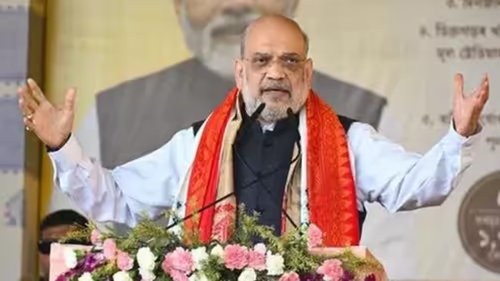
In a political salvo that has sent shockwaves through West Bengal, Union Home Minister Amit Shah has directly challenged the very foundation of Chief Minister Mamata Banerjee’s political identity. At a massive BJP workers’ conference in Kolkata, Shah declared that the cherished Trinamool Congress (TMC) slogan of “Maa, Maati, Manush” (Mother, Land, People) is no longer a promise of protection but a symbol of peril under the current state government.
Shah’s speech was a masterclass in political rhetoric, weaving together a narrative of administrative failure, corruption, and a threat to the core identity of Bengal. His central thesis was stark: the people, the land, and the cultural fabric of the state are all under siege, and the blame lies squarely with the ruling TMC.
Table of Contents
- The “Maa, Maati, Manush” Reversal
- Anandapur Fire: A Symbol of State Failure
- Beyond the Fire: Border Security and Infiltration
- The Political Battle for Bengal’s Soul
- Conclusion
- Sources
The “Maa, Maati, Manush” Reversal
For over a decade, “Maa, Maati, Manush” has been more than just a slogan for Mamata Banerjee; it’s been her political brand, a promise of a government that prioritizes the welfare of its citizens and the sanctity of its land. Amit Shah’s strategy was to turn this powerful symbol on its head. He argued that under TMC rule, the reality has become the opposite: the mother is dishonored, the land is compromised, and the people are unsafe [[5]].
Shah accused the TMC government of fostering an environment where corruption is rampant and accountability is absent. He claimed that the party’s focus on vote-bank politics has led to the appeasement of certain groups at the expense of the state’s overall security and development. This, he posited, is the direct cause of the crises facing Bengal today.
Anandapur Fire: A Symbol of State Failure
The tragic warehouse fire in Kolkata’s Anandapur area on January 26, 2026, which has claimed at least 25 lives with many still missing, became the emotional and factual centerpiece of Shah’s attack [[19]]. He didn’t mince words, calling the incident not an accident, but a “result of the corruption of the Mamata Banerjee government” [[4]].
His argument was that such a catastrophic event, where workers were found sleeping inside a storage facility, could only happen in a system riddled with negligence, illegal construction, and a complete lack of enforcement of safety regulations. He used the fire as a powerful metaphor for the larger administrative collapse in the state, suggesting that the government’s priorities are so misplaced that the basic safety of its citizens is an afterthought.
This tragedy has become a national talking point, with the National Human Rights Commission (NHRC) taking suo motu cognizance of the incident, further amplifying the pressure on the state government [[23]].
Beyond the Fire: Border Security and Infiltration
Shah’s critique extended far beyond the immediate tragedy of the fire. He launched a fierce assault on the TMC government’s handling of the India-Bangladesh border, which shares a 2,216-kilometer frontier with West Bengal—the longest of any Indian state [[12]].
Citing official data, he pointed to a sharp rise in infiltration attempts along this porous border. A report from earlier this month noted that the India-Bangladesh border saw the highest number of infiltration cases in nearly a decade, with over 7,500 attempts recorded in 2025 alone [[14], [16]]. Shah framed this as a direct threat to the “Maati” (land) and the demographic and cultural integrity of the state, accusing the TMC of turning a blind eye for political gain.
He alleged that the government’s policies have created an atmosphere of intimidation for certain communities, further destabilizing the social fabric of Bengal. This line of attack is a core part of the BJP’s national security narrative, positioning itself as the only party capable of protecting India’s borders and its people.
The Political Battle for Bengal’s Soul
This speech is not an isolated event but a critical move in the BJP’s long-term strategy to unseat the TMC in West Bengal. By directly challenging the foundational slogan of their main rival, the BJP is attempting to redefine the political conversation in the state. They are shifting the focus from regional identity to issues of governance, security, and development—areas where they believe they hold a national advantage.
Shah’s call to the people of Bengal was clear: to reject the current administration and vote for a BJP government that promises to restore safety, security, and true development. He positioned the upcoming elections as a choice between a corrupt, failing regime and a strong, nationalistic alternative that will finally make “Maa, Maati, Manush” safe again.
For readers interested in the broader context of national politics, our analysis on [INTERNAL_LINK:bjp-national-strategy-2026] provides deeper insights into the party’s electoral playbook.
Conclusion
Amit Shah’s speech was a calculated and multi-pronged political offensive. By linking the devastating Anandapur fire to systemic corruption and tying border security failures to a betrayal of the “Maa, Maati, Manush” ideal, he has crafted a powerful narrative for the BJP. The success of this strategy will depend on whether the voters of West Bengal see these events as isolated tragedies or as symptoms of a deeper governmental malaise. One thing is certain: the battle for Bengal’s political future has just intensified, with its most sacred slogan now at the heart of the conflict.
Sources
- Times of India: ‘Maa, Maati, Manush unsafe in Bengal’: Amit Shah targets Mamata Banerjee
- Dekoder: Mamata’s ‘Maa, Maati, Manush’ call is now ‘Mullah, Madrasa and Mafia’
- The New Mill: Amit Shah condoles Anandpur fire incident
- Avenue Mail: Death toll rises to 25, NHRC takes suo motu cognizance
- Times of India: Indo-Bangladesh border records highest infiltration cases in 2025
- Research Journal of Humanities and Social Sciences: Impact of Migration and Infiltration from Bangladesh