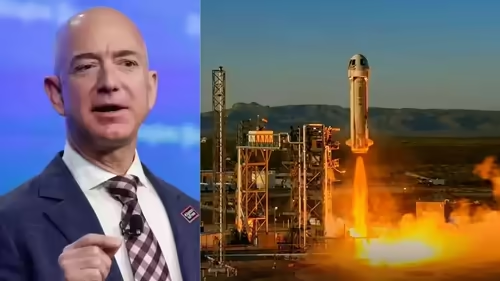
Just as civilian space travel was starting to feel like the next big thing, Blue Origin has hit the brakes. The company, founded by Jeff Bezos, has officially announced a **two-year pause** in its space tourism program. The reason? A full-throttle pivot to support NASA’s high-stakes Moon missions under the Artemis program [[1]]. This decision marks a pivotal moment in the commercial space race—one that prioritizes national ambition over private joyrides.
Table of Contents
- Why Blue Origin Is Pausing Space Tourism
- The Impact on New Shepard and Passengers
- Blue Origin’s Critical Role in NASA’s Artemis Program
- How This Shift Affects the Commercial Space Industry
- What Does This Mean for the Future of Space Tourism?
- Conclusion: A Strategic Retreat or Permanent Pivot?
- Sources
Why Blue Origin Is Pausing Space Tourism
The official statement from Blue Origin cites resource reallocation as the core reason behind the **Blue Origin space tourism pause**. According to internal sources, the company needs to redirect its engineering talent, manufacturing capacity, and financial resources toward developing its Blue Moon lunar lander—a key component of NASA’s plan to return humans to the lunar surface by 2026 [[3]].
This isn’t just a minor adjustment; it’s a complete operational overhaul. With tight deadlines and immense technical challenges, Blue Origin has decided that maintaining its suborbital tourism flights with the New Shepard rocket is no longer feasible without compromising its NASA commitments. In essence, the Moon mission takes precedence over million-dollar selfies in microgravity.
The Impact on New Shepard and Passengers
Since its debut in 2021, Blue Origin’s New Shepard has flown six crewed missions, carrying celebrities like William Shatner and everyday citizens who paid undisclosed sums (estimated between $250,000 and $1 million) for a 10-minute trip to the edge of space [[2]]. The suspension means all scheduled and future tourist flights are on hold until at least 2028.
For those who have already booked tickets or are on the waiting list, this news is undoubtedly disappointing. However, Blue Origin has assured customers that their reservations will be honored once operations resume. The company also emphasized that this pause allows them to incorporate safety and performance upgrades into the New Shepard system during the downtime—turning a setback into an opportunity for improvement.
Blue Origin’s Critical Role in NASA’s Artemis Program
Blue Origin’s involvement in the Artemis program is far from symbolic. In 2023, NASA awarded the company a $3.4 billion contract to develop the **Blue Moon** human landing system (HLS) for the Artemis V mission, scheduled for no earlier than 2029 [[4]]. This makes Blue Origin a crucial partner alongside SpaceX, which is handling the earlier Artemis III and IV landings.
The Blue Moon lander is designed to carry astronauts from lunar orbit down to the Moon’s South Pole—an area rich in water ice and scientific potential. Successfully delivering this vehicle on time is not just a business milestone for Blue Origin; it’s a matter of national prestige and technological leadership for the United States in the new space race against China and other global players.
How This Shift Affects the Commercial Space Industry
Blue Origin’s decision sends ripples across the entire commercial space sector. While competitors like Virgin Galactic continue limited suborbital flights, and SpaceX focuses on orbital tourism (e.g., Inspiration4, Polaris missions), Blue Origin’s exit—even if temporary—creates a vacuum in the high-profile suborbital market.
This move also highlights a growing trend: **space companies are increasingly dependent on government contracts for long-term viability**. Pure-play space tourism remains a niche, high-risk venture. As one industry analyst noted, “Government partnerships provide the stability that private ticket sales alone cannot guarantee” [[5]]. For deeper insights into this dynamic, check out our analysis on [INTERNAL_LINK:future-of-commercial-spaceflight].
What Does This Mean for the Future of Space Tourism?
Does this signal the end of civilian space travel? Not at all—but it does suggest a recalibration. The initial hype around routine space tourism may have been premature. Realistically, the industry is still in its infancy, facing regulatory, safety, and economic hurdles.
However, Blue Origin’s pause could ultimately strengthen the sector. By investing in lunar infrastructure now, the company is helping build the foundational technologies that could one day make space travel more affordable, reliable, and accessible. Think of it as a strategic timeout to build a better ladder before inviting more people to climb it.
Conclusion: A Strategic Retreat or Permanent Pivot?
The **Blue Origin space tourism pause** is less a retreat and more a calculated realignment. By focusing on NASA’s Moon missions, the company is betting on a future where lunar exploration and commercial spaceflight are deeply intertwined. While tourists may have to wait, this decision could pave the way for a more sustainable and scalable space economy in the long run. For now, the dream of floating above Earth isn’t dead—it’s just on hold while humanity prepares to walk on the Moon again.
Sources
- Times of India: Jeff Bezos’s Blue Origin pauses space tourism for 2 years [[1]]
- Blue Origin Official Site: New Shepard Crew Missions [[2]]
- NASA: Artemis Program Overview [[3]]
- NASA Press Release: NASA Selects Blue Origin for Artemis V Mission [[4]]
- SpaceNews: Blue Origin shifts focus from tourism to lunar lander [[5]]