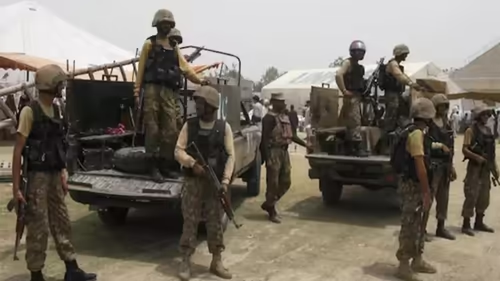
In a chilling escalation that has sent shockwaves through Pakistan’s corridors of power, the southwestern province of Balochistan is once again the epicenter of a violent insurgency. On Saturday, January 31, 2026, the Baloch Liberation Army (BLA) claimed responsibility for a series of Balochistan attacks that were not just isolated incidents but a terrifyingly well-coordinated campaign across five key districts.
The result? Four brave police officers have been martyred, and the nation is left grappling with a profound question: Is this the beginning of a new, more dangerous phase in Pakistan’s long-standing struggle with Baloch separatism? The scale and timing of these assaults suggest a deliberate and strategic move by the militants, one that could have far-reaching consequences for the entire country.
Table of Contents
- The Coordinated Assault: A Province Under Siege
- Who is Behind the Attacks? The BLA and ‘Operation Herof’
- Why Now? Timing and Strategy of the Militants
- The Broader Security Crisis in Pakistan
- Conclusion: A Nation at a Crossroads
- Sources
The Coordinated Assault: A Province Under Siege
The attacks were not a single event but a synchronized wave of violence that struck simultaneously in Quetta, Pasni, Mastung, Nushki, and Gwadar [[3]]. These are not random locations; they represent critical economic and strategic hubs. Gwadar, for instance, is the crown jewel of the China-Pakistan Economic Corridor (CPEC), while Quetta is the provincial capital.
Reports from the ground describe a harrowing scene: powerful explosions followed by intense, sustained gunfire that lasted for hours in some areas [[9]]. The primary targets appear to have been police and security force installations, a clear attempt to destabilize the state’s authority in the region. While four police officers have been confirmed dead, the full extent of casualties and damage is still emerging as security forces work to regain control [[1]].
Who is Behind the Attacks? The BLA and ‘Operation Herof’
The Baloch Liberation Army (BLA) was quick to claim responsibility for what it has dubbed “Operation Herof Phase Two” [[11]]. This is not a new name for the group, which has been designated a terrorist organization by Pakistan, the UK, and the EU [[13]]. The BLA is a militant ethnonationalist group that has been fighting for an independent Baloch state for decades, citing political and economic marginalization by the central government in Islamabad.
Their tactics have evolved over the years, and recent intelligence suggests they are increasingly using sophisticated urban warfare strategies, including suicide bombers and complex, multi-pronged assaults [[16]]. The claim that they hit 39 different locations across the province, while likely inflated, underscores their ambition to project an image of widespread control and capability [[5]].
Why Now? Timing and Strategy of the Militants
The timing of these Balochistan attacks is highly significant. They come just two days after the Pakistani military announced a major success, claiming to have killed 41 insurgents in two separate intelligence-based operations in the province [[2], [19]]. This is a classic insurgent tactic: to launch a devastating counter-strike to demonstrate resilience and negate the government’s narrative of victory.
Furthermore, the choice of target is strategic. By attacking Gwadar and other CPEC-linked sites, the BLA is sending a message to both the Pakistani state and its international partners, particularly China, that they can disrupt the multi-billion dollar economic corridor that is vital to Pakistan’s future. It’s a direct challenge to the state’s ability to provide security for its most important foreign investment.
The Broader Security Crisis in Pakistan
These events are not happening in a vacuum. They are part of a deepening Pakistan security crisis that has been brewing for months. The security situation in Balochistan has been deteriorating steadily, with universities being shut down indefinitely due to threats [[20]] and a general atmosphere of fear and instability.
The government’s response has been a mix of military crackdowns and political promises, but the underlying grievances of the Baloch people—related to resource rights, political autonomy, and alleged human rights abuses—remain largely unaddressed. This persistent discontent provides fertile ground for groups like the BLA to recruit and operate. The recent protests by Balochistan government employees over pay inequality are just one symptom of this deeper rift [[22]].
Conclusion: A Nation at a Crossroads
The coordinated Balochistan attacks of January 31, 2026, are a stark reminder of the fragility of Pakistan’s internal security. The killing of four policemen is a tragic loss, but the larger implication is the audacious challenge to the state’s sovereignty in a strategically vital province. If the government continues to rely solely on a military solution without addressing the core political and economic issues, it risks fueling a cycle of violence that could spiral out of control. The world is watching to see how Pakistan navigates this critical juncture. For more on regional conflicts, see our analysis on [INTERNAL_LINK:pakistan-afghanistan-border-tensions].
Sources
- Firstpost: Coordinated militant attacks hit multiple districts in Balochistan, killing 4 police officers
- The Hindu: Separatists launch ‘coordinated’ attacks in southwest Pakistan’s Balochistan
- Al Arabiya: Separatists launch ‘coordinated’ attacks in southwestern Pakistan
- Times of India: BLA launches ‘coordinated’ attacks across 5 Balochistan districts
- CTC at West Point: The Baloch Insurgency in Pakistan: Evolution, Tactics, and Regional Security Implications