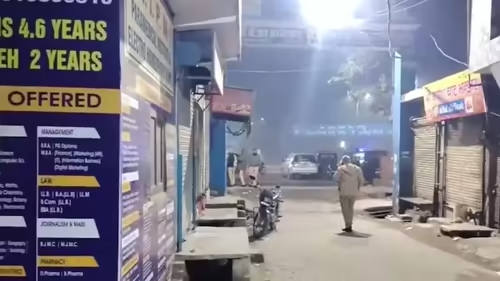
It was supposed to be a simple meal. But in a shocking turn of events on the evening of January 30, 2026, what began as a complaint about slow service at a roadside eatery in Ghaziabad spiraled into one of the most brazen acts of public violence in recent memory. The result? A fatal Ghaziabad stabbing that claimed two lives and left a community—and a nation—grappling with questions of safety, anger, and the thin line between frustration and fury.
The incident occurred just meters away from the Khoda police station, a location that adds a layer of chilling irony to the tragedy. How could such a brutal attack unfold in the very shadow of law enforcement? This is the story of a momentary dispute that ended in irreversible loss.
Table of Contents
- The Incident: From Complaint to Carnage
- Police Response and the Ongoing Investigation
- Ghaziabad Stabbing: Victims, Suspects, and Motives
- Public Safety Concerns: Violence in Plain Sight
- Broader Patterns of Public Violence in Urban India
- Conclusion: A Wake-Up Call for Community Policing
- Sources
The Incident: From Complaint to Carnage
According to initial police reports, the altercation started at a small eatery near the Khoda police station in Ghaziabad’s Loni area [[1]]. A group of customers, reportedly frustrated by a delay in their food order, began arguing with the staff. What should have been a minor inconvenience quickly escalated into a physical scuffle.
In the chaos that followed, knives were drawn. Three individuals were critically injured in the ensuing melee. Emergency services rushed them to a nearby hospital, but despite medical efforts, two of the victims succumbed to their injuries. The third victim remains stable and is cooperating with investigators.
The fact that this all happened within shouting distance of a police station has raised serious concerns about response times and public perception of safety in the area.
Police Response and the Ongoing Investigation
Local authorities acted swiftly following the incident. A team from the Khoda police station arrived on the scene shortly after the brawl was reported and secured the area. Four individuals have since been detained for questioning, though formal charges are pending as the investigation continues [[1]].
Police are currently reviewing CCTV footage from nearby businesses and interviewing eyewitnesses to reconstruct the exact sequence of events. A key focus of the probe is determining who initiated the violence and whether the stabbing was premeditated or a spontaneous act of rage.
For more on how Indian police handle homicide investigations, see our explainer on [INTERNAL_LINK:criminal_investigation_process_india].
Ghaziabad Stabbing: Victims, Suspects, and Motives
While the identities of the deceased have not yet been officially released to the public, sources close to the investigation suggest they were local residents. The nature of their relationship to each other and to the suspects is still under scrutiny.
Investigators are exploring several possible motives beyond the initial food delay:
- Prior Grudges: Was the argument over food merely a trigger for a deeper, pre-existing conflict?
- Alcohol or Substance Influence: Preliminary reports suggest alcohol may have played a role in lowering inhibitions and escalating tensions.
- Group Dynamics: In group confrontations, peer pressure can often lead individuals to act more aggressively than they would alone.
Understanding the motive is crucial, not just for legal proceedings, but for preventing similar tragedies in the future.
Public Safety Concerns: Violence in Plain Sight
The location of the Ghaziabad stabbing—so close to a police outpost—has sparked a wave of anxiety among local residents. If violence can erupt unchecked in such a monitored area, where is truly safe?
This incident highlights a critical gap in urban public safety strategies. While police stations serve as command centers, their immediate vicinity is not always under constant surveillance. Community members are now calling for increased foot patrols and better lighting in commercial zones to deter impulsive acts of violence.
Broader Patterns of Public Violence in Urban India
Unfortunately, the Ghaziabad case is not an isolated event. Across India’s rapidly growing cities, there has been a noticeable uptick in public altercations that turn deadly over seemingly trivial matters—traffic disputes, queue-jumping, or, as in this case, service delays.
Experts point to a combination of factors: rising urban stress, economic pressures, easy access to weapons, and a culture that sometimes glorifies aggressive responses. The National Crime Records Bureau (NCRB) regularly publishes data on crimes of passion and public brawls, which can provide valuable context for understanding these trends [[2]].
Conclusion: A Wake-Up Call for Community Policing
The Ghaziabad stabbing is a tragic reminder that peace can be shattered in an instant. It underscores the urgent need for not just stronger law enforcement, but also community-based conflict resolution programs and public awareness campaigns about de-escalation. In a society where tempers can flare over a late meal, fostering empathy and patience must become a collective priority.