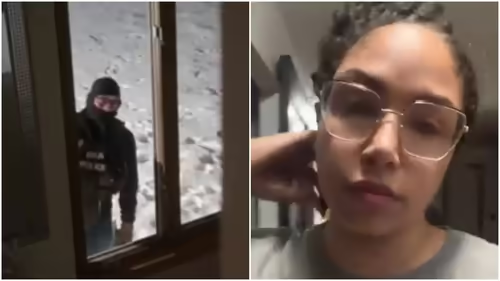
Her phone camera was rolling as she uttered the now-viral words: “Agents are at my door.” In a chilling and unprecedented moment for American journalism, independent reporter Georgia Fort documented her own arrest in real-time. The charge? Her coverage of an anti-Immigration and Customs Enforcement (ICE) protest at a St. Paul church—a story that has since become a flashpoint in the national conversation about the freedom of the press.
The arrest of Fort, along with former CNN anchor Don Lemon, has sent shockwaves through newsrooms and civil liberties organizations across the country. How did a routine act of journalism—reporting on a public protest—lead to federal detention? This is the story of the Georgia Fort arrested case and its profound implications for democracy.
Table of Contents
- The Arrest: A Live-Streamed Encounter with Federal Agents
- The Protest Backstory: What Happened at the St. Paul Church?
- Georgia Fort Arrested: The Legal and Ethical Questions
- Media and Public Outcry: Defending the Fourth Estate
- Broader Implications for Press Freedom in America
- Conclusion: A Watershed Moment for Journalism
- Sources
The Arrest: A Live-Streamed Encounter with Federal Agents
On a Friday in late January 2026, Georgia Fort’s life changed forever. After having covered an anti-ICE demonstration at Cities Church in St. Paul earlier in the month, she found herself on the other side of the story [[3]]. As federal agents approached her residence, she turned on her phone and began to record, capturing the raw, unfiltered fear and confusion of the moment. Her video, which quickly went viral on social media, shows her calmly stating, “Agents are at my door,” before the footage cuts out [[4]].
Fort was not alone. Former CNN anchor Don Lemon was also arrested in connection with the same protest coverage, making them the first two high-profile journalists to be detained by federal authorities for simply doing their jobs in recent memory [[5]]. Their arrests have been widely condemned by journalism groups and civil rights advocates.
The Protest Backstory: What Happened at the St. Paul Church?
The root of this controversy lies in a protest that took place at Cities Church in St. Paul. The demonstration was organized to oppose ICE operations and policies, a common form of civic action in the United States. According to reports, the protest disrupted a church service, which may have been the catalyst for the subsequent legal action [[8]].
However, the critical distinction here is between the protesters and the journalists. Fort and Lemon were not participants; they were observers and reporters. Their role was to document the event for the public, a fundamental tenet of a free press in a democratic society. The conflation of these two roles—activist and journalist—is at the heart of the current legal and ethical storm.
Georgia Fort Arrested: The Legal and Ethical Questions
The Georgia Fort arrested case raises serious questions about the legal protections afforded to journalists in the United States. The First Amendment is clear in its protection of a free press, yet this incident suggests a dangerous blurring of the lines.
Key concerns include:
- Guilt by Association: Can a journalist be held legally responsible for the actions of the people they are covering? This sets a perilous precedent that could effectively outlaw reporting on any controversial or unlawful assembly.
- Chilling Effect: The fear of arrest will inevitably deter other reporters from covering sensitive but newsworthy events, leading to a less informed public.
- Selective Enforcement: Why were these two journalists—both prominent Black media figures—singled out for arrest? This has led to discussions about potential bias in law enforcement [[4]].
For more on the legal framework protecting journalists, see our guide on [INTERNAL_LINK:first_amendment_and_journalism].
Media and Public Outcry: Defending the Fourth Estate
The reaction to the arrests was swift and severe. Major journalism organizations, including Sahan Journal and the Mississippi Free Press, have issued strong statements condemning the actions of federal authorities [[5], [6]]. They argue that arresting journalists for covering a protest is a direct attack on the public’s right to know.
Public figures and fellow journalists have rallied around Fort and Lemon, using social media to amplify their cause and demand their immediate release. The case has become a symbol of the increasing pressures faced by the media in an era of heightened political tension and distrust in institutions.
Broader Implications for Press Freedom in America
This incident is not happening in a vacuum. It occurs against a backdrop of declining trust in media and increasing hostility toward journalists worldwide. According to the Committee to Protect Journalists, a non-profit organization that promotes press freedom globally, the number of journalists imprisoned for their work has been on the rise [[7]]. While the U.S. has historically been a bastion of free speech, the Georgia Fort arrested case serves as a stark warning that these freedoms cannot be taken for granted.
Conclusion: A Watershed Moment for Journalism
The arrest of Georgia Fort is more than just a personal ordeal; it is a watershed moment for American journalism. It forces us to confront a fundamental question: What is the cost of a free press, and are we willing to pay it? The outcome of this case will have far-reaching consequences for every reporter who picks up a camera or a notepad to hold power to account. The world is watching.
Sources
- Times of India: ‘Agents are at my door’: Journalist Georgia Fort films moments before being arrested
- The 19th: Journalist Georgia Fort arrested over reporting on anti-ICE protest
- Forbes: What The Arrest Of Journalist Georgia Fort Could Mean For Women In Media
- Mississippi Free Press: Journalism Leaders Decry Arrests of Georgia Fort and Don Lemon
- Committee to Protect Journalists