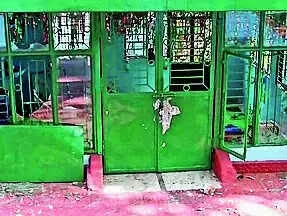
In the serene hill station of Mussoorie, a place known for its colonial charm and misty views, a disturbing act of religious intolerance has cast a long shadow. The small shrine dedicated to the revered 18th-century Sufi poet, **Bulleh Shah**, was recently reduced to rubble. Now, a local right-wing group isn’t just claiming responsibility; they’ve issued a stark warning: any attempt to rebuild the **Bulleh Shah shrine** will be met with fierce opposition.
This incident is far more than a simple case of property damage. It strikes at the heart of India’s syncretic heritage and has ignited a firestorm of debate about the space for pluralism in contemporary society. Who was Bulleh Shah, and why has his humble shrine become a battleground?
Table of Contents
- Who Was Bulleh Shah? A Beacon of Love and Unity
- The Mussoorie Incident: From Vandalism to Vow
- Why Target a Sufi Shrine? The Ideological Conflict
- National Reaction and the Broader Debate
- Conclusion: Rebuilding More Than Just Bricks and Mortar
- Sources
Who Was Bulleh Shah? A Beacon of Love and Unity
Bulleh Shah (1680–1757) wasn’t just a poet; he was a revolutionary philosopher whose Punjabi verses transcended the rigid boundaries of religion, caste, and creed [[10]]. His poetry, a powerful blend of mysticism and humanism, championed a direct, personal connection with the divine, often criticizing empty ritualism and the hypocrisy of religious orthodoxy.
His most famous declaration, “Bullah ki jaana main kaun” (“Bulleh, I know not who I am”), is a profound inquiry into the nature of self and existence that resonates with seekers across faiths. For centuries, his message of universal love and equality has made him a unifying figure across South Asia, particularly in Punjab, which is now divided between India and Pakistan.
The primary **Bulleh Shah shrine** is located in Kasur, Pakistan, and remains a major pilgrimage site [[12]]. The small structure in Mussoorie was a local place of quiet reflection for admirers of his work, symbolizing the deep cultural and spiritual links that bind the region beyond modern political borders.
The Mussoorie Incident: From Vandalism to Vow
On January 24, 2026, the tranquility of Mussoorie was shattered when a group of individuals allegedly affiliated with the Hindu Raksha Dal stormed the shrine [[2]]. According to police reports and eyewitness accounts, they broke open a donation box, stole silver jewellery, and completely demolished the structure [[7]]. Chants of ‘Jai Shri Ram’ were reportedly heard during the act [[6]].
An FIR has since been registered against three individuals identified as Hariom, Shivam, and Shraddha [[3]]. However, the story didn’t end there. In a move that has escalated tensions, members of the same right-wing group have publicly vowed to block any efforts to rebuild the shrine. Their stated reason? They claim the original structure was built “without proper sanction on government land” [[18]]. This justification has been widely criticized as a pretext for a deeper ideological agenda.
Why Target a Sufi Shrine? The Ideological Conflict
The attack on the **Bulleh Shah shrine** is not an isolated event but part of a larger, troubling pattern. Sufi shrines, with their emphasis on music (qawwali), interfaith gatherings, and veneration of saints, have long been targets for certain hardline ideologies that view these practices as shirk (idolatry) or un-Islamic from one end of the spectrum, and as symbols of a syncretic past that contradicts a more homogenized national identity from the other [[17]].
In the Indian context, some right-wing groups perceive Sufi sites, especially those linked to figures from what is now Pakistan, as representing a historical narrative they seek to dismantle. The opposition is less about land-use violations—a common bureaucratic issue—and more about erasing visible symbols of a shared, pluralistic heritage that doesn’t fit their vision of the nation [[23]]. This mirrors similar conflicts seen in Pakistan, where militant groups have repeatedly attacked Sufi shrines for their perceived deviation from a puritanical form of Islam [[19]].
A Symbol Under Siege
Bulleh Shah’s legacy is inherently subversive to any form of extremism. His poetry is a direct challenge to dogma. Consider these core tenets of his philosophy:
- Rejection of Religious Formalism: He famously questioned the value of mosque and temple if the heart is not pure.
- Emphasis on Humanism: His primary concern was the welfare and dignity of all human beings, regardless of their background.
- Unity of Existence: His work points towards a single, universal truth that transcends man-made religious divisions.
It is precisely this message of unity and love that makes his shrines a target for those who thrive on division and fear.
National Reaction and the Broader Debate
The vandalism and the subsequent threat have drawn sharp criticism from various quarters. Political leaders like Mehbooba Mufti have condemned the act, calling it an assault on India’s composite culture [[4]]. Intellectuals, poets, and civil society groups have rallied to defend the shrine, seeing it as a defense of India’s constitutional values of secularism and freedom of belief.
The incident has sparked a crucial national conversation. Is India willing to protect its diverse cultural tapestry, even when it includes symbols that originate from across its borders? Can a nation that prides itself on its ancient traditions of philosophical inquiry allow a narrow ideology to dictate what is permissible to remember and revere?
This case also highlights the vulnerability of smaller, community-run religious sites that lack the political clout or institutional backing of larger establishments. Their protection often relies entirely on the goodwill of the local administration and the broader social consensus—a consensus that appears to be fraying.
Conclusion: Rebuilding More Than Just Bricks and Mortar
The fight over the **Bulleh Shah shrine** in Mussoorie is about far more than a small building on a hillside. It is a referendum on the soul of modern India. To allow a right-wing group to successfully block its reconstruction would set a dangerous precedent, signaling that intimidation can erase history and silence voices of peace and unity.
Bulleh Shah’s timeless question, “Bullah ki jaana main kaun,” is one that every society must continually ask itself. The answer lies not in walls and divisions, but in the courage to embrace the complex, beautiful mosaic of its own past. Rebuilding this shrine is not just an act of restoration; it is a powerful affirmation of the values that have defined the subcontinent for centuries. The nation watches to see what choice will be made.
Sources
- Times of India: Right-wing group vows to block rebuilding of Bulleh Shah shrine [[7], [18]]
- The Wire: Baba Bulleh Shah Shrine in Mussoorie Vandalised [[5], [23]]
- Kasur City: Bulleh Shah Kasur, Life and History [[10]]
- New Age Islam: Preserving Sufi Heritage: Confronting the Threats of Right-Wing Extremism [[17]]
- NPR: In Pakistan, Ultra-Conservative Rivals Attack Moderate Muslims [[19]]