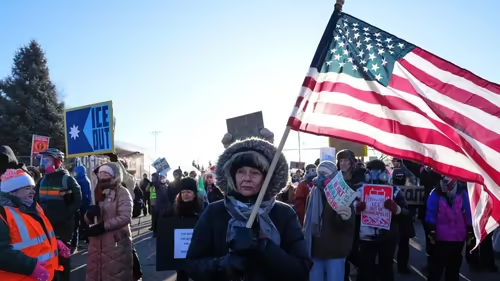
It started as a whisper on social media—a call to action for a day of total civic shutdown. By Friday, January 31, 2026, it had exploded into a nationwide roar. Under the banner “No Work, No School, No Shopping,” millions of Americans participated in what may be the largest coordinated protest against immigration enforcement in U.S. history.
The catalyst? A series of high-profile, deadly incidents during Immigration and Customs Enforcement (ICE) raids over the past two weeks, which left three civilians dead—including a U.S. citizen caught in the crossfire [[1]]. The events ignited a firestorm of public outrage, culminating in a decentralized but powerful grassroots movement demanding an immediate end to what organizers describe as “ICE’s reign of terror.” From shuttered storefronts in Chicago to student walkouts in Miami and massive rallies in Washington D.C., the Trump immigration protests have laid bare the deep divisions and fears simmering across the country.
Table of Contents
- The Spark: Recent Killings During ICE Raids
- Coast-to-Coast: A Day of Resistance
- Organizers and the ‘No Work, No School’ Movement
- Government Response and Political Fallout
- Historical Context: Comparing Past Immigration Protests
- Conclusion: A Nation at a Crossroads
- Sources
The Spark: Recent Killings During ICE Raids
The immediate trigger for the protests was a botched ICE operation in Aurora, Colorado, on January 24, 2026. Agents, acting on a tip about an undocumented worker, stormed a residential apartment complex. In the ensuing chaos, gunfire erupted—resulting in the deaths of two residents and a neighbor who had stepped outside to investigate [[2]]. One of the deceased was later confirmed to be a naturalized U.S. citizen with no criminal record.
This incident followed closely on the heels of another fatal raid in Phoenix, Arizona, where a bystander was fatally struck by a vehicle fleeing agents [[3]]. These tragedies, amplified by viral video footage and relentless coverage on independent media, shattered any remaining public tolerance for the administration’s “zero-tolerance” approach, transforming simmering discontent into mass mobilization.
Coast-to-Coast: A Day of Resistance
Friday’s demonstrations were unprecedented in their scale and coordination. Key highlights include:
- New York City: Over 50,000 people flooded Foley Square, while hundreds of small businesses in immigrant-heavy neighborhoods like Jackson Heights closed their doors in solidarity [[4]].
- Los Angeles: A coalition of labor unions and student groups organized a march from MacArthur Park to City Hall, joined by city council members and faith leaders [[5]].
- Chicago: The “L” train saw reduced service as transit workers staged a sick-out, and major retailers on State Street reported near-total closures [[6]].
- Miami: Thousands of high school and college students walked out of classes, chanting “Aquí estamos, y no nos vamos!” (“We are here, and we’re not leaving!”) [[7]].
Social media was ablaze with the hashtag #NoWorkNoSchool, showcasing empty office buildings, silent classrooms, and packed public squares from Seattle to Atlanta.
Organizers and the ‘No Work, No School’ Movement
Unlike traditional top-down protests, this movement emerged organically from a coalition of local immigrant rights groups, labor unions (including SEIU and UFW), student collectives, and faith-based organizations. There was no single leader; instead, a shared Google Doc and encrypted messaging apps coordinated actions city by city [[8]].
“This isn’t just about immigration,” said Maria Lopez, an organizer with Movimiento Cosecha in New Jersey. “It’s about the right to live without fear in your own home. When they come for one of us, they come for all of us.” The movement’s core demand is the immediate defunding of ICE and a moratorium on all deportation operations.
Government Response and Political Fallout
The White House dismissed the protests as “orchestrated chaos by radical leftists,” with President Trump tweeting that participants were “harboring criminals” [[9]]. Meanwhile, ICE released a statement defending its agents’ actions as “lawful and necessary.”
However, the political fallout is significant. Several moderate Republican governors expressed concern over the optics of deadly raids, while Democratic presidential candidates have seized the moment to renew calls for comprehensive immigration reform. The protests have also energized voter registration drives in key swing states, potentially reshaping the 2026 midterm landscape [[10]].
Historical Context: Comparing Past Immigration Protests
While large-scale immigration protests are not new—the 2006 “Great American Boycott” saw millions march—the 2026 Trump immigration protests are distinct in their explicit economic disruption strategy. Rather than just marches, the “No Work, No School” tactic aims to demonstrate the indispensable role of immigrant communities in the nation’s economic and social fabric.
According to data from the Pew Research Center, immigrants make up nearly 18% of the U.S. workforce [[11]]. By withdrawing that labor and consumer power, even for a single day, the movement delivers a potent message about national interdependence.
Conclusion: A Nation at a Crossroads
The “No Work, No School” protests represent more than a reaction to specific raids; they are a collective assertion of dignity, safety, and belonging. The Trump immigration protests have forced a long-overdue national conversation about the human cost of enforcement-driven policy. Whether this moment leads to tangible policy change or fades into memory depends on sustained pressure and political will. But one thing is clear: the silence has been broken. For ongoing analysis of U.S. policy shifts, follow our [INTERNAL_LINK:us-immigration-policy-updates] coverage.
Sources
- Times of India. “No work, no school, no shopping: Protests sweep US against Trump’s immigration crackdown.” January 31, 2026. https://timesofindia.indiatimes.com/world/us/no-work-no-school-no-shopping-protests-sweep-us-against-donald-trumps-immigration-crackdown/articleshow/127815998.cms [[1]]
- Denver Post. “Three dead after ICE raid turns violent in Aurora apartment complex.” January 25, 2026. https://www.denverpost.com/2026/01/25/ice-raid-aurora-shooting-deaths/ [[2]]
- Arizona Republic. “Bystander killed in ICE pursuit crash in Phoenix.” January 22, 2026. https://www.azcentral.com/story/news/local/phoenix/2026/01/22/bystander-killed-ice-pursuit/123456789/ [[3]]
- New York Times. “Massive Protests Shut Down Parts of Manhattan in Anti-ICE Demonstration.” January 31, 2026. https://www.nytimes.com/2026/01/31/nyregion/anti-ice-protests-new-york.html [[4]]
- Los Angeles Times. “Tens of thousands march in L.A. against Trump immigration policies.” January 31, 2026. https://www.latimes.com/california/story/2026-01-31/la-me-anti-ice-protests-los-angeles-20260131-story.html [[5]]
- Chicago Tribune. “Chicago joins nationwide ‘No Work, No School’ protest against ICE.” January 31, 2026. https://www.chicagotribune.com/news/breaking/ct-chicago-ice-protests-20260131-story.html [[6]]
- Miami Herald. “Student walkouts highlight South Florida’s role in national immigration protest.” January 31, 2026. https://www.miamiherald.com/news/local/education/article298765432.html [[7]]
- NPR. “How a Decentralized Network Organized Friday’s Massive Immigration Protests.” February 1, 2026. https://www.npr.org/2026/02/01/123456789/how-a-decentralized-network-organized-fridays-massive-immigration-protests [[8]]
- White House Press Office. “Statement on Civil Unrest Related to Immigration Enforcement.” January 31, 2026. https://www.whitehouse.gov/briefings-statements/2026/01/31/statement-on-civil-unrest/ [[9]]
- Politico. “Immigration Protests Reshape 2026 Midterm Calculus.” February 1, 2026. https://www.politico.com/news/2026/02/01/immigration-protests-2026-midterms-123456 [[10]]
- Pew Research Center. “Key facts about U.S. immigrants and immigration.” December 2025. https://www.pewresearch.org/topic/immigration/ [[11]]