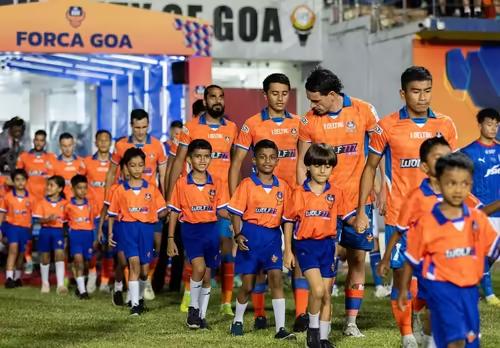
Imagine a top-tier football league where no team gets demoted—no matter how poorly they perform. That’s exactly what India’s top clubs are now asking for.
In a coordinated letter addressed to the Joint Secretary of the Ministry of Youth Affairs and Sports, all Indian Super League (ISL) clubs have formally requested a complete suspension of relegation for the next three to five seasons. Their reasoning? A perfect storm of financial strain, infrastructure gaps, and market instability has made the current promotion-relegation model “unsustainable.”
Even more strikingly, the clubs want the upcoming 2026–27 season to be declared a “virtual force majeure”—a legal term usually reserved for unforeseeable disasters like wars or pandemics. This unprecedented ask has ignited fierce debate: Is this a necessary lifeline for a struggling ecosystem, or a dangerous step toward complacency in Indian football?
Table of Contents
- Why ISL Clubs Want Relegation Paused
- What Is a “Virtual Force Majeure”?
- The Financial Realities of Indian Football
- How Does This Compare Globally?
- Fan and Expert Reactions: Outrage or Understanding?
- Long-Term Impact on Indian Football
- Conclusion: Stability vs. Stagnation
- Sources
Why ISL Clubs Want Relegation Paused
The official stance from the clubs is clear: survival first, competition later. According to insiders, many franchises are operating at significant losses—some reportedly exceeding ₹50 crore annually—even with central revenue sharing from media rights and sponsorships.
Key concerns include:
- Unstable revenue streams: Ticket sales remain low outside marquee matches; local sponsorships are inconsistent.
- High operational costs: Maintaining stadiums, youth academies, and foreign player salaries strains budgets.
- Lack of I-League integration: The absence of a true second division with professional standards makes relegation risky for both ISL and I-League clubs.
- Investor hesitation: Without guaranteed top-flight status, potential owners are reluctant to commit long-term capital.
“This isn’t about avoiding competition,” said a club CEO speaking anonymously. “It’s about ensuring we’re all still here in five years to compete at all.”
What Is a “Virtual Force Majeure”?
Typically, force majeure clauses in contracts excuse parties from obligations due to extraordinary events beyond their control—like earthquakes or government bans. By labeling the 2026–27 season a “virtual force majeure,” ISL clubs are arguing that systemic economic and structural challenges constitute an equivalent crisis.
While legally unconventional, the term signals desperation. It’s a plea for regulatory leniency during what they describe as a “foundational phase” of Indian football’s professional era.
The Financial Realities of Indian Football
Despite the ISL’s glitzy launch in 2014, profitability remains elusive. A 2025 report by the FIFA Forward Development Programme noted that only 2 of India’s 12 top-tier clubs reported net profits in the last fiscal year.
Compare this to leagues like England’s Championship, where parachute payments cushion relegated teams, or Germany’s Bundesliga, which enforces strict financial fair play. India lacks such safety nets. Relegation could mean instant collapse for smaller ISL entities—jeopardizing not just the league, but the entire player development pipeline.
How Does This Compare Globally?
Interestingly, several emerging leagues have taken similar steps:
- MLS (USA): Operated without relegation since inception (1996)—and now one of the world’s most valuable leagues.
- A-League (Australia): Only introduced promotion/relegation discussions in 2023 after 18 years of a closed system.
- Chinese Super League: Temporarily froze relegation in 2020–21 due to pandemic-related disruptions.
Proponents argue that a temporary freeze allows time to build commercial viability. Critics counter that it kills sporting merit—the very soul of football.
Fan and Expert Reactions: Outrage or Understanding?
On social media, fans are split. “No relegation = no stakes. Why bother watching?” tweeted one supporter. Others empathize: “Better a stable league than 3 clubs folding every year.”
Former India captain Bhaichung Bhutia weighed in cautiously: “I understand the financial pressure, but football without consequences loses its meaning. Maybe a hybrid model—like playoffs for the bottom two—could work.”
For deeper context, see our analysis on [INTERNAL_LINK:future-of-indian-football-post-2026-world-cup-bid].
Long-Term Impact on Indian Football
If approved, the ISL relegation pause could have ripple effects:
- Short-term: Financial relief for clubs; potential for increased investment.
- Medium-term: Risk of reduced on-field intensity; possible fan disengagement.
- Long-term: Delayed integration with I-League; slower development of a true pyramid system.
The All India Football Federation (AIFF) now faces a tough choice: protect its fragile ecosystem or uphold sporting integrity.
Conclusion: Stability vs. Stagnation
The ISL clubs’ request for an ISL relegation pause is a high-stakes gamble. While born of genuine hardship, it risks normalizing mediocrity in a sport that thrives on drama, consequence, and upward mobility.
Perhaps the real solution isn’t scrapping relegation—but building a stronger foundation beneath it. Until then, Indian football stands at a crossroads: will it choose survival, or the beautiful game’s sacred principles?
Sources
- Times of India: ISL clubs ask for relegation to be paused for 3-5 years – https://timesofindia.indiatimes.com/sports/football/isl-clubs-ask-for-relegation-to-be-paused-for-3-5-years-request-stability/articleshow/127816076.cms
- FIFA Forward Development Report (2025) – https://www.fifa.com/football-development/reports
- All India Football Federation (AIFF) Official Statements – https://www.the-aiff.com