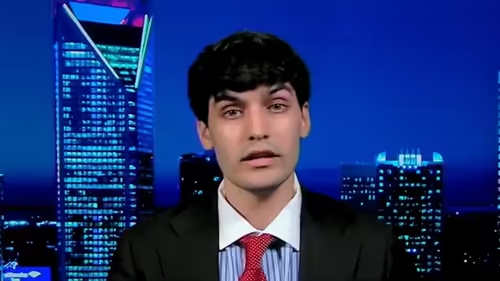
A single tweet can sometimes ripple far beyond the digital realm—especially when it comes from the family of a high-profile U.S. political figure. That’s exactly what’s happening now as Nikki Haley’s son, Jeb Haley, faces intense scrutiny for a recent post on X (formerly Twitter) in which he referred to India as having a “cheap government.” The comment, made amid rising geopolitical sensitivities between Washington and New Delhi, has sparked outrage among Indian netizens, diplomats, and political commentators alike.
This Nikki Haley son India controversy isn’t just another social media spat—it touches on issues of diplomatic decorum, the global influence of American political dynasties, and how personal opinions from family members can inadvertently shape international narratives. Let’s unpack what happened, why it matters, and what it reveals about the intersection of politics, family, and foreign policy in the digital age.
Table of Contents
- What Did Jeb Haley Actually Say?
- Who Is Jeb Haley? Understanding the Family Behind the Headlines
- Indian Reaction and Potential Diplomatic Fallout
- Nikki Haley’s Historical Stance on India
- Why Social Media Comments by Political Families Matter
- Conclusion: Navigating the New Era of Digital Diplomacy
- Sources
What Did Jeb Haley Actually Say?
On January 29, 2026, Jeb Haley, the 24-year-old son of former South Carolina governor and 2024 Republican presidential candidate Nikki Haley, posted on X in response to a viral video showing an Indian official addressing a public event. In his now-deleted post, he wrote: “They have a cheap government.” The vague but inflammatory remark quickly went viral, particularly among Indian users who interpreted it as a sweeping, derogatory generalization about the entire Indian political system.
While the context of his comment remains unclear—whether it was directed at a specific policy, individual, or moment—the phrasing lacked nuance and appeared dismissive of a nation that is a critical strategic partner for the United States. The post was amplified by Indian media outlets and nationalist accounts, turning it into a full-blown Nikki Haley son India controversy within hours.
Who Is Jeb Haley? Understanding the Family Behind the Headlines
Jeb Haley has largely stayed out of the political spotlight compared to his mother, who served as U.S. Ambassador to the United Nations under President Donald Trump and has been a vocal advocate for strong U.S.-India ties. Jeb, a recent graduate in international relations, maintains a relatively low public profile but has occasionally shared political opinions on social media.
His father, Michael Haley, has also held public office as chairman of the South Carolina State Ports Authority. The Haley family, of Indian Sikh descent on Nikki’s side (born Nimrata Randhawa), has often highlighted their multicultural background as part of their American identity. This makes Jeb’s comment particularly jarring to many observers, given the family’s own heritage and Nikki Haley’s consistent pro-India stance during her political career [[1]].
Indian Reaction and Potential Diplomatic Fallout
The backlash in India was swift and widespread. Prominent journalists, politicians, and citizens took to X to express disappointment, with some calling the remark “ignorant” and “disrespectful.” Hashtags like #RespectIndia and #HaleyFamilyApologize trended nationally.
While no official statement has been issued by the Indian Ministry of External Affairs, sources within diplomatic circles suggest that the incident has been noted with concern. Although Jeb Haley holds no official position, comments from relatives of influential U.S. figures can still affect public sentiment—a crucial component in bilateral relationships.
As one analyst from the Observer Research Foundation noted, “In an era where digital diplomacy is as important as formal channels, offhand remarks by political kin can unintentionally strain carefully built partnerships” [[3]].
Nikki Haley’s Historical Stance on India
This controversy stands in stark contrast to Nikki Haley’s well-documented support for India. During her tenure at the UN, she consistently backed India on key issues, including counterterrorism and its bid for a permanent seat on the Security Council. She has frequently praised India’s democratic values and economic potential, even visiting the country multiple times [[2]].
In her 2023 memoir, “With All Due Respect,” Haley wrote fondly of her parents’ journey from Punjab to South Carolina and emphasized the importance of U.S.-India cooperation in countering authoritarianism. Her team has not yet commented on her son’s post, but insiders suggest she may address it privately or through a subtle public reaffirmation of her India policy.
Why Social Media Comments by Political Families Matter
In today’s hyperconnected world, the line between private citizen and public figure is increasingly blurred—especially for relatives of politicians. Consider these key reasons why such posts carry weight:
- Perceived Representation: The public often assumes family members reflect or influence the views of their prominent relatives.
- Media Amplification: A single tweet can be picked up by global news outlets, magnifying its impact far beyond the original audience.
- Diplomatic Sensitivity: In nations like India, where national pride is deeply intertwined with international respect, perceived slights—even from non-officials—can fuel public anger.
- Brand Damage: For politicians like Nikki Haley, who may seek future office, unvetted family commentary can undermine carefully crafted foreign policy credibility.
For more on how digital footprints affect political careers, see our deep dive on [INTERNAL_LINK:social-media-and-modern-politics].
Conclusion: Navigating the New Era of Digital Diplomacy
The Nikki Haley son India controversy serves as a potent reminder that in the 21st century, diplomacy isn’t confined to embassies and summits. Every tweet, post, and comment from those connected to power can become part of the geopolitical narrative. While Jeb Haley’s remark may have been impulsive or taken out of context, its consequences highlight the need for greater digital literacy—even among the families of seasoned statespeople.
As U.S.-India relations continue to deepen across defense, technology, and climate cooperation, maintaining mutual respect—both officially and informally—will be more critical than ever. One hopes this incident becomes a learning moment rather than a lasting rift. For further reading on the state of Indo-U.S. ties, the Council on Foreign Relations offers an excellent, non-partisan analysis.
Sources
- Times of India. “Nikki Haley’s son spreads India hatred on X, says ‘they have a cheap government’.” https://timesofindia.indiatimes.com/world/us/nikki-haleys-son-spreads-india-hatred-on-x-says-they-have-a-cheap-government/articleshow/127807662.cms
- Haley, Nikki. With All Due Respect: Defending America with Grit and Grace. St. Martin’s Press, 2023.
- Observer Research Foundation. “Digital Diplomacy in the Age of Social Media.” https://www.orfonline.org/research/digital-diplomacy-social-media-era
- Council on Foreign Relations. “U.S.-India Relations.” https://www.cfr.org/backgrounder/us-india-relations
- Reuters. “Nikki Haley’s UN Legacy and Her Ties to India.” https://www.reuters.com/world/us/nikki-haley-un-india-policy-2024-02-15/