Introduction: The Quiet Missions That Could Save—or Sink—Pakistan
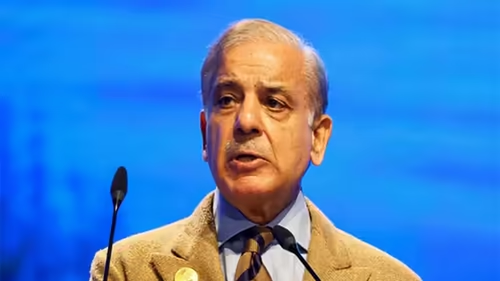
In a moment of startling candor, Pakistan’s Prime Minister Shehbaz Sharif has pulled back the curtain on a high-stakes, behind-the-scenes effort to rescue his country from the brink of financial ruin. According to his own account, he and Pakistan’s powerful Army Chief, General Asim Munir, have been quietly shuttling between friendly nations to secure emergency loans totaling billions of dollars [[1]]. This unprecedented civil-military duo diplomacy underscores just how dire Pakistan’s economic situation has become—and the painful compromises its leadership is now forced to make. The phrase “Shehbaz Sharif Asim Munir loans” is no longer just gossip; it’s the stark reality of a nation fighting for economic survival.
Table of Contents
- The Shehbaz Sharif Asim Munir Loans Revelation
- Why Pakistan Is on the Brink of Economic Collapse
- The “Quiet Diplomacy” Strategy: Why Secrecy Was Key
- China’s Role as Pakistan’s Financial Lifeline
- The IMF Shadow and Sovereignty Concerns
- Conclusion: A Nation Paying with Its Self-Esteem
- Sources
The Shehbaz Sharif Asim Munir Loans Revelation
Prime Minister Shehbaz Sharif’s public acknowledgment of these secret missions is itself a strategic move. By admitting the truth, he’s attempting to manage public expectations and preempt criticism. He didn’t just ask for help; he framed it as a necessary act of national sacrifice. “We had to lower our self-esteem,” he reportedly said, a poignant admission that speaks volumes about the humiliation of having to beg for financial assistance [[1]].
The involvement of Army Chief Asim Munir is particularly significant. In Pakistan, the military has long held sway over foreign and security policy. His presence on these loan-seeking missions signals that this is not just an economic issue but a matter of national security. It also suggests that any loan agreements likely come with strategic strings attached, especially from key partners like China.
Why Pakistan Is on the Brink of Economic Collapse
Pakistan’s current crisis isn’t sudden; it’s the culmination of decades of structural economic weaknesses:
- Chronic Trade Deficit: The country imports far more than it exports, draining its foreign exchange reserves.
- Massive Public Debt: Servicing existing debt consumes a huge portion of the national budget.
- Political Instability: Frequent changes in government scare away long-term investors.
- External Shocks: Global inflation, rising oil prices, and climate-related disasters (like the 2022 floods) have devastated the economy [[2]].
The result is a gaping external financing gap—the difference between what Pakistan needs to pay its bills and what it actually has. Without immediate inflows of cash, the country risks defaulting on its international obligations.
The “Quiet Diplomacy” Strategy: Why Secrecy Was Key
These missions were conducted “quietly” for several critical reasons:
- Market Stability: Public knowledge of a desperate loan hunt could trigger a panic, causing the Pakistani rupee to plummet further and capital to flee.
- Negotiating Leverage: Announcing their desperation would weaken their bargaining position with lenders.
- Domestic Politics: Admitting dependence on foreign powers is politically toxic in a country with a strong nationalist sentiment.
This approach, while pragmatic, also highlights the fragility of Pakistan’s economic sovereignty. [INTERNAL_LINK:pakistan-economic-policy-history] shows a recurring pattern of crisis-driven, reactive policymaking rather than long-term planning.
China’s Role as Pakistan’s Financial Lifeline
While the specific countries visited haven’t all been named, China is widely understood to be the primary benefactor. As Pakistan’s all-weather friend and the driving force behind the $60+ billion China-Pakistan Economic Corridor (CPEC), Beijing has a vested interest in preventing its strategic partner from collapsing [[3]].
However, Chinese loans are not charity. They often come with conditions related to infrastructure projects, port access, and geopolitical alignment. This deepens Pakistan’s dependency on China, creating a complex dynamic where economic aid reinforces strategic subservience. For Islamabad, it’s a choice between two difficult paths: austerity under the IMF or deeper entanglement with Beijing.
The IMF Shadow and Sovereignty Concerns
Pakistan has a long and troubled history with the International Monetary Fund (IMF), having entered into over 20 bailout programs since the 1950s [[4]]. While the current efforts are focused on bilateral loans, the IMF remains a looming presence. Any new agreement with the Fund would almost certainly demand painful reforms: cutting subsidies, raising taxes, and privatizing state-owned enterprises.
The core dilemma for Pakistan’s leadership is this: every dollar of aid, whether from China or the IMF, comes at the cost of national autonomy. The “lowered self-esteem” Sharif spoke of is the erosion of a nation’s ability to chart its own course. The world is watching to see if this latest round of Shehbaz Sharif Asim Munir loans will be a temporary reprieve or the prelude to a more profound loss of control.
Conclusion: A Nation Paying with Its Self-Esteem
The story of the Shehbaz Sharif Asim Munir loans is more than a financial tale; it’s a human and political drama about a nation’s struggle for dignity in the face of overwhelming odds. The quiet missions may have secured the funds needed to keep the lights on for another few months, but they have also exposed the deep structural flaws in Pakistan’s economy and governance. The real test will be whether this crisis becomes a catalyst for genuine reform, or merely another chapter in a cycle of dependency and decline.
Sources
- Times of India: Shehbaz Sharif, Asim Munir ‘quietly’ visited countries to seek loans for Pakistan [[1]]
- World Bank: Pakistan Overview [[2]]
- Council on Foreign Relations: The China-Pakistan Economic Corridor [[3]]
- International Monetary Fund: IMF Country Focus: Pakistan [[4]]