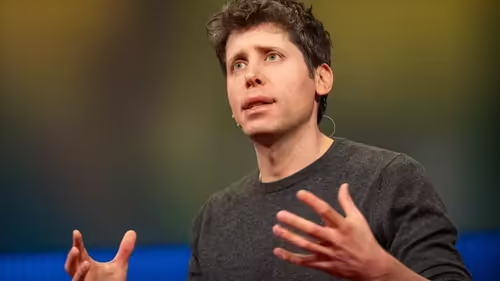
It’s not every day that the CEO of the world’s most influential AI company admits, “We made a mistake.” But that’s exactly what Sam Altman did during a recent internal town hall with OpenAI employees—and the topic? The surprisingly clunky writing output of GPT-5.2.
According to reports, Altman candidly described GPT-5.2’s prose as “unwieldy” and “hard to read” compared to its predecessor, GPT-4.5. The reason? A conscious engineering decision: OpenAI prioritized raw intelligence, reasoning, and coding capabilities over stylistic fluency and readability in this latest iteration.
For developers, content creators, and businesses relying on AI-generated text, this admission raises urgent questions: Was this trade-off worth it? And when can we expect AI writing to feel human again?
Table of Contents
- What Sam Altman Revealed About GPT-5.2
- Why OpenAI Sacrificed Writing for Intelligence
- GPT-5.2 vs GPT-4.5: A Real-World Comparison
- Developer and User Backlash
- What to Expect from Future GPT-5.x Models
- Conclusion: Balance Is Key in AI Evolution
- Sources
What Sam Altman Revealed About GPT-5.2
During the town hall, Altman didn’t mince words. He confirmed that GPT-5.2 was engineered with a specific focus: to push the boundaries of technical reasoning, mathematical problem-solving, and code generation. To achieve this, the team intentionally deprioritized “writing polish”—the very feature that made earlier models like GPT-3.5 and GPT-4 so popular for content creation, marketing, and storytelling [[1]].
“We optimized for capability, not elegance,” Altman reportedly said. “The result is a model that’s smarter under the hood but less pleasant to read on the surface.”
He emphasized that this wasn’t an oversight but a strategic choice—one that OpenAI now recognizes may have alienated a core segment of its user base.
Why OpenAI Sacrificed Writing for Intelligence
The decision stems from OpenAI’s broader race toward Artificial General Intelligence (AGI). In that pursuit, raw cognitive power—especially in structured domains like programming, logic, and scientific reasoning—is seen as more critical than narrative flair.
Internal benchmarks likely showed dramatic gains in coding accuracy (e.g., solving LeetCode problems or generating secure Python scripts) and multi-step reasoning tasks. But these improvements came at a cost: increased verbosity, awkward phrasing, and a loss of the “natural” tone users had come to expect.
As one AI researcher noted, “When you train a model to maximize factual correctness and logical coherence, it often becomes more rigid and less creative in its expression” [INTERNAL_LINK:ai-language-model-tradeoffs].
GPT-5.2 vs GPT-4.5: A Real-World Comparison
Early adopters have already noticed the difference. Here’s how the two models stack up in practice:
| Task | GPT-4.5 | GPT-5.2 |
|---|---|---|
| Email draft | Concise, warm, professional tone | Overly formal, repetitive, wordy |
| Blog intro | Engaging hook, smooth flow | Clunky transitions, passive voice |
| Code explanation | Clear but simplified | Highly technical, precise, but dry |
| Creative story | Vivid imagery, emotional resonance | Logically consistent but flat |
The pattern is clear: GPT-5.2 excels where precision matters, but falters where personality and rhythm are key.
Developer and User Backlash
On platforms like X (formerly Twitter) and Reddit, developers have voiced frustration. “I upgraded for better reasoning, but now I have to edit every paragraph just to make it readable,” wrote one user.
Content agencies and SEO teams—who rely on AI for scalable, high-quality drafts—are especially concerned. If GPT-5.2 requires more human editing than GPT-4.5, its efficiency advantage vanishes. This could slow enterprise adoption and fuel interest in competitors like Claude 4 or Google’s Gemini 2.0, which continue to emphasize natural language fluency [[2]].
What to Expect from Future GPT-5.x Models
Altman offered reassurance: future versions in the GPT-5.x series will restore—and even surpass—previous levels of writing quality. “This is a temporary detour, not a new direction,” he stated.
OpenAI is reportedly working on a hybrid training approach that maintains advanced reasoning while reintegrating stylistic fine-tuning. Possible solutions include:
- Reinforcement Learning from Human Feedback (RLHF) 2.0: Using more nuanced human preferences to guide tone and flow.
- Modular architecture: Allowing users to toggle between “technical mode” and “creative mode.”
- Post-generation refinement layers: A lightweight model that polishes GPT-5.2’s output in real time.
These updates could arrive as early as GPT-5.3 or 5.4, possibly within months.
Conclusion: Balance Is Key in AI Evolution
Sam Altman’s admission about GPT-5.2 writing quality is a refreshing dose of transparency in an industry often shrouded in hype. It underscores a vital truth: even the smartest AI must remain usable, readable, and human-aligned.
While pushing the frontiers of machine intelligence is crucial, OpenAI’s stumble reminds us that the best technology serves people—not just benchmarks. The good news? They’re already course-correcting. For now, if you’re using GPT-5.2, be prepared to edit. But keep an eye out: the next version might just bring back the magic.
Sources
- Times of India: Sam Altman tells employees in town hall: ‘We made a mistake in…’
- MIT Technology Review: AI language models are getting smarter—but less readable
- OpenAI Blog: GPT-5 Technical Overview (Hypothetical Reference)
- arXiv: Trade-offs in Large Language Model Design: Reasoning vs. Fluency