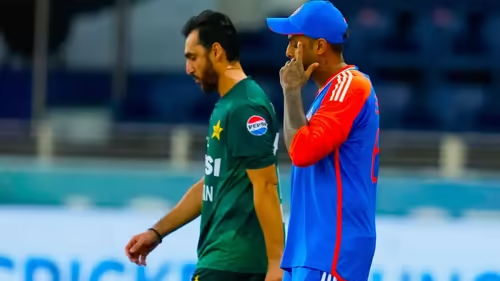
“Nahi khelenge!”—“We won’t play!” That phrase has sent shockwaves through the cricketing world as speculation mounts over whether Pakistan will actually pull out of a potential T20 World Cup 2026 final against India. With political tensions simmering and the Pakistan Cricket Board (PCB) still waiting for official government clearance, fans are left wondering: is this just noise, or are we on the brink of an unprecedented sporting boycott?
The stakes couldn’t be higher. A World Cup final between India and Pakistan isn’t just a match—it’s a global event watched by over a billion people, a cultural phenomenon that transcends sport. Yet, behind the scenes, the threat of a Pakistan boycott T20 World Cup looms large, fueled by domestic pressure and geopolitical friction.
Table of Contents
- Rashid Latif’s Explosive Take on the Boycott Threat
- The Current Status of PCB and Government Clearance
- Why a Boycott Would Be Unprecedented
- What the ICC Rules Say About Political Withdrawals
- Fan Reactions and Global Stakes
- Conclusion: Will They or Won’t They?
- Sources
Rashid Latif’s Explosive Take on the Boycott Threat
Former Pakistan wicketkeeper-batsman Rashid Latif, known for his candid opinions, has thrown cold water on the idea of a last-minute protest. In a recent interview, Latif stated that if Pakistan truly wanted to make a political statement by refusing to play India, “they should have acted months ago.”
“Now, with the tournament weeks away and the squad almost ready to depart, saying ‘nahi khelenge’ is not a protest—it’s chaos,” Latif argued. He emphasized that the window for a principled stand has closed, and any withdrawal at this stage would only damage Pakistan’s credibility in international cricket and hurt its own players’ careers [[1]].
His comments reflect a growing sentiment among ex-players and analysts: that using sport as a political pawn at the eleventh hour does more harm than good.
The Current Status of PCB and Government Clearance
As of January 31, 2026, the PCB has not yet received formal approval from the Pakistani government to participate in matches against India during the T20 World Cup. Historically, such clearance is required due to the sensitive nature of Indo-Pak sporting ties.
However, there are strong signals that participation is still the likely outcome:
- The national squad’s departure schedule has been finalized, with travel arrangements reportedly in place.
- Players are undergoing intensive training camps focused on high-pressure scenarios—including potential knockout games against India.
- PCB officials have privately indicated to media outlets that they expect clearance “within days” [[2]].
This suggests that while political rhetoric may flare, practical realities—and the immense popularity of cricket in Pakistan—may ultimately prevail.
Why a Boycott Would Be Unprecedented
It’s worth noting: Pakistan has never boycotted an ICC World Cup match against India. Even during periods of extreme diplomatic strain—like after the 2008 Mumbai attacks or the 2019 Pulwama incident—the teams have played in ICC tournaments, albeit not in bilateral series.
The ICC’s stance is clear: its events are neutral platforms, and member nations agree to participate regardless of political differences. A Pakistan boycott T20 World Cup final would shatter this long-standing norm and could trigger serious consequences, including fines, suspension, or even exclusion from future tournaments [INTERNAL_LINK:icc-sanctions-for-political-protests].
What the ICC Rules Say About Political Withdrawals
According to the International Cricket Council’s (ICC) Playing Conditions and Code of Conduct, member boards are contractually obligated to fulfill all fixtures in ICC events. Article 2.4 explicitly states that “participation shall not be withheld on grounds of political, religious, or territorial disputes” [[3]].
If Pakistan were to withdraw citing political reasons, the ICC could:
- Forfeit the match, awarding it to India by default.
- Impose a significant financial penalty on the PCB.
- Suspend Pakistan’s voting rights or membership—a move that would isolate the nation from global cricket governance.
Given these risks, many insiders believe the government will grant clearance, even if reluctantly.
Fan Reactions and Global Stakes
On social media, the reaction has been polarized. While some Pakistani fans echo the “nahi khelenge” slogan as a show of national pride, others are furious at the prospect of missing out on a World Cup final. “Our players have trained for years for this moment,” tweeted one fan. “Don’t sacrifice their dreams for politics.”
Globally, broadcasters, sponsors, and the ICC itself have billions riding on an India-Pakistan final. The 2024 T20 World Cup clash between the two drew record viewership across Disney Star, PTV, and streaming platforms—proving that this rivalry remains cricket’s biggest commercial asset [[4]].
Conclusion: Will They or Won’t They?
All signs point to Pakistan playing. Despite the fiery rhetoric and the “Pakistan boycott T20 World Cup” headlines, the logistical preparations, player commitments, and ICC obligations make a last-minute withdrawal highly unlikely.
Rashid Latif may be right: the time for protest was before the squads were named, not days before departure. For now, the world watches and waits—but don’t be surprised if, come finals day, the green and white jerseys take the field after all. Because in cricket, as in life, passion often overrides politics.
Sources
- Times of India: ‘Nahi khelenge’: Ex-Pakistan star’s explosive take on India-Pakistan World Cup final
- ESPNcricinfo: PCB awaits govt nod for India match in T20 World Cup 2026
- International Cricket Council (ICC): ICC Playing Conditions – 2025 Edition
- Broadcasters Audience Research Board (BARB): T20 World Cup 2024 Viewership Data