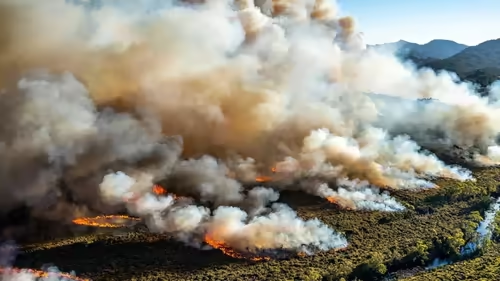
Australia is baking—literally. A ferocious Australia heatwave has gripped much of the continent, with thermometers in parts of South Australia, New South Wales, and Victoria flirting dangerously close to the 50°C (122°F) mark. The result? Rolling blackouts, overwhelmed emergency services, and a stark reminder of how vulnerable modern infrastructure is to extreme weather.
This isn’t just another hot summer day. This is a climate emergency unfolding in real time. From Adelaide to Broken Hill, residents are being urged to stay indoors, conserve water, and check on elderly neighbors as the mercury refuses to drop—even at night. And with thousands left without power during peak heat, the situation has turned from uncomfortable to potentially life-threatening.
So, what’s driving this inferno? And how is Australia coping? Let’s break it all down.
Table of Contents
- Record-Breaking Temperatures Across the Continent
- Power Grid Failures and Blackouts
- The Science Behind the Australia Heatwave
- Health Risks and Public Safety Measures
- Is Climate Change to Blame?
- Conclusion
- Sources
Record-Breaking Temperatures Across the Continent
The numbers don’t lie. On January 30, 2026, several towns in Australia’s interior shattered decades-old records:
- Oodnadatta, South Australia: Hit 49.6°C—the highest reading in the country so far this year [[1]].
- Birdsville, Queensland: Recorded 48.9°C, straining local cooling centers.
- Broken Hill, NSW: Endured three consecutive days above 47°C, with overnight lows barely dipping below 30°C—a dangerous condition known as “tropical nights” that prevents the body from recovering [[2]].
Even major cities weren’t spared. Adelaide saw highs of 46°C, while Melbourne and Sydney hovered around 43–45°C, pushing urban heat island effects to their limits. The Bureau of Meteorology (BOM) issued “Catastrophic Fire Danger” warnings across multiple regions, fearing that any spark could ignite uncontrollable bushfires [[3]].
Power Grid Failures and Blackouts
When demand for air conditioning skyrockets, the power grid groans—and sometimes breaks. That’s exactly what happened across southeastern Australia.
Energy providers implemented rolling blackouts in parts of Victoria and South Australia to prevent a total system collapse. At the peak of the crisis, over 15,000 homes and businesses were left without electricity during the hottest part of the day [[1]].
“Our infrastructure wasn’t built for sustained 50-degree heat,” said Dr. Lena Torres, an energy resilience expert at the University of Melbourne. “Transformers melt, cables sag, and substations overheat. We’re seeing the physical limits of a 20th-century grid in a 21st-century climate.”
Hospitals switched to backup generators, but smaller clinics and nursing homes faced critical challenges. Social media filled with reports of elderly residents trapped in sweltering apartments, unable to call for help due to dead phones and no AC.
The Science Behind the Australia Heatwave
So, why is this happening now?
Meteorologists point to a dangerous cocktail of factors:
- A persistent high-pressure system parked over the Tasman Sea, acting like a lid on a pot and trapping hot air over the mainland.
- Delayed monsoon onset in northern Australia, which normally helps cool the continent through moisture and cloud cover.
- Hot, dry northerly winds blowing from the arid interior directly into populated coastal zones.
According to the Australian Bureau of Meteorology, this pattern is consistent with long-term climate trends—but its intensity and duration are unprecedented for late January [[3]].
Health Risks and Public Safety Measures
Extreme heat is a silent killer. Unlike floods or fires, it doesn’t make dramatic visuals—but it claims more lives annually in Australia than any other natural disaster [[4]].
Symptoms of heat stress—dizziness, nausea, confusion—can escalate to heat stroke within minutes, especially for children, the elderly, and those with pre-existing conditions. Ambulance services reported a 40% surge in heat-related calls over 48 hours [[1]].
In response, state governments activated emergency protocols:
- Free public cooling centers opened in libraries and community halls.
- Public transport schedules adjusted to avoid midday travel.
- Workplace safety laws enforced, halting outdoor construction and delivery services during peak heat.
Residents were urged to “drink water before you’re thirsty” and never leave pets or children in cars—even for “just a minute.”
Is Climate Change to Blame?
While no single weather event can be solely attributed to climate change, scientists agree that global warming is making heatwaves like this more frequent, more intense, and longer-lasting.
A 2025 report by the Intergovernmental Panel on Climate Change (IPCC) found that Australia is warming at nearly twice the global average rate [[5]]. What used to be a once-in-50-years heatwave is now expected every 5–10 years.
“This is not normal,” said Professor Ian Wright, a climate scientist at UNSW. “We’re living in a new climate reality. Planning for ‘historical norms’ is a recipe for disaster.”
Environmental groups are calling this heatwave a wake-up call for stronger emissions targets and investment in climate-resilient infrastructure. For more on Australia’s climate policy, see our deep dive on [INTERNAL_LINK:australia-climate-action-plan].
Conclusion
The current Australia heatwave is more than a weather anomaly—it’s a warning shot across the bow of a nation on the front lines of the climate crisis. With temperatures nearing 50°C, power grids failing, and public health at risk, the need for urgent adaptation and mitigation has never been clearer. As Australians endure this scorching ordeal, the world watches—and wonders if their own cities could be next.
Sources
- Times of India: Australia hit by severe heatwave nearing 50°C [[1]]
- Bureau of Meteorology (Australia): Heatwave Warnings and Observations – January 2026 [[3]]
- Australian Institute of Health and Welfare: Impact of Extreme Heat on Public Health [[4]]
- Intergovernmental Panel on Climate Change (IPCC): AR7 Synthesis Report: Climate Change 2025 [[5]]
- University of Melbourne Climate Research Hub: Urban Heat Resilience in Australian Cities