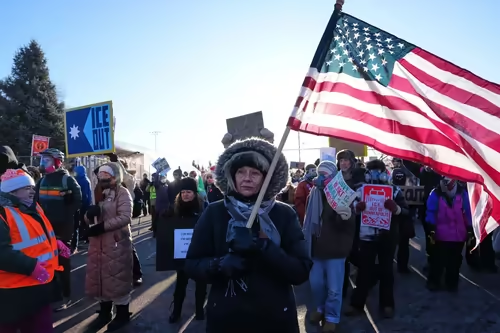
In an unprecedented show of collective resistance, a massive wave of civil disobedience has swept across the United States. The trigger? A renewed and aggressive Trump immigration crackdown that has left communities fearful and furious. The rallying cry is simple yet powerful: “No work, no school, no shopping.” This isn’t just a protest; it’s a full-throated demand for humanity in the face of what many see as a dehumanizing government policy.
Table of Contents
- The Nationwide Impact of the Strike
- How the Trump Immigration Crackdown Sparked National Fury
- Businesses Join the Movement: More Than Just a Boycott
- The Human Cost and Community Response
- Conclusion: A Nation at a Crossroads
- Sources
The Nationwide Impact of the Strike
The scale of this coordinated action is staggering. What began as calls for a general strike has materialized into a tangible disruption of daily life in major cities and small towns alike. In Minneapolis, thousands flooded the streets outside the Bishop Henry Whipple Federal Building, effectively shutting down a key government hub [[3]]. The city, which had already seen a one-day general strike earlier in January, became a focal point for national media attention [[7]].
Nowhere was the impact more visible than in the education system. In Arizona, the Tucson Unified School District made the extraordinary decision to cancel classes at over 20 campuses, citing severe staffing shortages as teachers and support staff joined the protest [[16]]. Similarly, in the Phoenix metro area, students from around 30 schools staged walkouts, their voices echoing through state capitols [[12]]. Colorado saw a parallel response, with multiple Denver metro school districts cancelling classes due to high staff absences linked directly to the planned “ICE OUT” demonstrations [[13]].
How the Trump Immigration Crackdown Sparked National Fury
The current wave of outrage is not happening in a vacuum. It is a direct reaction to a series of fatal shootings and aggressive raids by Immigration and Customs Enforcement (ICE) agents, which have been widely publicized and condemned. The Department of Justice has even launched a probe into one such deadly incident, further fueling public distrust [[4]].
The administration’s policies, often referred to as “Operation Metro Surge,” have created an atmosphere of fear in immigrant communities. Families are afraid to send their children to school or visit the doctor, and workers are hesitant to report to their jobs [[6]]. This climate of fear is the very engine driving the “no work, no school, no shopping” movement—it’s a strategy to make the invisible human cost of these policies impossible for the government to ignore.
Businesses Join the Movement: More Than Just a Boycott
The strike has transcended individual action, with a significant number of businesses choosing to stand in solidarity. From Chicago to Tacoma, small business owners have closed their doors for the day, not just as a political statement but as a practical act of community care [[22], [20]]. Many are going a step further by donating a portion of their profits—or their entire day’s potential revenue—to organizations that support immigrant rights, such as the National Immigration Law Center and United We Dream [[25]].
This business participation is crucial. It demonstrates that the opposition to the Trump immigration crackdown isn’t limited to activist circles but is deeply embedded in the economic and social fabric of local communities. For many immigrant-owned businesses, the increased ICE activity has already led to a sharp decline in customers and staffing, making their participation both a moral and a personal stance [[21]].
The Human Cost and Community Response
Beyond the headlines of school closures and street protests lies a profound human story. The crackdown has fractured families, silenced communities, and instilled a deep sense of insecurity. Social media has been flooded with stories of children too scared to go to school and parents who haven’t left their homes in days.
In response, a powerful network of mutual aid and support has emerged. Community centers are offering legal aid workshops, neighbors are organizing childcare for striking parents, and local restaurants are providing free meals to protesters. This grassroots mobilization is a testament to the resilience of the communities most affected. It’s a clear message: while the government may seek to divide, these communities are choosing to unite and protect one another.
Conclusion: A Nation at a Crossroads
The “no work, no school, no shopping” strike is more than a single day of protest; it’s a defining moment for American democracy. It forces a national conversation about the values the country wishes to uphold. The widespread participation—from students and teachers to small business owners and ordinary citizens—shows a deep-seated belief that the current Trump immigration crackdown is not just a policy failure, but a moral one. As the nation watches, the question remains: will this powerful display of collective action lead to a change in course?
Sources
- [[1]] PBS NewsHour: Protesters call for nationwide strike against Trump’s immigration policies
- [[3]] OPB: People gather for a protest outside the Bishop Henry Whipple Federal Building
- [[4]] Al Jazeera: US protesters begin nationwide strike as DOJ launches Petti killing probe
- [[6]] Wikipedia: Operation Metro Surge
- [[7]] Workers Liberty: One-day general strike in Minnesota
- [[12]] KTAR News: Students from around 30 Valley schools walk out for ICE protests
- [[13]] Chalkbeat Colorado: Denver metro school districts cancel classes on day of planned ICE protests
- [[16]] Arizona Republic: Students walk out across metro Phoenix to rally against ICE
- [[20]] The News Tribune: Tacoma businesses respond to ‘National shutdown’ protest
- [[21]] Sahan Journal: ICE raids leave Minnesota businesses reeling
- [[22]] CBS Chicago: Chicago businesses join national “ICE Out” strike day
- [[25]] Lataco: 31 Non-Profit Organizations Supporting Immigrants Right Now