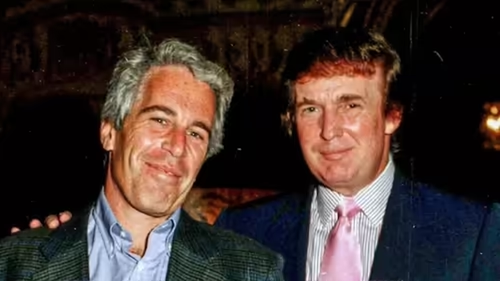
In a move that reignited conspiracy theories and political firestorms alike, the U.S. Department of Justice (DOJ) briefly released—and then swiftly removed—a document from the so-called ‘Epstein Files‘ that contained unverified allegations tying former President Donald Trump to convicted sex offender Jeffrey Epstein. The file, which also mentioned Bill Clinton and the late Lisa Marie Presley, was published as part of a broader release of materials but yanked within hours, raising urgent questions about transparency, credibility, and the weaponization of decades-old rumors [[1]].
Table of Contents
- What Happened: The Epstein Files Trump Document Release
- Contents of the Removed File: Unverified and Secondhand
- Why the Justice Department Pulled the Document
- Historical Context: Trump-Epstein Relationship – Facts vs. Rumors
- Media Reaction and Public Discourse
- Legal and Ethical Implications of Releasing Unverified Complaints
- Conclusion: Navigating Truth in the Age of Information Overload
- Sources
What Happened: The Epstein Files Trump Document Release
On January 30, 2026, the DOJ published a batch of documents related to its ongoing review of materials tied to Jeffrey Epstein’s criminal activities. Among them was a PDF containing summaries of FBI complaints—some dating back as far as 35 years—that referenced high-profile individuals, including Donald Trump, Bill Clinton, and Lisa Marie Presley [[1]]. Within hours, however, the document vanished from the official portal. The DOJ later confirmed the removal, citing “quality control and verification protocols” as the reason [[3]].
Despite its brief appearance, the file was archived and shared widely online, ensuring its contents would not be easily erased from public discourse. This incident has become the latest flashpoint in the long-running saga of the Epstein files Trump narrative.
Contents of the Removed File: Unverified and Secondhand
Critically, the document did not contain evidence of criminal conduct. Instead, it compiled raw, unvetted summaries of tips and complaints received by the FBI over decades. Key red flags about its reliability include:
- Several complainants provided no contact information, making follow-up impossible.
- At least one entry was based on secondhand information, with an email noting the source “heard from someone who heard…” [[1]].
- The summaries were not investigations—they were preliminary intake notes, often lacking corroboration or factual basis.
Legal experts stress that such documents are standard in large-scale investigations but are never meant to be treated as proof of wrongdoing. As the DOJ itself has repeatedly stated, inclusion in such files does not imply guilt or even credibility.
Why the Justice Department Pulled the Document
The DOJ’s quick retraction suggests internal oversight failures. According to a statement from a department spokesperson, the file was “inadvertently published without undergoing final redaction and verification checks” [[3]]. This aligns with standard procedure: sensitive documents involving unproven allegations against public figures are typically reviewed multiple times before release to avoid reputational harm and misinformation.
The incident highlights the immense pressure on federal agencies to balance transparency with responsibility—a challenge amplified by today’s hyper-partisan media landscape.
Historical Context: Trump-Epstein Relationship – Facts vs. Rumors
Donald Trump and Jeffrey Epstein were known to socialize in the 1990s and early 2000s, often seen at parties in Palm Beach and New York. Trump himself once called Epstein a “terrific guy” in a 2002 New York Magazine interview—but later claimed they had a falling out around 2004 and hadn’t spoken since [[5]].
Notably, Trump is not named in any of Epstein’s court records as a participant in illegal activity, and no credible evidence has emerged linking him to Epstein’s trafficking ring. In fact, during his presidency, Trump’s administration oversaw the continuation of the investigation that led to Ghislaine Maxwell’s conviction [[7]].
For a deeper dive into the timeline of their association, see [INTERNAL_LINK:trump-epstein-relationship-timeline].
Media Reaction and Public Discourse
The temporary release triggered a polarized media storm. Outlets like CNN and MSNBC ran cautious segments emphasizing the unverified nature of the claims, while certain right-wing platforms decried it as a politically motivated leak. Social media exploded with memes, conspiracy threads, and calls for “full transparency”—despite the document’s lack of evidentiary value.
This episode underscores how easily raw data can be weaponized in the digital age, especially when it involves polarizing figures like Trump.
Legal and Ethical Implications of Releasing Unverified Complaints
Releasing unverified allegations—even accidentally—raises serious ethical concerns. The American Bar Association and legal scholars warn that such disclosures can cause irreparable reputational damage, regardless of truth. The FBI’s own guidelines state that “raw tips are not evidence” and should not be disseminated publicly without context [[9]].
Moving forward, this incident may prompt stricter protocols for document releases under the Freedom of Information Act (FOIA), especially in high-profile cases.
Conclusion: Navigating Truth in the Age of Information Overload
The brief appearance of the Epstein files Trump document serves as a cautionary tale. In an era where a screenshot can go viral before facts are verified, both institutions and citizens must exercise extreme diligence. While transparency is vital, it must be paired with responsibility. The real story here isn’t the content of the file—it’s how we choose to interpret, share, and act on unverified information in a world hungry for scandal.
Sources
- Times of India: Epstein Files – Justice Department Temporarily Removes Document
- U.S. Department of Justice: Official Statement on Epstein Document Releases
- FBI: Jeffrey Epstein Case History
- The New York Times: DOJ Pulls Epstein Document Mentioning Trump
- The Washington Post: What We Know About the Removed Epstein File