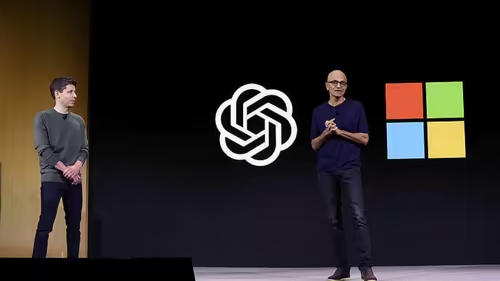
It was a reckoning Wall Street had been dreading. On January 28, 2026, Microsoft’s stock price plummeted by over 10%, vaporizing a staggering $360 billion in market value in a single trading session [[5]]. This wasn’t just a bad day; it was a seismic event that laid bare the immense, and potentially catastrophic, financial exposure from its deepening alliance with Sam Altman’s OpenAI. The era of unchecked AI optimism was officially over, replaced by a harsh reality check for investors.
Table of Contents
- The $360 Billion Selloff: What Happened?
- The Microsoft OpenAI Alliance: A Deep Dive
- The Hidden Risk: 45% of Cloud Tied to One Partner
- Is the AI Spending Bubble Bursting?
- Conclusion: A Strategic Pivot or a Costly Mistake?
- Sources
The $360 Billion Selloff: What Happened?
The trigger was Microsoft’s Q2 FY2026 earnings report. While the company beat overall revenue expectations, the details sent shivers down investors’ spines. The core issue? Azure cloud growth, while still strong at 39%, came in just below analyst forecasts [[8]]. In the current climate, “just below” is not good enough. Investors, already wary of the massive capital expenditures required to fuel the AI race, saw this as a red flag. They began to question the sustainability of pouring billions into an unprofitable venture with no clear path to ROI [[1]].
The Microsoft OpenAI Alliance: A Deep Dive
Microsoft’s relationship with OpenAI is far more than a simple investment. It’s a complex, multi-layered strategic partnership that has fundamentally reshaped the company’s future. To date, Microsoft has committed a colossal $13 billion to the AI lab, with $11.6 billion already funded [[9]]. In return, Microsoft secured a reported 27% stake in OpenAI and, crucially, became its exclusive cloud provider [[13], [26]].
This deal included a landmark agreement for OpenAI to spend an incremental $250 billion on Microsoft Azure services [[12], [26]]. On the surface, this looked like a guaranteed revenue stream. However, the reality is more nuanced. OpenAI is a money-losing machine, reportedly burning through billions of dollars a quarter [[6]]. Its ability to fulfill that $250 billion promise is entirely dependent on its continued access to massive funding rounds, which are becoming increasingly difficult to secure in a tightening market.
The Hidden Risk: 45% of Cloud Tied to One Partner
The most alarming revelation from the earnings call was a statistic that stunned the financial world: 45% of Microsoft’s $625 billion backlog of future cloud contracts is directly tied to OpenAI [[12], [19], [24]]. This is an extraordinary level of concentration risk. For context, this means nearly half of Microsoft’s future cloud revenue is dependent on the financial health and continued existence of a single, unprofitable partner.
This dependency creates a dangerous circular financing scheme:
- Microsoft invests billions in OpenAI.
- OpenAI uses that money (and more) to buy Azure credits from Microsoft.
- Microsoft books this as cloud revenue, boosting its financials.
- Investors reward Microsoft with a higher stock price, allowing it to raise more capital to… invest in OpenAI.
This loop works beautifully in a bull market. But when investor sentiment shifts, as it did in January 2026, the entire structure looks perilously fragile. If OpenAI stumbles, Microsoft’s cloud growth narrative—the very engine of its modern valuation—could stall dramatically.
Is the AI Spending Bubble Bursting?
Microsoft’s historic crash is a stark warning sign for the entire tech sector. The company spent a record $37.5 billion on capital expenditures in Q2 alone, a 66% year-over-year increase, almost all of it dedicated to building out its AI infrastructure [[11]]. This level of spending is unsustainable without a clear and rapid path to profitability from its AI ventures.
Investors are starting to ask tough questions: Are we in an AI bubble? Is the massive spending on data centers and custom silicon justified by the actual demand and monetization potential? Microsoft’s stock action suggests that the market is losing patience with the “growth at all costs” mentality that has dominated the AI gold rush. The focus is now shifting squarely to profitability and tangible returns on investment.
Conclusion: A Strategic Pivot or a Costly Mistake?
The $360 billion question is whether Microsoft’s deep integration with OpenAI will be remembered as a visionary strategic move or a catastrophic misstep. The partnership has undeniably positioned Microsoft at the forefront of the AI revolution. However, the extreme financial concentration and reliance on a partner with no clear path to profitability have created a significant vulnerability. The recent stock crash is a powerful reminder that even the world’s most valuable companies are not immune to the risks of putting all their eggs in one basket, especially when that basket is still being woven. For Microsoft, the path forward requires a delicate balance: continuing to innovate in AI while urgently demonstrating a credible plan to turn its massive investments into sustainable, profitable growth. The friendship with Sam Altman may have opened the door to the future, but it has also left Microsoft dangerously exposed to its potential pitfalls.
Sources
- [[1]] Times of India: How ‘friendship’ with Sam Altman cost Microsoft $360 billion in a day
- [[5]] TradingView: Microsoft Stock Sheds $360 Billion in Steep Post-Earnings Selloff
- [[6]] Heise Online: Altman’s reaction to OpenAI’s billion-dollar loss: “Enough”
- [[8]] Capacity Media: What Microsoft’s Azure miss says about the AI trade
- [[9]] LinkedIn (Analytics India Magazine): Microsoft’s Q1 FY2026 loss due to OpenAI investment
- [[11]] GeekWire: Microsoft beats expectations, cloud tops $50B as OpenAI and Anthropic deals reshape its business
- [[12]] CNBC: Microsoft (MSFT) Q2 earnings report 2026
- [[13]] Next Platform: Microsoft Is More Dependent On OpenAI Than The Converse
- [[19]] Instagram (W.Media): Microsoft has disclosed for the first time that 45 percent…
- [[24]] Times of India: How ‘friendship’ with Sam Altman cost Microsoft $360 billion in a day
- [[26]] GeekWire: Microsoft gets 27% stake in OpenAI, and a $250B Azure commitment