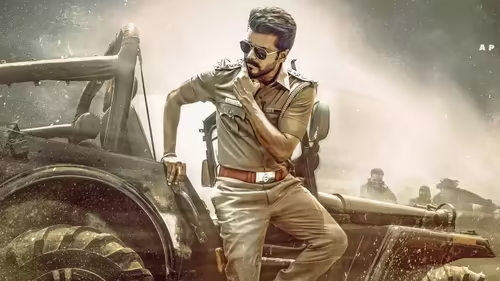
Introduction: A Blockbuster Held Hostage by Bureaucracy
For fans of Thalapathy Vijay, 2026 was supposed to be the year of Jana Nayagan—a high-stakes political drama billed as his most ambitious project yet. But instead of box office records, the film has become embroiled in a protracted legal battle with the Central Board of Film Certification (CBFC), pushing its release into uncertainty and sparking a nationwide debate about creative freedom versus regulatory control [[1]].
What began as a routine certification process has escalated into a constitutional showdown, with the CBFC now taking the matter to the Supreme Court. The stakes? Not just one film’s fate—but the future of artistic expression in Indian cinema.
Table of Contents
- What Happened? The Jana Nayagan Censor Controversy
- Legal Timeline: From Madras High Court to Supreme Court
- Why Is Jana Nayagan Under Scrutiny?
- Impact on Vijay’s Fans and the Tamil Film Industry
- Broader Implications for Indian Cinema
- Conclusion: Will Jana Nayagan Ever Release?
- Sources
What Happened? The Jana Nayagan Censor Controversy
The trouble began when the producers of Jana Nayagan submitted the final cut to the CBFC for certification. Reports suggest the board raised objections over certain dialogues and scenes deemed “politically sensitive” and potentially “inflammatory” in the current socio-political climate [[1]].
Instead of requesting minor edits, the CBFC reportedly withheld certification altogether—a move that stunned the production team, given Vijay’s track record of navigating censorship without major clashes. Frustrated by the delay, the producers approached the Madras High Court, seeking urgent relief.
Legal Timeline: From Madras High Court to Supreme Court
The legal saga unfolded in three key phases:
- Single Judge Order (January 2026): A single judge at the Madras High Court ruled in favor of the producers, directing the CBFC to grant an immediate U/A certificate, citing “undue delay” and lack of specific legal grounds for denial [[1]].
- CBFC Appeal: The CBFC swiftly challenged this order before a division bench of the same court, arguing that the film contained content that could “disturb public order.”
- Division Bench Reversal: The two-judge panel overturned the initial ruling, ordering a fresh hearing and effectively halting certification.
- Supreme Court Move: Now, the CBFC has escalated the matter to the Supreme Court of India, seeking to uphold its authority to withhold certification on national interest grounds [[1]].
As of today, the film cannot be released until the apex court delivers its verdict—a process that could take weeks or even months.
Why Is Jana Nayagan Under Scrutiny?
While the CBFC hasn’t released the full list of objections, industry insiders and leaked reports point to several flashpoints:
- Political Allegories: The film’s plot allegedly mirrors real-life political movements and figures, raising concerns about misinterpretation.
- Dialogue on Governance: Certain monologues by Vijay’s character are said to critique systemic corruption in ways regulators fear could incite unrest.
- Mass Appeal Factor: Given Vijay’s immense influence—especially among youth and politically active demographics—the CBFC may be exercising extreme caution [[2]].
Notably, similar concerns were raised during the release of films like *Kabali* and *Sarkar*, but those cleared with minor trims. The total certification block on Jana Nayagan is unprecedented for a Vijay-led project.
Impact on Vijay’s Fans and the Tamil Film Industry
The delay has sent shockwaves through the Tamil film ecosystem:
- Financial Losses: Distributors have already invested heavily in promotions, with advance bookings canceled and theater slots reassigned.
- Fan Disappointment: #ReleaseJanaNayagan trended nationally for days, with fan clubs organizing peaceful protests outside CBFC offices.
- Industry Precedent: Other big-budget films now face heightened scrutiny, fearing similar delays if their content touches on governance or social justice [INTERNAL_LINK:tamil-cinema-censorship-history].
For Vijay, who is widely speculated to be considering a political career, the controversy adds another layer of complexity—blurring the lines between cinema and real-world impact.
Broader Implications for Indian Cinema
This case isn’t just about one film—it’s a test of India’s commitment to free expression under Article 19(1)(a) of the Constitution. The Supreme Court has previously ruled in cases like *S. Rangarajan v. P. Jagjivan Ram* (1989) that film censorship must be narrowly tailored and not based on “vague apprehensions” [[3]].
If the CBFC’s appeal succeeds, it could embolden regulators to block more content preemptively. If the court sides with the filmmakers, it may force the CBFC to adopt clearer, more transparent guidelines—aligning with global standards upheld by bodies like the British Board of Film Classification (BBFC) [[4]].
Conclusion: Will Jana Nayagan Ever Release?
For now, the fate of Jana Nayagan rests in the hands of India’s highest judiciary. While fans hold onto hope, the delay underscores a growing tension between artistic vision and state oversight in modern Indian cinema.
One thing is certain: whether it releases tomorrow or six months from now, Jana Nayagan has already ignited a crucial conversation—one that may reshape how stories are told, and seen, in India for years to come.
Sources
- Times of India: Jana Nayagan censor row: CBFC moves Supreme Court, Thalapathy Vijay’s film release to be pushed further [[1]]
- The Hindu: Inside the Jana Nayagan Censor Debate [[2]]
- Supreme Court of India Judgments: S. Rangarajan v. P. Jagjivan Ram (1989) [[3]]
- British Board of Film Classification: Official Guidelines on Political Content [[4]]