Introduction: When History Becomes a Political Battleground
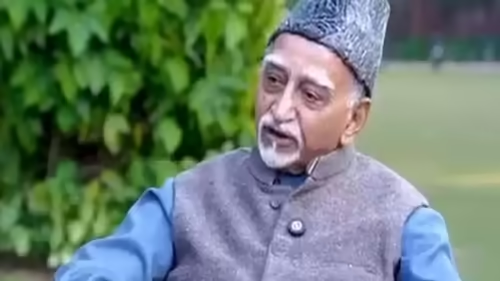
In a statement that has ignited a fierce national debate, former Vice President Hamid Ansari recently described the 11th-century conqueror Mahmud of Ghazni as an ‘Indian.’ This seemingly simple remark has been met with a barrage of criticism from the ruling Bharatiya Janata Party (BJP), which has accused Ansari—and by extension, the Congress party—of attempting to whitewash one of the most violent and destructive chapters in Indian history [[1]].
The controversy is more than just a semantic argument; it strikes at the heart of how a nation chooses to remember its past. Was Ghazni a foreign invader who plundered and destroyed, or can he be claimed as part of India’s complex historical tapestry? Let’s unpack this explosive issue.
Table of Contents
- The Controversial Remark and BJP Backlash
- Who Was Mahmud of Ghazni? The Historical Facts
- Why This Controversy Matters Today
- Conclusion: A Battle Over Narrative
- Sources
The Controversial Remark and BJP Backlash
The firestorm began when Hamid Ansari, who served two terms as Vice President under the Congress-led UPA government, made his comments during a public address. While the exact context of his full statement is debated, the core assertion—that Mahmud of Ghazni was ‘Indian’—has been seized upon by the BJP as evidence of a dangerous historical revisionism [[6]].
BJP spokesperson C. Kesavan led the charge, calling the remarks “shocking” and directly linking them to the Congress party’s legacy. In a social media post, she stated, “Indeed shocking remarks by former Vice President Shri Hamid Ansari ji, who was the Congress-led UPA’s choice for Vice President twice” [[6]].
Another prominent BJP leader, Shehzad Poonawalla, escalated the attack, accusing the entire Congress ecosystem of “eulogising” figures like Ghazni and the Lodhi dynasty as mere “Indian looters,” thereby downplaying their atrocities against Hindus, including the infamous destruction of the Somnath temple [[7]].
This political row is not happening in a vacuum. It’s a strategic move in the ongoing cultural and historical narrative war, where both parties seek to position themselves as the true guardians of India’s heritage and identity.
Who Was Mahmud of Ghazni? The Historical Facts
To understand the gravity of the controversy, we must first look at the historical record of Mahmud of Ghazni. He was the Sultan of the Ghaznavid Empire, with his capital in Ghazni, located in modern-day Afghanistan—a region that was never part of any historical Indian kingdom [[10]].
Between 1000 and 1027 AD, Mahmud launched a staggering 17 military campaigns into the Indian subcontinent [[13]]. His primary motives were wealth and religious zeal. His armies were notorious for their brutality, targeting wealthy Hindu and Jain temples, which were centers of both spiritual and economic power.
His most infamous raid was the 1025 AD sack of the Somnath temple in Gujarat. Historical accounts, including those from his own court historian Al-Utbi, describe how his forces demolished the temple, massacred its defenders, and carried away a colossal haul of gold, jewels, and other treasures back to Ghazni [[10]].
Indian historian Kishori Saran Lal estimates that Mahmud’s repeated invasions resulted in the death and enslavement of up to 2 million people [[11]]. These were not acts of a domestic ruler consolidating power; they were the systematic raids of a foreign conqueror seeking to plunder a wealthy neighbor. The idea that he could be considered ‘Indian’ is, from a historical and geographical standpoint, fundamentally flawed.
Key Facts About Mahmud of Ghazni’s Invasions
- Origin: Ruled from Ghazni (modern-day Afghanistan), not from any territory within the Indian subcontinent.
- Number of Raids: Conducted 17 separate military expeditions into India over a period of 27 years [[13]].
- Primary Target: Wealthy temples, especially the Somnath temple, which he destroyed in 1025 AD [[10]].
- Legacy: His invasions exposed the military fragmentation of Indian kingdoms and paved the way for future Turkic and Afghan invasions [[17]].
Why This Controversy Matters Today
This isn’t just about a 1000-year-old historical figure. The debate over Mahmud of Ghazni is a proxy for a much larger conflict over national identity and historical memory.
For the BJP, defending the narrative of Ghazni as a brutal foreign invader is central to its political ideology, which often emphasizes the protection of Hindu heritage from historical persecution. By attacking Ansari’s comments, they are reinforcing their base’s worldview and painting the Congress as out of touch with the sentiments of a large section of the population.
Conversely, the Congress and its supporters might argue that such a rigid, binary view of history ignores the complex syncretic culture that has developed in India over centuries. However, in this specific instance, the historical consensus is overwhelmingly clear: Ghazni was an external aggressor.
As a reader, you might be wondering, [INTERNAL_LINK:how-political-parties-use-history] or [INTERNAL_LINK:impact-of-historical-narratives-on-modern-politics]. These are crucial questions for any informed citizen in a democracy.
Conclusion: A Battle Over Narrative
The controversy sparked by Hamid Ansari’s remarks on Mahmud of Ghazni is a stark reminder that history is never just about the past—it’s a powerful tool used in the present. While the historical facts about Ghazni’s foreign origins and destructive raids are well-documented, the political interpretation of those facts remains a contentious battleground.
The BJP’s strong reaction is a calculated political strategy to dominate the narrative of India’s historical struggles. For the public, this episode serves as a call to engage critically with history, to seek out credible sources, and to understand how the past is constantly being reshaped to serve contemporary agendas. As the debate rages on, one thing is certain: the legacy of Mahmud of Ghazni will continue to be a flashpoint in India’s ongoing cultural and political discourse.
Sources
- Times of India: ‘Whitewashing brutal raids’: BJP on ex-VP Hamid Ansari calling Mahmud of Ghazni ‘Indian’ [[6]]
- Moneycontrol: BJP slams Hamid Ansari on ‘Ghazni and Lodhi were Indian looters’ remark [[7]]
- Indian Military History: Mahmud Ghaznavi’s 17 Invasions of India [[10]]
- Wikipedia: Mahmud of Ghazni [[11]]
- Maps of India: Mahmud Ghazni’s Invasions of India 17 Times [[13]]
- Vajiram & Ravi: Mahmud of Ghazni, Invasion in India, UPSC NOTES [[17]]