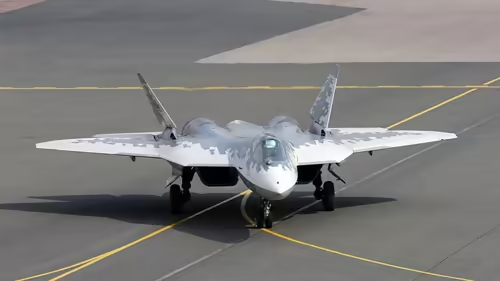
As China rapidly fields its J-20 stealth fighters and Pakistan eyes next-gen airpower, India faces a critical question: how to maintain air superiority in the 2030s? The answer may lie in an unexpected revival of old plans—advanced technical talks between New Delhi and Moscow for the joint production of Russia’s Su-57 fighter jet [[1]].
This isn’t just another arms deal. If finalized, it would mark India’s first foray into fifth-generation combat aviation, offering a potential stopgap until the indigenous Advanced Medium Combat Aircraft (AMCA) becomes operational around 2035. But the Su-57 is no F-35. Praised for its agility and long-range missiles, it’s also dogged by questions about its true stealth, sensor fusion, and engine reliability. So, is this a strategic masterstroke—or a costly detour?
Table of Contents
- What’s on the Table? Joint Production Details
- Su-57 Capabilities: Strengths and Weaknesses
- Stealth Reality Check: How ‘Invisible’ Is It Really?
- The Engine Woes: Saturn AL-41F1 vs. Future Izdeliye 30
- Impact on India’s AMCA Program: Complement or Compete?
- Geopolitical Implications: Balancing Russia and the West
- Conclusion: A Calculated Risk in a High-Stakes Game
- Sources
What’s on the Table? Joint Production Details
According to Indian defence sources, the current negotiations focus on licensed production of the **Su-57E**—the export variant—within India, likely through a partnership with Hindustan Aeronautics Limited (HAL) [[1]]. This echoes the 2007–2012 FGFA (Fifth Generation Fighter Aircraft) project, which India abandoned due to cost overruns and performance concerns.
The new proposal is leaner: instead of co-developing a bespoke variant, India would assemble and potentially integrate indigenous systems like the Uttam AESA radar and ASRAAM missiles. Estimated procurement: 36–48 aircraft over a decade, at roughly $80–100 million per unit—far cheaper than Western alternatives [[2]].
Su-57 Capabilities: Strengths and Weaknesses
The Su-57 fighter jet was designed to counter the F-22 and F-35, blending Russian air combat philosophy with modern tech:
- Maneuverability: Thrust-vectoring engines enable Pugachev’s Cobra and other extreme post-stall maneuvers.
- Weapons Load: Internal bays carry up to 6 missiles; external hardpoints allow for 10+ tons of ordnance.
- Sensor Suite: N036 Byelka radar system with X- and L-band arrays for enhanced detection.
- Range: Combat radius of ~1,200 km—superior to the F-35A’s ~1,100 km.
However, these advantages come with caveats—especially in the realm of stealth.
Stealth Reality Check: How ‘Invisible’ Is It Really?
Unlike the F-35’s seamless skin and internal weapon bays, the Su-57 uses a “limited stealth” approach. Its planform alignment reduces frontal radar cross-section (RCS), but panel gaps, exposed engine blades, and less refined RAM (radar-absorbent material) make it significantly more detectable from side and rear aspects [[3]].
U.S. intelligence estimates place the Su-57’s frontal RCS at **0.1–1 m²**—comparable to a 4.5-gen fighter like the Rafale—versus the F-35’s **0.001 m²** [[4]]. In a high-threat environment with Chinese JY-27 VHF radars, this could be a fatal flaw. For India, operating near contested borders, true low-observability isn’t optional—it’s essential.
The Engine Woes: Saturn AL-41F1 vs. Future Izdeliye 30
Currently, all Su-57s—including Russian Air Force units—fly with the interim **AL-41F1** engine, a modified version of the Su-35’s powerplant. The promised next-gen **Izdeliye 30** engine, with supercruise and improved stealth nozzles, remains in testing.
For India, this is a major red flag. Without the Izdeliye 30, the Su-57 cannot sustain supersonic speeds without afterburner, reducing range and increasing infrared signature. If the export variant ships with older engines, India risks buying a compromised platform—one that may struggle against PL-15-equipped J-20s.
Impact on India’s AMCA Program: Complement or Compete?
Proponents argue the Su-57 could accelerate India’s stealth learning curve—offering hands-on experience with composite structures, radar integration, and maintenance protocols. “Flying the Su-57 gives our pilots and engineers real-world data to feed into AMCA,” says Air Marshal (Retd.) Anil Chopra [[5]].
Critics counter that it could drain resources and delay AMCA. At $4–5 billion, the Su-57 buy might divert funds from DRDO’s flagship program. Worse, reliance on Russian tech could lock India into a support ecosystem incompatible with Western or indigenous systems.
Geopolitical Implications: Balancing Russia and the West
In an era of CAATSA sanctions and U.S.-India defense convergence, acquiring a Russian stealth fighter is diplomatically fraught. While Washington has granted waivers for S-400 purchases, the Su-57—being offensive and networked—could trigger stricter scrutiny.
Yet, Moscow sees this as a lifeline. With limited Su-57 exports (only Algeria has shown interest), India’s entry could validate the platform globally. For New Delhi, it’s about strategic autonomy—but at what cost?
Conclusion: A Calculated Risk in a High-Stakes Game
The Su-57 fighter jet offers India a tempting shortcut to fifth-generation capability. Its agility, firepower, and lower cost are undeniable assets. But in an age where stealth and electronic warfare decide air battles, compromises on radar signature and engine performance could prove dangerous.
If India proceeds, it must demand the Izdeliye 30 engine, full tech transfer, and integration rights for indigenous systems. Otherwise, this gamble may yield not a force multiplier—but a high-priced lesson in the limits of great-power partnerships.
Sources
- [[1]] The Times of India: “Russia–India talks on Su-57: what is on the table, and what the fighter really offers”
- [[2]] Janes Defence Weekly: “Su-57 Export Pricing and Production Outlook”, January 2026
- [[3]] Royal United Services Institute (RUSI): “Assessing the Su-57’s Stealth Claims”, 2025
- [[4]] U.S. Air Force National Air and Space Intelligence Center (NASIC): “Foreign Military Aircraft RCS Estimates”, 2024
- [[5]] Interview with Air Marshal Anil Chopra (Retd.), IDSA Webinar, Dec 2025