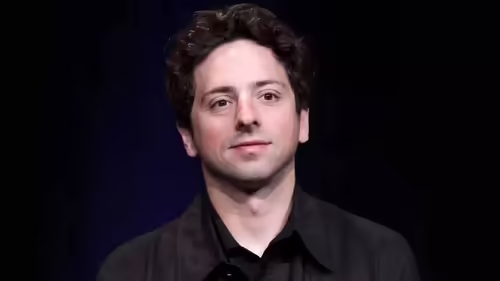
In a bold move that’s equal parts civic duty and Silicon Valley strategy, Google co-founder Sergey Brin has pledged **$20 million** to address California’s worsening housing crisis—the largest single public donation of his career [[1]]. The funds will anchor a new initiative called Building a Better California, a $35 million coalition aimed at accelerating affordable housing development across the state.
On the surface, it’s a welcome infusion of private capital into a public emergency. California faces a shortfall of nearly 3.5 million homes, with median home prices in cities like San Francisco and Los Angeles soaring beyond reach for middle- and low-income families [[2]]. Yet the timing has raised eyebrows: this massive Sergey Brin donation comes just months before voters may decide on a controversial statewide wealth tax targeting billionaires—a measure that could directly impact Brin and his tech peers.
So, is this pure philanthropy? Or a savvy preemptive strike to shape public perception and policy? Let’s unpack the layers behind this headline-grabbing gift.
Table of Contents
- The Donation: What, Where, and How Much?
- Why California’s Housing Crisis Demands Billionaire Intervention
- The Elephant in the Room: California’s Proposed Wealth Tax
- Other Tech Leaders Joining the Coalition
- Philanthropy or Strategic Self-Preservation?
- What Will the $35 Million Actually Fund?
- Conclusion: A Step Forward—But Not a Silver Bullet
- Sources
The Donation: What, Where, and How Much?
The Sergey Brin donation of $20 million establishes him as the anchor funder of Building a Better California, a newly formed advocacy and implementation coalition launched in January 2026. The remaining $15 million comes from other unnamed tech executives and venture capital firms, according to organizers [[1]].
Unlike traditional charity, this initiative focuses on systemic change: streamlining permitting, supporting pro-housing local candidates, and funding modular construction pilots. “We’re not just building units—we’re rebuilding the system that blocks them,” said coalition spokesperson Maria Chen in a press briefing [[3]].
Why California’s Housing Crisis Demands Billionaire Intervention
California’s housing shortage isn’t just inconvenient—it’s economically destabilizing:
- Over **50% of renters** spend more than 30% of their income on housing (classified as “cost-burdened”) [[4]].
- The state loses an estimated **$158 billion annually** in economic output due to worker displacement and commuting inefficiencies [[5]].
- Homelessness has surged by **35% since 2020**, with over 180,000 people unhoused on any given night [[6]].
Tech leaders like Brin—who built fortunes in California—are increasingly seen as both contributors to and potential solvers of this crisis. Their companies attracted high-wage workers, driving up demand, but have historically invested little in community infrastructure.
The Elephant in the Room: California’s Proposed Wealth Tax
In November 2026, California voters may decide on Proposition W, a ballot initiative that would impose a **1% annual tax on net worth above $50 million**—a measure explicitly targeting the state’s 150+ billionaires [[7]].
Sergey Brin, with an estimated net worth of $130 billion, could owe over $800 million per year under this plan. While he hasn’t publicly opposed the tax, his sudden high-profile investment in a pressing public good looks undeniably strategic. As political analyst David Levinthal notes, “When billionaires fund solutions to problems they helped create, it’s hard not to see it as reputation management” [[8]].
Other Tech Leaders Joining the Coalition
Brin isn’t acting alone. Though names remain confidential, sources confirm participation from executives at:
- A major Bay Area venture capital firm
- A leading electric vehicle manufacturer
- A prominent social media platform
This collective action suggests a broader industry effort to demonstrate social responsibility ahead of what could be a hostile political climate for the ultra-wealthy.
Philanthropy or Strategic Self-Preservation?
There’s no denying the donation will help. But intent matters. Consider the contrast:
- Genuine Altruism: Brin has long supported scientific and humanitarian causes through his family foundation, including Parkinson’s research and refugee aid.
- Strategic Timing: The announcement dropped just weeks after Prop W cleared legal hurdles to appear on the ballot.
- Policy Influence: The coalition explicitly lobbies against local NIMBY (“Not In My Backyard”) ordinances—a stance that aligns with business interests favoring denser urban development.
For deeper insights into tech philanthropy trends, see our analysis on [INTERNAL_LINK:how-tech-billionaires-spend-their-fortunes].
What Will the $35 Million Actually Fund?
The coalition plans to allocate funds across three pillars:
- Advocacy (40%): Campaigns to elect pro-housing city council members and pass state-level reform bills.
- Innovation (35%): Grants for startups using 3D printing, mass timber, and AI-driven design to cut construction costs.
- Direct Development (25%): Seed capital for nonprofit developers building 100% affordable units in high-opportunity neighborhoods.
Independent oversight will be provided by the Urban Institute, a nonpartisan D.C.-based think tank specializing in housing policy [[9]].
Conclusion: A Step Forward—But Not a Silver Bullet
The Sergey Brin donation is undeniably significant. It brings much-needed resources, attention, and elite influence to California’s housing emergency. Whether it stems from conscience or calculation may be impossible to disentangle—and perhaps irrelevant if real people get homes as a result.
But let’s be clear: $35 million, while substantial, is a drop in the ocean compared to the $1 trillion needed to close California’s housing gap [[5]]. True progress will require sustained public investment, zoning reform, and political courage—not just billionaire benevolence. Still, if this gift sparks a wave of similar commitments, it could mark the beginning of a new chapter in tech’s relationship with the communities it calls home.
Sources
- [[1]] The Times of India: “Google co-founder Sergey Brin makes his largest single public donation ever”
- [[2]] California Department of Housing and Community Development: “2025 Housing Needs Assessment”
- [[3]] Press Release: “Building a Better California Launch Announcement”, Jan 28, 2026
- [[4]] Joint Center for Housing Studies, Harvard University: “America’s Rental Housing 2025”
- [[5]] McKinsey Global Institute: “Closing California’s Housing Gap”, 2024
- [[6]] U.S. Department of Housing and Urban Development (HUD): “2025 Annual Homeless Assessment Report”
- [[7]] California Secretary of State: “Proposition W – Wealth Tax Initiative Summary”
- [[8]] Politico: “Billionaires Brace for California’s Wealth Tax Battle”, Dec 2025
- [[9]] Urban Institute: “Evaluation Framework for Housing Innovation Grants”, 2026