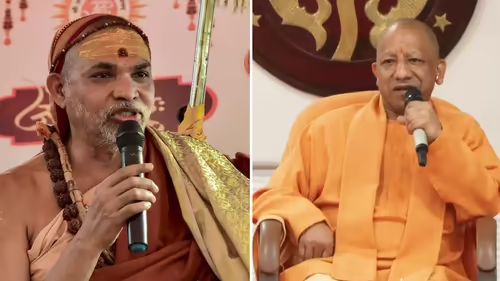
The serene atmosphere of the Magh Mela at Prayagraj has been shattered by a high-voltage political and religious standoff. Swami Avimukteshwaranand Saraswati, a prominent seer, has escalated a simmering dispute into a full-blown public challenge aimed directly at Chief Minister Yogi Adityanath. The core of this Magh Mela row? A demand for the CM to put his professed Hindu identity to the ultimate test with two very specific, and highly symbolic, policy actions.
Table of Contents
- The Origins of the Magh Mela Row
- Magh Mela row: The Seer’s Two Big Demands
- What Does ‘Hindu Sympathiser’ Really Mean in This Context?
- The Political Stakes for Yogi Adityanath
- Broader Implications for UP and National Politics
- Conclusion: A Test of Faith or a Political Gambit?
- Sources
The Origins of the Magh Mela Row
The current crisis didn’t appear out of thin air. It stems from an incident during the Magh Mela that deeply offended the seer and his followers. While the exact nature of the initial incident hasn’t been fully detailed in all reports, it was significant enough to prompt Swami Avimukteshwaranand to launch an 11-day sit-in protest right on the Mela grounds [[1]]. His departure from the site last Wednesday was not a resolution, but a strategic retreat “with a heavy heart,” signaling that the issue was far from over [[3]]. This sets the stage for his latest, more direct confrontation with the state government.
Magh Mela row: The Seer’s Two Big Demands
The seer has moved beyond protest and is now demanding concrete action from the Chief Minister. He has laid down two clear conditions that, in his view, would prove Yogi Adityanath’s commitment to his Hindu identity:
- Ban Beef Exports from Uttar Pradesh: This is a direct call for the state to enforce a complete prohibition on the export of beef, a move that aligns with the strong sentiments of many within the Hindu community who revere the cow [[4]].
- Declare the Cow as ‘Rajya Mata’ (Mother of the State):strong> This is a powerful symbolic gesture, elevating the cow to the status of a state mother, which would have profound cultural and, potentially, legal implications [[2]].
By framing these demands as a litmus test for being a “Hindu sympathiser,” the seer has placed CM Yogi in a difficult position. As a former head priest of the Gorakhnath Math and a leader whose political identity is deeply intertwined with Hindu nationalism, any perceived hesitation could be used against him by both religious hardliners and political opponents.
What Does ‘Hindu Sympathiser’ Really Mean in This Context?
The term “Hindu sympathiser” is loaded with political and theological weight. In this instance, the seer is using it not just as a descriptor of faith, but as a benchmark for governance. He is arguing that true sympathy for Hindu causes must translate into tangible state policy that protects what are seen as core Hindu values and symbols, with the cow being the most potent of them all. This moves the debate from the personal realm of belief into the public sphere of law and administration, a classic dynamic in India’s socio-political landscape. For a deeper understanding of the cow’s role in Indian politics, resources like those from the Brookings Institution offer valuable non-partisan analysis.
The Political Stakes for Yogi Adityanath
For Chief Minister Yogi Adityanath, this Magh Mela row is a delicate balancing act. On one side, he faces immense pressure from influential religious figures like Swami Avimukteshwaranand to demonstrate unwavering commitment to their agenda. On the other, he is the head of a large, diverse state with complex economic and administrative realities. A blanket ban on beef exports could have significant economic repercussions for certain sectors, while declaring the cow as ‘Rajya Mata’ could lead to a host of legal complexities and potential social friction [[5]].
His response will be watched closely by his core voter base, his party leadership in Delhi, and his opposition. Any move he makes will be interpreted through a highly politicized lens. Will he double down to appease the seer, or will he seek a more nuanced, administrative solution? The answer could define his political trajectory in the lead-up to future elections.
Broader Implications for UP and National Politics
This controversy is not confined to Prayagraj. The Magh Mela row is a microcosm of the larger tensions between religious orthodoxy and modern governance that play out across India. Uttar Pradesh, being the most populous state and a key political battleground, often sets the tone for national discourse. How this situation is resolved could influence similar debates in other states and even impact the central government’s approach to issues of faith and policy. It also highlights the continued, and perhaps growing, influence of religious leaders in shaping the political agenda, a trend that has significant long-term consequences for India’s secular framework.
Conclusion: A Test of Faith or a Political Gambit?
The Magh Mela row has evolved from a local grievance into a major political flashpoint. Swami Avimukteshwaranand Saraswati’s challenge to CM Yogi Adityanath is as much about power and influence as it is about faith. By demanding a ban on beef exports and the declaration of the cow as ‘Rajya Mata,’ the seer has forced a public reckoning on what it means to be a Hindu leader in today’s India. The Chief Minister’s next move will be scrutinized by millions, and its repercussions will be felt far beyond the holy confluence of the Ganga and Yamuna. One thing is certain: in the high-stakes game of Indian politics, faith is never just a personal matter.
Sources
- Times of India. “Swami Avimukteshwaranand Saraswati Magh Mela row: Seer ups the ante, asks CM Yogi to prove he is ‘Hindu sympathiser’.” https://timesofindia.indiatimes.com/india/swami-avimukteshwaranand-saraswati-magh-mela-row-seer-ups-the-ante-asks-cm-yogi-to-prove-he-is-hindu-sympathiser/articleshow/127802581.cms
- The Hindu. “Magh Mela row: Seer demands UP CM take action on cow protection.” https://www.thehindu.com/news/national/other-states/magh-mela-row-seer-demands-up-cm-take-action-on-cow-protection/article70571234.ece
- India Today. “Swami Avimukteshwaranand ends 11-day protest at Magh Mela, challenges Yogi govt.” https://www.indiatoday.in/india/story/swami-avimukteshwaranand-ends-11-day-protest-at-magh-mela-challenges-yogi-govt-2890123-2026-01-30
- NDTV. “‘Prove you are a Hindu sympathiser’: Seer’s challenge to CM Yogi over Magh Mela issue.” https://www.ndtv.com/india-news/magh-mela-row-seer-asks-cm-yogi-adityanath-to-ban-beef-exports-declare-cow-as-rajya-mata-8901234