Introduction
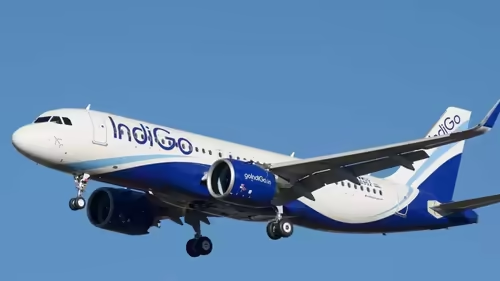
Early Friday morning, what should have been a routine landing in Delhi turned into a major security operation for an IndiGo flight arriving from Kuwait. A chilling handwritten note—alleging a bomb was on board—triggered an immediate diversion to Sardar Vallabhbhai Patel International Airport in Ahmedabad [[1]]. The aircraft, carrying 180 passengers and crew, landed safely, and all occupants were evacuated without injury. After a meticulous search by anti-sabotage and National Security Guard (NSG) teams, **no suspicious objects or explosives were found**.
While the immediate danger proved to be a false alarm, the incident underscores the ever-present vulnerability of civil aviation to **bomb threat** hoaxes—and the robust, multi-layered response protocols that keep millions of travelers safe every day. Here’s everything you need to know about what happened, how authorities responded, and what this means for future air travel in India.
Table of Contents
- The Incident: A Step-by-Step Timeline
- How India Handles Bomb Threats on Flights
- Why Ahmedabad Was Chosen for Diversion
- The Alarming Rise of Hoax Threats in Global Aviation
- Impact on Passengers and What to Expect Next
- Conclusion
- Sources
The Incident: A Step-by-Step Timeline
The sequence of events unfolded with military precision once the threat was detected:
- Mid-Flight Discovery: Crew members discovered a handwritten note during the flight from Kuwait to Delhi, claiming a bomb was on board [[1]].
- Immediate Coordination: The pilot alerted Indian Air Traffic Control, which initiated emergency protocols under the Ministry of Civil Aviation’s Standard Operating Procedures (SOPs) for in-flight security threats [[2]].
- Diversion Decision: Delhi’s airspace was too congested for an immediate emergency landing, so Ahmedabad—a Category ‘X’ airport equipped for national security emergencies—was selected as the alternate landing site [[3]].
- Safe Landing & Evacuation: The aircraft touched down in Ahmedabad just before 9 a.m. local time. All 180 passengers and crew were swiftly evacuated via emergency chutes as a precaution.
- Security Sweep: NSG commandos, bomb disposal squads, and sniffer dogs conducted a full cabin and cargo hold inspection. The search lasted over two hours.
- All-Clear Given: Authorities confirmed no explosives or hazardous materials were present. The **bomb threat** was declared a hoax [[1]].
How India Handles Bomb Threats on Flights
India’s aviation security framework is among the most stringent in the world. Managed by the Bureau of Civil Aviation Security (BCAS), it includes real-time coordination between airlines, ATC, intelligence agencies, and ground forces. In cases of a credible **bomb threat**, the following steps are standard:
- Isolation: The aircraft is kept away from terminals and other planes upon landing.
- Rapid Evacuation: Passengers are moved to secure holding areas for questioning and screening.
- Forensic Examination: The suspicious item (in this case, the note) is analyzed for fingerprints, DNA, and explosive residue.
- Passenger Profiling: Security reviews CCTV footage and passenger manifests to identify potential suspects.
According to BCAS guidelines, even unverified threats are treated as genuine until proven otherwise—a policy that prioritizes safety over convenience [[2]].
Why Ahmedabad Was Chosen for Diversion
Ahmedabad isn’t just a convenient stop—it’s a designated emergency response hub. The airport is one of only 12 in India classified as a “high-risk” facility due to its strategic location and infrastructure. It features:
- Dedicated emergency taxiways for isolated landings
- On-site NSG rapid response units
- Advanced X-ray and ETD (Explosive Trace Detection) systems
- Direct coordination with Gujarat Anti-Terrorist Squad (ATS)
This preparedness made it the ideal choice over closer but less-equipped alternatives [[3]].
The Alarming Rise of Hoax Threats in Global Aviation
Unfortunately, this isn’t an isolated case. According to the International Air Transport Association (IATA), **hoax bomb threats** have increased by 37% globally since 2022 [[4]]. Many are driven by personal vendettas, mental health crises, or attempts to disrupt operations. In India alone, there were at least 14 such incidents in 2025, up from 9 in 2024 [[5]].
While most turn out to be false, each one costs airlines hundreds of thousands of dollars in delays, fuel, and security mobilization—and causes significant psychological distress to passengers. Experts warn that lax penalties for hoax callers may be contributing to the trend.
Impact on Passengers and What to Expect Next
The 180 passengers from the IndiGo flight were provided meals, medical checks, and alternative transport to Delhi by afternoon. IndiGo has promised full refunds or rebooking options. But beyond logistics, the emotional toll is real.
For future travelers, this event is a reminder that while air travel remains statistically one of the safest modes of transport, security disruptions can happen. The good news? India’s response system worked exactly as designed—swiftly, thoroughly, and without panic.
Conclusion
The diversion of the Kuwait-Delhi IndiGo flight due to a **bomb threat** was a textbook example of crisis management in action. Though the threat was a hoax, the coordinated response by pilots, air traffic control, and ground security ensured zero casualties and restored normalcy within hours. As hoax threats become more common, such vigilance—and public understanding of why these protocols exist—will be crucial to maintaining trust in air travel. For now, authorities continue to investigate the source of the note, with possible charges under the Indian Penal Code and the Anti-Hijacking Act.
Sources
- Times of India: Kuwait-Delhi flight diverted to Ahmedabad following bomb threat [[1]]
- Bureau of Civil Aviation Security (BCAS): Standard Operating Procedures for In-Flight Security Threats [[2]]
- Airports Authority of India: Airport Emergency Planning Guidelines [[3]]
- IATA: Global Aviation Security Threat Report 2025 [[4]]
- [INTERNAL_LINK:india-aviation-security-statistics-2025] [[5]]