Introduction
The geopolitical landscape of the Middle East is shifting once again, and this time, India finds itself in the spotlight. The newly proposed Gaza Peace Board, an initiative spearheaded by former U.S. President Donald Trump, has extended an invitation to New Delhi to join its ranks. The response from Palestine? A carefully worded statement from its Foreign Minister that carries immense weight and a clear message: India’s decision must be rooted in international law.
This isn’t just a routine diplomatic exchange; it’s a high-stakes moment that tests India’s long-standing position on the Israel-Palestine conflict and its strategic autonomy on the world stage. Let’s break down what’s happening, why it matters, and what the Palestine FM’s statement truly means for India’s future moves.
Table of Contents
- What is the Gaza Peace Board?
- Palestine FM’s Message to India: A Call for Principle
- India’s Delicate Diplomatic Tightrope
- Who Else is on the Gaza Peace Board?
- The Road Ahead for India
- Conclusion
- Sources
What is the Gaza Peace Board?
Unveiled in January 2026, the Gaza Peace Board is a controversial new entity designed to oversee the post-war governance, reconstruction, and stabilization of the Gaza Strip [[2]]. Chaired for life by Donald Trump, the board aims to establish a transitional Palestinian technocratic government and manage key portfolios like civil services, security, and humanitarian aid [[10], [11]].
Critics, however, argue that the board bypasses established international bodies like the United Nations and could serve as a vehicle for a political agenda that doesn’t fully align with Palestinian self-determination [[4]]. Its creation has sparked intense debate, with some viewing it as a pragmatic solution and others as a dangerous overreach.
Palestine FM’s Message to India: A Call for Principle
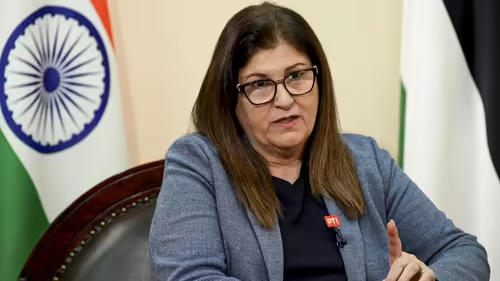
In his public remarks, Palestine’s Foreign Minister, Varsen Aghabekian, did not directly urge India to accept or reject the invitation. Instead, he took a more nuanced and principled stance. He stated that “India will decide in line with international law” regarding the Gaza Peace Board offer [[5]].
This statement is a masterclass in diplomatic language. On one hand, it respects India’s sovereignty to make its own choice. On the other, it’s a powerful reminder of the foundational principles that have historically guided India’s foreign policy, especially its support for the Palestinian cause. By invoking international law, the FM is implicitly asking India to consider whether the board’s structure and mandate align with UN resolutions and the rights of the Palestinian people.
India’s Delicate Diplomatic Tightrope
India now faces a complex balancing act. Historically, India has been a staunch supporter of Palestine, providing millions in budgetary and humanitarian aid [[15]]. At the same time, its strategic and economic ties with Israel have grown significantly in recent decades [[18]].
Accepting a seat on the Gaza Peace Board could be seen as aligning too closely with a U.S.-led initiative that many in the Global South view with skepticism. In fact, India’s own Left parties have already urged the government to reject the offer, calling it a potential “betrayal of the Palestinian cause” [[4], [7]].
Conversely, declining the invitation might be interpreted as a snub to a major global power and could limit India’s influence in shaping Gaza’s future. India’s official stance has consistently called for an immediate ceasefire, the release of hostages, and the protection of civilians—all principles that should theoretically be central to any peace effort [[17], [19]]. The question is whether the Gaza Peace Board is the right vehicle to achieve these goals.
Who Else is on the Gaza Peace Board?
Understanding the company India would be keeping is crucial. The board’s membership includes a mix of Western figures and regional players:
- Steve Witkoff (U.S. Special Envoy for the Middle East)
- Jared Kushner (Former U.S. Senior Advisor)
- Hakan Fidan (Turkiye’s Foreign Minister)
- Ali Al-Thawadi (Qatari diplomat)
- Representatives from Egypt and Jordan [[11]]
This diverse composition is meant to lend the board regional credibility, but it also reflects the complex web of interests at play in the region.
The Road Ahead for India
India’s decision on the Gaza Peace Board will be a defining moment for its foreign policy in 2026. The government must weigh several factors:
- Historical Stance: Will it uphold its traditional support for Palestinian statehood based on pre-1967 borders?
- Strategic Autonomy: Can it participate without being perceived as a junior partner in a U.S.-dominated project?
- Domestic Politics: How will its decision resonate with its own citizens and political parties?
Whatever the choice, it must be a clear, well-communicated one that reinforces India’s identity as a responsible and principle-driven global actor.
Conclusion
The Palestine Foreign Minister’s statement on India’s potential involvement in the Gaza Peace Board is far more than a simple acknowledgment. It’s a diplomatic nudge, a quiet appeal to shared values, and a test of India’s commitment to a rules-based international order. As New Delhi deliberates, the eyes of the world—and especially the Palestinian people—will be watching closely to see which path it chooses. The decision will not just impact the future of Gaza but will also signal India’s role in the new world order.
Sources
- Times of India: Palestine FM on Gaza Peace Board invitation for New Delhi [[5]]
- DD News: Trump invites India to join proposed ‘Board of Peace’ on Gaza conflict [[2]]
- Al Jazeera: Who is part of Trump’s ‘Board of Peace’ for Gaza? [[11]]
- Britannica: Board of Peace | Trump, Members, Gaza, Countries [[10]]
- CPIM: India Should Not Join US Constituted Board of Peace [[7]]
- Ministry of External Affairs, India: India-Palestine Relations [[15]]