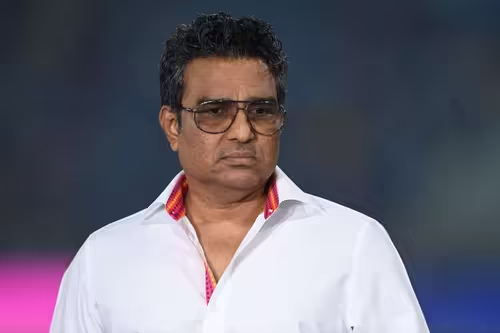
Is the T20 World Cup a ‘Real’ World Cup? Sanjay Manjrekar’s Controversial Take Sparks Debate
Just months before the highly anticipated 2026 T20 World Cup, a familiar voice from the cricketing world has thrown a massive curveball into the conversation. Former Indian batter and now a prominent commentator, Sanjay Manjrekar, has reignited a long-standing debate by boldly declaring that the 50-over ICC Cricket World Cup is the only “real” one.
His comments, which question the very credibility of the T20 World Cup, have sent shockwaves through the cricket community, forcing fans and experts alike to re-evaluate what truly makes a tournament worthy of the coveted “World Cup” title.
Table of Contents
- Manjrekar’s Bold Statement on the T20 World Cup
- The Unmatched Legacy of the 50-Over World Cup
- Rohit Sharma’s Deep Reverence for the ODI Format
- Why the T20 World Cup Deserves Its Place
- Conclusion: A Matter of Perspective
- Sources
Manjrekar’s Bold Statement on the T20 World Cup
Manjrekar’s argument is rooted in history and tradition. He contends that the original four-year cycle of the ODI World Cup, first held in 1975, has built a unique and irreplaceable legacy over nearly five decades [[17]]. In his view, this historical weight and the grueling nature of the 50-over format create a tournament that is fundamentally different—and superior—to its T20 counterpart.
He has even gone so far as to suggest that the T20 event, held every two years, should perhaps be stripped of the “World Cup” moniker altogether to preserve the sanctity of the original competition [[1]]. His stance is clear: “Only 50-over is the real one” [[5]]. This isn’t just a casual opinion; it’s a philosophical position on what constitutes the pinnacle of international cricket achievement.
The Unmatched Legacy of the 50-Over World Cup
There’s undeniable truth to Manjrekar’s point about legacy. The ICC Cricket World Cup has been the stage for some of the most iconic moments in sporting history—from the West Indies’ early dominance to India’s emotional victories in 1983 and 2011, and Australia’s era of supremacy. Its quadrennial schedule creates a sense of occasion and anticipation that is hard to replicate.
The 50-over format itself is often seen as the ultimate test of a team’s all-round skill, requiring a blend of patience, strategy, power-hitting, and bowling endurance. It’s a format that demands depth in both batting and bowling line-ups, making victory a true testament to a team’s comprehensive strength [[22]].
Rohit Sharma’s Deep Reverence for the ODI Format
Interestingly, Manjrekar’s views find an unlikely echo in the words of India’s current captain, Rohit Sharma. Despite being a two-time T20 World Cup winner (as a player in 2007 and as captain in 2024), Rohit has consistently placed the 50-over World Cup on a higher pedestal.
Back in 2024, he was quoted saying, “‘ODI WC is the actual World Cup for me’,” a statement that clearly diminishes the upcoming T20 tournaments in his personal hierarchy of importance [[11]]. This sentiment from a man who has tasted success in both formats adds significant weight to the argument that the 50-over game holds a special, almost sacred, place in the hearts of many cricketers.
Why the T20 World Cup Deserves Its Place
However, to dismiss the T20 World Cup as anything less than a premier global event would be a disservice to the modern game and its global fanbase. Here’s why the T20 format has earned its spot in the cricketing pantheon:
- Global Accessibility: The fast-paced, three-hour format has been instrumental in taking cricket to new markets, including the USA, where the 2026 edition will be co-hosted. Its accessibility is key to the sport’s future growth.
- Unpredictability & Drama: The shorter format levels the playing field, allowing associate nations to compete with and even defeat traditional powerhouses, creating unforgettable upsets and moments of pure drama.
- A Different Kind of Skill: While the 50-over game tests endurance, T20 cricket is a high-octane battle of nerve, innovation, and execution under extreme pressure. It requires a unique set of skills from both batters and bowlers.
The T20 World Cup has its own rich history of iconic moments, from India’s inaugural win in 2007 to the West Indies’ back-to-back triumphs. To call it anything less than a “real” World Cup ignores its massive cultural impact and its role in evolving the sport.
Conclusion: A Matter of Perspective
Ultimately, the debate between Sanjay Manjrekar and the proponents of the T20 World Cup boils down to perspective. Manjrekar represents a purist’s view, valuing the historical weight and traditional test of the 50-over game. On the other side are those who see the T20 World Cup as a dynamic, inclusive, and thrilling evolution of the sport that deserves its own unique form of respect.
Perhaps the healthiest way forward is not to rank them against each other, but to appreciate them for what they are: two distinct, world-class tournaments that showcase the beautiful game of cricket in two very different, yet equally compelling, ways. As fans, we are lucky to have both. For more on the evolution of cricket formats, check out our deep dive on [INTERNAL_LINK:history-of-icc-tournaments].
Sources
- [[1]] Sportskeeda. “Sanjay Manjrekar believes the T20 World Cup must be stripped of the ‘World Cup’ tag.”
- [[5]] Times of India. “‘Only 50-over is the real one’: Sanjay Manjrekar questions T20 World Cup’s credibility.”
- [[11]] InsideSport. “‘ODI WC is the actual World Cup for me’: Rohit Sharma diminishes upcoming T20 World Cup.”
- [[17]] Cricket World. “A Global Sport with Deep Roots and Growing Influence.”
- [[22]] Oreate AI Blog. “ICC Champions Trophy vs. World Cup: A Deep Dive Into Cricket’s Premier Tournaments.”